Full Article
about Coca
Historic town with one of Spain’s most striking Mudéjar castles; birthplace of Emperor Theodosius
Hide article Read full article
A town shaped by its castle
Tourism in Coca inevitably revolves around its castle. The town sits in the centre of the Campiña Segoviana, surrounded by pine forests and cereal fields, in a landscape where Mudéjar brick construction defined building traditions for centuries. With just over 1,700 residents, Coca holds a level of heritage that feels disproportionate to its size, and its story stretches back well before the Middle Ages.
The silhouette of the castle, built in the 15th century by the Fonseca family, dominates the skyline. Its prominence reflects Coca’s past importance within Castilian territory, something that can be read directly in its architecture. Even so, the present-day town is not frozen in history. The central streets are still residential, with everyday life continuing around visitors: cars crossing the square, neighbours moving through the same spaces that others come to explore.
The origins of Coca go much further back. Tradition places the birth of the Roman emperor Theodosius the Great here, when the settlement was known as Cauca. Archaeological references and scattered remains in the surrounding area point to that earlier phase. They are not extensive, but they are enough to show that Coca’s history did not begin with its medieval walls.
Reading the past through its landmarks
The Castillo de Coca stands as one of the best-known Mudéjar fortresses in Castile. Built mainly in brick during the 15th century, it combines defensive purpose with the display of noble power. Its double moat, cylindrical towers and geometric exterior decoration illustrate the meeting point between military needs and Mudéjar artistic language, a style influenced by Islamic traditions but developed in Christian territories. The interior can be visited through organised routes, which usually focus on both the architecture and the history of the Fonseca family.
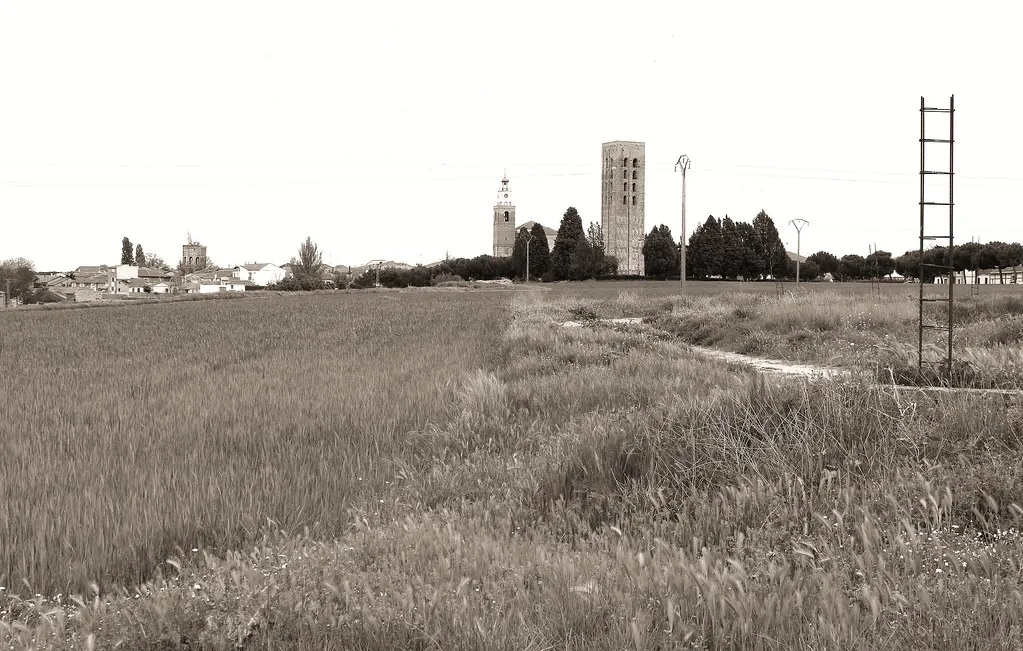
The Iglesia de Santa María la Mayor provides another way to understand the town’s past. Its structure blends Gothic elements with Mudéjar brickwork, a common combination across this part of the Meseta. The tower is visible from several approaches to Coca and works as a useful point of reference when entering the town centre.
The Arco de la Villa is a reminder of the former defensive system. It was one of the access points within the medieval walls and is now integrated into the route through the historic centre.
To explore the Roman phase, several interpretive spaces in the town explain the role of ancient Cauca within the wider Roman settlement of the area. There are no large, intact ruins dominating the landscape. Instead, the emphasis is on historical context and archaeological finds that have appeared over time.
Moving through Coca and its surroundings
The historic centre is easy to explore on foot. A simple way to begin is by walking around the castle first, taking in its structure from different angles. Its position, slightly apart from the main cluster of buildings, allows its scale to be appreciated clearly. From there, the route naturally leads towards the church and into the streets of the centre.
The landscape changes quickly once outside the urban area. The pine forests typical of the region appear almost immediately, long associated with resin extraction, alongside wide agricultural fields. Dirt tracks and forest paths run through this environment, and it is common to see people walking or cycling along them.
Local cooking follows the traditions of inland Castile. Roasts, hearty soups and cured meats form the base of the cuisine, reflecting both the agricultural work and the climate. When in season, mushrooms from the nearby pine forests also play a role in local dishes.
In the surrounding area, some traditional underground wine cellars can still be found. These structures, common in many Castilian villages, made use of the stable temperature below ground to store wine and food.
Festive moments and local rhythm
The main celebrations in Coca are dedicated to the Virgen del Rosario and usually take place at the beginning of October. Processions, religious events and popular activities fill those days, when many families who live elsewhere return to the town.
During the summer, additional festivities and activities bring life to the streets of the centre. At that time, the population increases and Coca briefly recovers a sense of movement that echoes busier periods in its past.


