Full Article
about Codorniz
Village on the cereal plain; brick-and-adobe architecture still stands.
Hide article Read full article
Midday Stillness in Codorniz
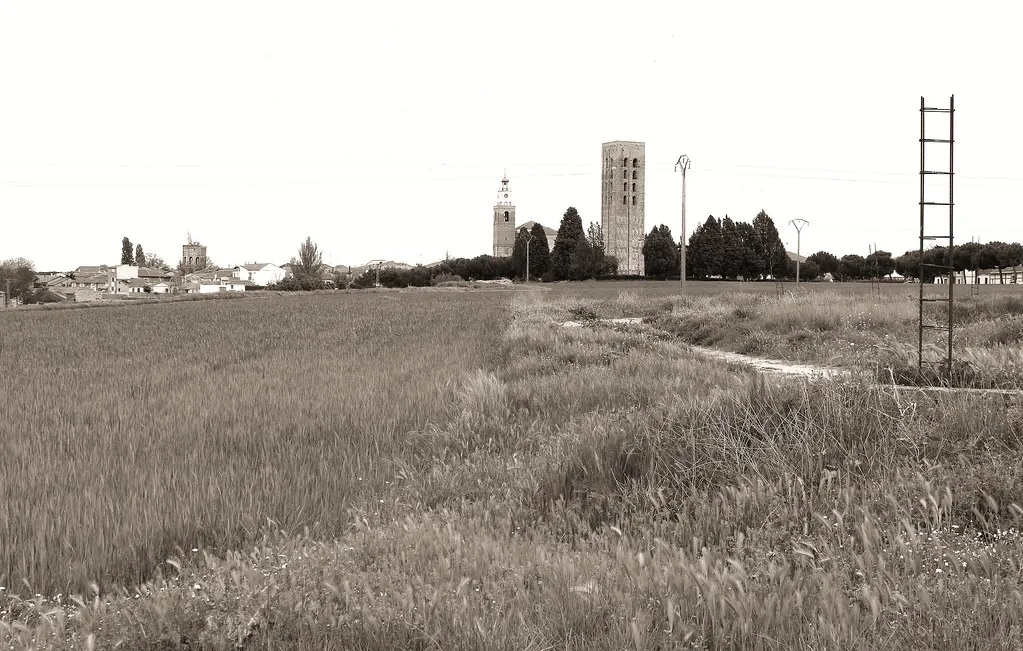
At midday, when the sun falls hard over the Campiña Segoviana, tourism in Codorniz begins with silence. In front of the church of Santo Domingo there is little to hear beyond the occasional slow-moving car and the sharp snap of a shutter closing against the heat. The tower, built from pale sandstone, stands over the centre of the village with a restraint typical of this part of Segovia: straight walls, minimal decoration, and a bell tower that cuts into the light with a slightly harsh edge when the sky is clear.
Inside, the mood barely shifts. Whitewashed walls, simple wooden benches, and an altar without excess. It is one of those churches where footsteps echo clearly when no one else is around.
Adobe Streets and Weathered Doors
The historic centre is small. A handful of streets, Calle Mayor and the main square, intersect between houses built from adobe and rammed earth. Some still keep their original wooden gates, fitted with old locks and darkened nails worn by time. Not everything has been restored, and that is visible: fine cracks in the walls, uneven plasterwork, courtyards where stone pens hint at how central agricultural life once was here.
At certain hours in the afternoon, the village seems to pause completely. A bicycle rests against a wall, a window left open, a faint smell of wood smoke drifting if someone has lit a stove early.
Wine Cellars Beneath the Ground
At the edges of Codorniz, small openings appear in the الأرض: low metal doors, sometimes half buried. These are old wine cellars dug into the earth, part of a tradition shared across many villages in the surrounding plain. Most remain private and cannot be visited, yet from the outside their logic is clear: underground galleries where wine could be kept at a stable temperature throughout the year.
From these points, the landscape opens fully. There are no hills to close the view, only cereal fields that shift colour with the seasons: bright green in spring, dry gold at harvest time, and softer ochre tones afterwards.
Walking the Campiña
Farm tracks leave the village in straight lines, without many turns. They are wide paths linking Codorniz to nearby settlements, used by locals for tractors or for a walk as evening approaches.
They work well for walking or cycling since there is no technical difficulty, though the central hours of summer are best avoided. Shade is scarce here and the sun falls directly overhead. It is also worth staying alert for agricultural machinery, which can appear suddenly, raising dust along the tracks.
The Quail That Gives the Village Its Name
The name Codorniz, meaning quail, is no coincidence. In the surrounding fields, these birds can still be heard, especially at dawn or as the light begins to fade. Seeing them is another matter. They tend to remain hidden in the vegetation and only take flight when someone gets too close.
For those interested in birdwatching, it is worth pausing with binoculars along the edges of the paths. Patience tends to work better than constant movement.
When the Village Fills Again
For much of the year, Codorniz moves at the slow pace of a small rural community. In August, that rhythm shifts. Many residents who live elsewhere return, and for a few days the streets become livelier during the festivities dedicated to San Bartolomé. Processions, music and activities in the square are usually part of the celebration.
At other times of the year, smaller events appear, tied either to the religious calendar or the agricultural cycle. They are brief moments, yet enough to see the village with more movement than usual.
Eating and Stopping Nearby
Within Codorniz itself, options for eating are limited. It is more common to head to other villages in the surrounding area where bars or restaurants open more regularly. Codorniz works better as a short stop within a wider route through the countryside, or combined with visits to nearby places.
If planning to stay for several hours, it is sensible to bring water or something to eat, especially outside the summer season.
Getting There and Practical Notes
Codorniz sits in the flat part of the province of Segovia, connected by secondary roads that cut through cereal fields with barely a curve. From cities such as Segovia or Valladolid, it can be reached by car without much difficulty.
Public transport in this area tends to run infrequently, so checking schedules in advance is advisable. One practical detail: in small villages across the Campiña, petrol stations and shops are not always nearby, so it is worth arriving prepared.
In the end, what stays with Codorniz is its sense of open horizon. Straight tracks, fields that change colour with the seasons, and a quiet that, as evening falls, is broken only by birds and the wind moving through the grain. Life here unfolds slowly, with the landscape always stretching far into the distance.