Full Article
about Domingo García
Known for its open-air rock art site; an archaeological treasure in the province
Hide article Read full article
Domingo García and the Open Plain
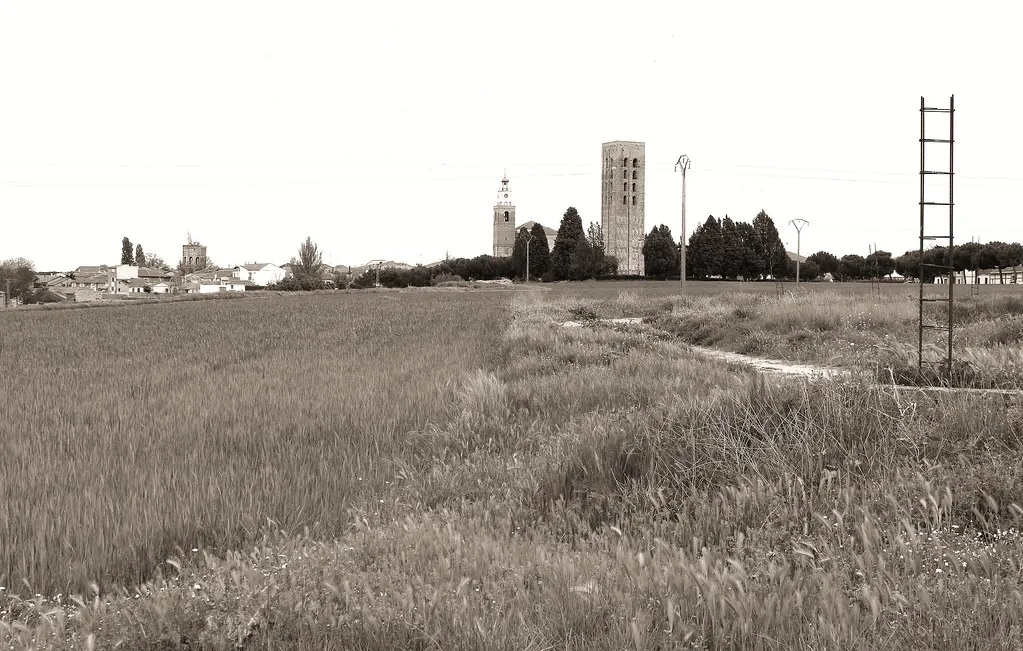
Domingo García sits on the northern edge of the Campiña Segoviana, a wide expanse of farmland that begins just beyond the city of Segovia. With fewer than thirty residents, it is a settlement defined by its relationship to the land. The village exists at roughly 900 metres, a point from which the horizon is a long, uninterrupted line of cereal fields and low sky.
The architecture here is a direct product of that environment. The older houses are built of adobe and tapial—rammed earth—materials sourced from the land itself. Their design is pragmatic: thick walls for insulation, simple forms. This isn't an architectural style meant for display; it was a solution for living and working on the dry, exposed meseta.
Los Casares: Engravings on the Hill
The significance of Domingo García comes from a low hill to the south-east of the village. On its rock surfaces are the incised lines known as Los Casares, a site of open-air Paleolithic art.
The engravings are not immediately dramatic. You are looking at fine, weathered lines depicting horses, bovines, and other figures, attributed to the Upper Paleolithic period. Without context, they can be difficult to discern. This is not a cave with painted bison; it is a hillside where someone, thousands of years ago, marked the stone.
Access is controlled to protect the site. Visits typically require prior arrangement and are conducted with a guide who can explain the identification of the figures and their place in Iberian prehistoric art. The location itself is key: this hill is a natural vantage point. From here, you can survey the entire plain, a strategic advantage for hunter-gatherers tracking game across open ground. Standing there now, the exposure is total.
A Built Environment of Necessity
The village centre is compact, a handful of quiet streets. The parish church of Santo Domingo de Silos follows the same principle of necessity as the houses. It is a simple, functional building with a modest bell gable. Its importance was local, serving the spiritual needs of a small farming community, not making a grand architectural statement.
A walk through Domingo García is a lesson in rural Castilian building techniques. Look for the textured surfaces of earthen walls, often protected by a lime render. Ornament is scarce. The logic here was always about shelter and durability against the climate.
The Cereal Sea
The landscape around Domingo García is its dominant feature. This is wheat and barley country. The fields roll in gentle waves, cut by straight dirt tracks used by tractors. From any slight elevation, the village appears as a small, tight cluster almost submerged in a sea of cultivated land.
These open plains are habitat for steppe birds. With patience and binoculars, you might spot great bustards or Montagu's harriers, especially around dawn or dusk in spring. Their presence is a reminder that this is a working agricultural landscape with space for wildlife.
Those same agricultural tracks are the way to explore on foot. They are not signposted trails, but they provide clear routes into the fields and up to the low hills that offer perspective. There is no shade. The sun and wind are constant companions.
Practical Notes
Life in Domingo García follows the rhythm common to many depopulated villages in Castilla. The population swells slightly in August when former residents return. The main social and religious events, like the sober observance of Holy Week, are for the community, not for visitors.
You will need a car to get here; there is no regular public transport. There are no shops or tourist services in the village. If you plan to walk the tracks or visit the area around Los Casares, bring water and whatever supplies you need. Spring and autumn are the most temperate seasons for walking. In summer, the heat on the plain is intense.
Domingo García doesn't offer typical attractions. Its value lies in understanding a way of life shaped by cereal farming on the meseta, and in standing before the subtle engravings that connect this specific hill to a deep human past.