Full Article
about Escalona del Prado
Known for its church with a Baroque altarpiece and the Segovian sgraffito tradition on its façades.
Hide article Read full article
A village that lives rather than performs
Some places seem designed to look good on Instagram, others are simply built for everyday life. Escalona del Prado clearly belongs to the latter. Visiting for tourism in Escalona del Prado, that’s the first thing you notice: ordinary streets, traditional houses and a kind of quiet that isn’t staged. It comes from being a village of just over four hundred people, where daily life follows the rhythm of the countryside and the agricultural calendar.
It sits in the Campiña Segoviana, around twenty kilometres from the city of Segovia via the A‑601. In practical terms, that means you can leave the busy surroundings of the aqueduct and reach this open landscape in less than half an hour. The contrast is immediate and noticeable.
Wide horizons in the Campiña Segoviana
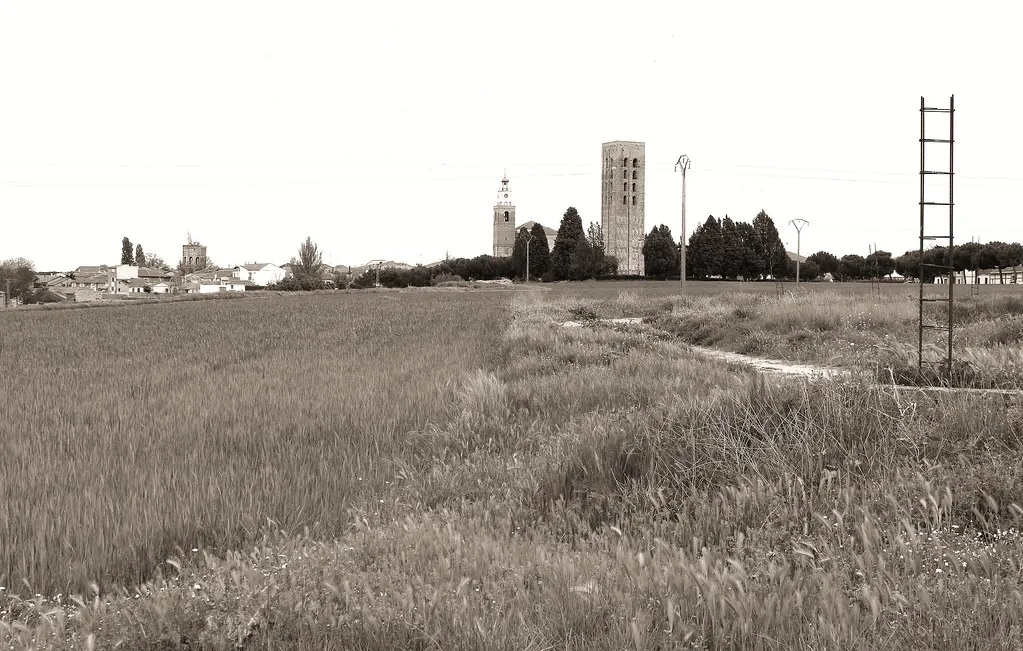
Step outside the village and the land opens up. Cereal fields stretch out in long lines, broken here and there by a solitary holm oak or dirt tracks that disappear into the distance. It is a type of Castilian landscape where the horizon seems to extend further than expected.
Driving along the local roads has a steady, almost hypnotic feel. Gentle bends, agricultural plots and, now and then, a farm building or a row of poplars marking a dip in the land. There are no viewpoints set up for visitors, no panels explaining what you’re looking at. The usual plan is much simpler: pull over on a track, get out and walk for a while.
The church and the small village centre
Life in the village revolves largely around the parish church of San Miguel. It isn’t monumental. Instead, it has a sober appearance, built in simple masonry like many churches in this part of Segovia. The tower works almost like a marker, helping you find your bearings as you arrive by road.
Inside, there is a Baroque altarpiece which, according to local residents, has been there for centuries. It doesn’t feature in art books, but it is well kept and remains part of everyday life in the village.
Nearby streets such as Calle Mayor and Calle Real, along with a few smaller ones branching off, still show the age of the houses. Large wooden gates, iron window grilles and some well-worn cobbled sections give subtle clues. Nothing showy, but unmistakably authentic. It is also common to see garages that were once stables, a reminder of how the village has evolved.
Built for the Castilian climate
The houses themselves reflect practical thinking. Stone façades or simple render are common, along with small balconies and wooden eaves. Everything is designed with function in mind.
The reason is straightforward. Winters in the Campiña Segoviana can be harsh, while summers bring strong sun. Traditional buildings here respond to those conditions rather than aesthetic trends.
Walking the surrounding tracks
For a walk, there is no need to search for marked routes. Agricultural tracks leave directly from the village and run between the fields.
Early in the morning or towards sunset, the landscape shifts noticeably. The cereal turns golden, shadows grow longer and the quiet deepens, broken only by the distant sound of a tractor or a dog somewhere on a property. There is no formal signage for visitors, so the most sensible option is to walk out for a while and return along the same path.
It is the kind of walk done without checking the time.
Cycling across open country
The secondary roads around Escalona del Prado are well suited to cycling. They are long, relatively flat and carry little traffic. The main factor to consider is the wind.
When it picks up, which happens often in this part of Castilla, those straight stretches that look easy on a map can feel much longer than expected. Regular cyclists in the area know this well, and setting off early in the day is usually the best approach.
Food from the surrounding countryside
The cooking in Escalona del Prado is what you would expect in this part of Segovia: hearty dishes and home-style recipes. Roast lamb, or lechazo asado, has a strong tradition across the province and has long been part of family celebrations in nearby villages.
Legumes are also common, including beans and chickpeas, along with Castilian soups that are particularly welcome in colder weather. Portions tend to be generous, the cooking straightforward and without unnecessary embellishment.
Birdlife over the cereal fields
The open fields of the Campiña Segoviana also attract those who travel with binoculars. With a bit of patience, it is possible to spot birds associated with cereal landscapes. Species such as the little bustard, known locally as sisón, or the great bustard, avutarda, have traditionally been observed across these plains, along with smaller birds of prey that patrol the fields.
It is not a widely known birdwatching destination. Still, for anyone who enjoys slow walks and occasionally looking up at the sky, there is always some movement to catch the eye.
San Miguel celebrations
The main festival in the village is usually held around the day of San Miguel, at the end of September. These are traditional local celebrations, centred on a procession, music and the involvement of residents who make sure everything comes together.
There are no large stages or programmes designed to attract crowds. Quite the opposite. It is a village festival in the most literal sense, shaped by the people who live there and by customs that have continued over time.