Full Article
about Hontanares de Eresma
Expanding town on the Eresma river; riverside nature meets residential areas.
Hide article Read full article
A village shaped by proximity
Hontanares de Eresma sits a few kilometres north of Segovia, on the plain of the Campiña Segoviana. Its population, around 1,680, reflects a modern reality: for many, it is a residential base for work in the city. The layout of the place, however, and the fields that press against its streets, speak of a different, older logic.
The name is the first clue. Hontanar is an old term for a spring or water source, common in this part of the Eresma river basin. Settlement here was dictated by water and the farmland it sustained, a relationship still legible in the landscape.
Architecture of the plain
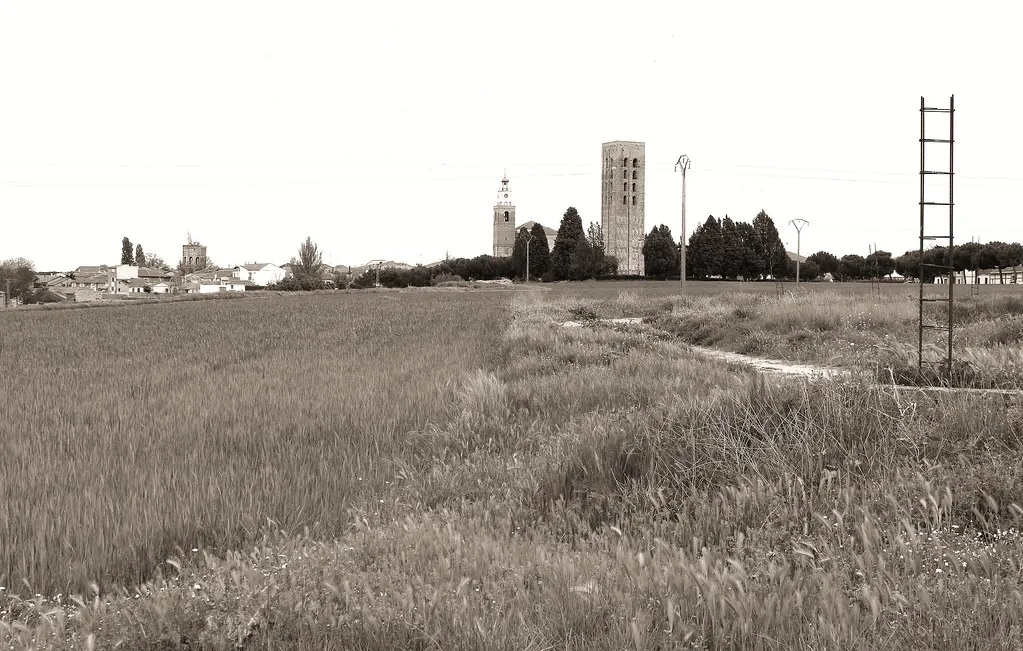
You will not find monumental architecture here. The built environment is a mix of recent construction and the traditional rural forms of the campiña: thick walls of stone masonry and rendered adobe, houses built around interior courtyards meant for utility. The church of San Juan Bautista, likely medieval in origin but much altered, occupies a central position. Its tower, with simple lines, still serves as a waymarker across the fields.
The church interior is usually closed outside services, common in villages of this size. When accessible, its scale is what strikes you—built for a larger, past agricultural community. The street plan feels organic, following old property lines and farmyards rather than a formal grid. On some façades, weathered stone coats of arms hint at families who once held local standing.
Landscape and a distant sierra
Beyond the last houses, the land opens into cereal fields. The horizon is flat and wide, broken only by the occasional line of trees marking a watercourse. On days when the air is clear, looking south reveals the silhouette of the Sierra de Guadarrama, a distant blue barrier that gives scale to the entire plain.
A straightforward walk from the village leads down to the Eresma river. Here, the river does not carve a dramatic gorge but supports a narrow corridor of riparian vegetation—poplars, willows—that provides a tangible contrast to the surrounding gold and green of the crops.
Paths and connections
The agricultural tracks that crisscross the municipality are its true footpaths. They are functional, used for accessing fields, but they also offer a direct way to move through the terrain with almost no change in elevation. By car or bicycle, the local roads connect Hontanares to neighbouring villages like Bernuy de Porreros or Valverde del Majano. These are short journeys, part of the daily fabric of the area. Cyclists should note these are working roads: often narrow, with verges used for parking or machinery.
Rhythms and feast days
The annual rhythm peaks around the 24th of June, for the feast of San Juan Bautista, the parish patron. The program typically mixes a religious procession with events organized by the town hall and local peñas. Outside these summer dates, the weekly rhythm is tied to Segovia. The morning and evening commute is a visible phenomenon, overlaying the older, slower patterns of agricultural work that continue in the fields.
This coexistence defines Hontanares de Eresma. It is not an isolated farming village, nor is it a dormitory suburb. It functions as both.
A practical view
Hontanares is about a quarter-hour drive from Segovia via local roads. The village itself can be walked thoroughly in under an hour. Its value for a visitor lies not in a checklist of sights but in observing this duality—how the geography of water and wheat interacts with the pull of a nearby city. To see the logic of the Campiña Segoviana, look past any single building. Look at the field systems, the course of the Eresma, and the roads that link one settlement to the next. Here, that logic remains fully operational.