Full Article
about Juarros de Voltoya
Known for the Voltoya reservoir; a spot popular with anglers and birdwatchers.
Hide article Read full article
An Afternoon in the Campiña Segoviana
By mid-afternoon, the wind lifts a little dust along the main street of Juarros de Voltoya. Light falls at an angle across the façade of the church of San Miguel, turning the stone a muted gold. A car passes now and then. A door shuts somewhere nearby, and further off a dog barks from behind a wall.
Tourism in Juarros de Voltoya has little to do with shop windows or clearly marked routes. This small village in the Campiña Segoviana, a rural district within the province of Segovia, has around 185 inhabitants and remains closely tied to the land. Adobe houses, some restored and others slowly worn down by winter after winter, line short streets where there are still corrals and earth-floored courtyards. Life here continues to follow the rhythms of sowing and harvest, and the dry winds that sweep in from the Castilian plateau.
There are no big landmarks waiting to be ticked off. What defines the place is scale and atmosphere: open sky, working buildings, and a quiet that deepens when the wind drops.
The Heart of the Village
The church of San Miguel forms the centre of the small urban core. It is a simple masonry building with a bell gable rising above the entrance, where the bells hang. As the sun lowers, the tower’s shadow stretches across the square and the air carries the scent of earth and straw.
Around the nearby streets, large wooden gateways still stand, built wide enough for carts and livestock. Some retain old iron fittings, darkened by years of use. There are also traces of former stone washhouses and structures that recall old forges. They are not always signposted. At times they simply appear as you turn a corner, part of the everyday fabric rather than set apart as monuments.
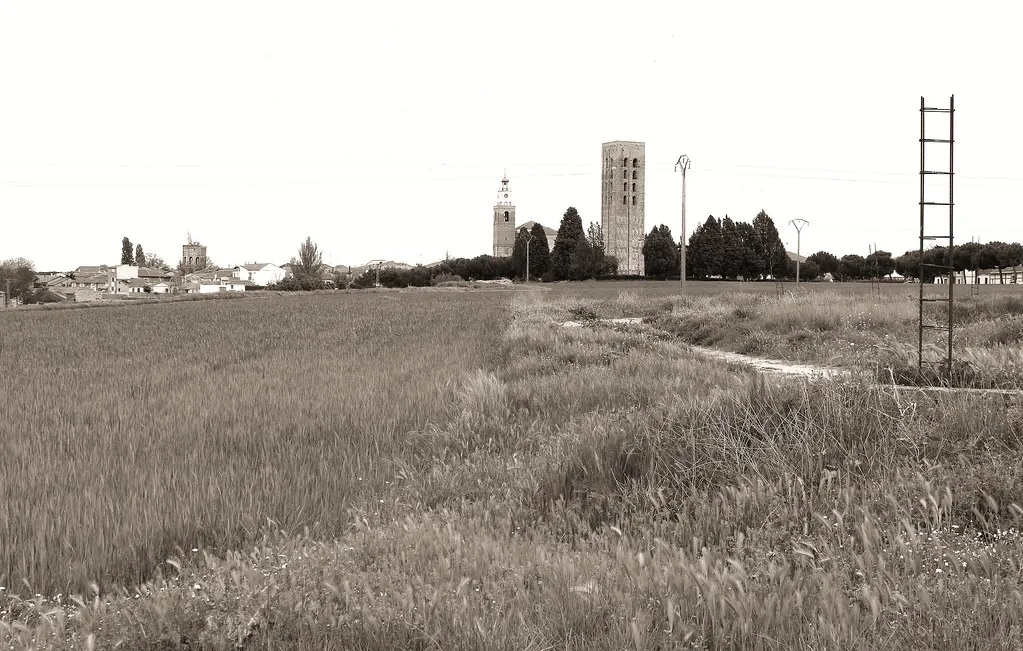
Leaving the built-up area, dirt tracks begin almost immediately. Low stone walls mark out vegetable plots and small parcels of land. On the horizon, a few dovecotes made of clay and brick rise above the fields. Many are damaged, yet they still suggest how agricultural life was organised decades ago, when every structure had a clear practical purpose.
The village does not present itself as an open-air museum. Instead, its past survives in doors, walls and working spaces that have not entirely lost their original function.
Walking the Open Landscape
The countryside around Juarros de Voltoya is open and gently undulating. In summer, fields of wheat dominate. After the harvest, stubble covers the ground. Scattered holm oaks cast uneven patches of shade. The colours shift with the seasons: a brief green in spring, long stretches of ochre for much of the year.
Near the municipal boundary runs the Voltoya stream, known locally as the arroyo Voltoya. In summer it carries very little water and can be difficult to distinguish among the low vegetation. In winter it becomes more noticeable. A greener strip appears, with rushes and reeds where small birds move between the stems. Standing still for a few minutes is often enough to hear wagtails and the quick splash of something darting through the water.
There are no marked walking routes. The usual way to explore is to follow agricultural tracks that link Juarros de Voltoya with neighbouring villages. Crossroads are not always clearly indicated, so it helps to have a simple map or a route downloaded to a mobile phone.
Early morning tends to be the best time to walk here. The light is lower and the wind is usually calmer. In summer, from midday onwards, the sun is strong and there is very little shade across the open fields.
This is not a landscape of dramatic viewpoints. Its appeal lies in its breadth and continuity, in the sense of space that stretches out in every direction.
Daily Life and Food
Social life in Juarros de Voltoya is low-key. During the summer months the village becomes livelier as families return to spend part of their holidays in their grandparents’ houses. The patron saint festivities are usually held in August in honour of San Miguel. There is a procession, shared meals among neighbours and simple activities in the square.
Food follows the same straightforward tone as the landscape. Locally cured embutidos, the Spanish term for cured sausages and cold meats, appear regularly at family gatherings. Legumes from the surrounding area are common, as are lamb dishes. For traditional wood-fired roasts and a busier dining scene, it is necessary to travel to other towns in the province.
For the rest of the year, the pace remains steady and quiet. On some autumn afternoons there is the smell of firewood in the air. In winter the wind from the plateau can be harsh, and the streets are almost empty once night falls.
There are no large annual events beyond the August festivities, and no programme of activities aimed specifically at visitors. Any encounter with local life tends to happen naturally, in the square or along the main street, rather than as part of an organised experience.
When the Village Changes Colour
Spring alters the appearance of the surroundings quite noticeably. For a few weeks the fields turn green and the air carries more moisture. Autumn also has its moments, particularly once the cereal has been harvested and the light feels clearer across the open land.
Winter can be austere when the wind blows in from the plateau. Summer brings more movement, especially in August during the celebrations around San Miguel. Those who want to see Juarros de Voltoya as it is for most of the year will find greater calm outside those weeks.
Juarros de Voltoya does not offer grand monuments or a defined sightseeing circuit. What it does offer is an expansive landscape, houses that still reflect their original purpose, and the wide silence of the Segovian countryside that settles in when the wind pauses for a few minutes.