Full Article
about Los Huertos
Near Segovia; known for its hermitage and the quiet countryside.
Hide article Read full article
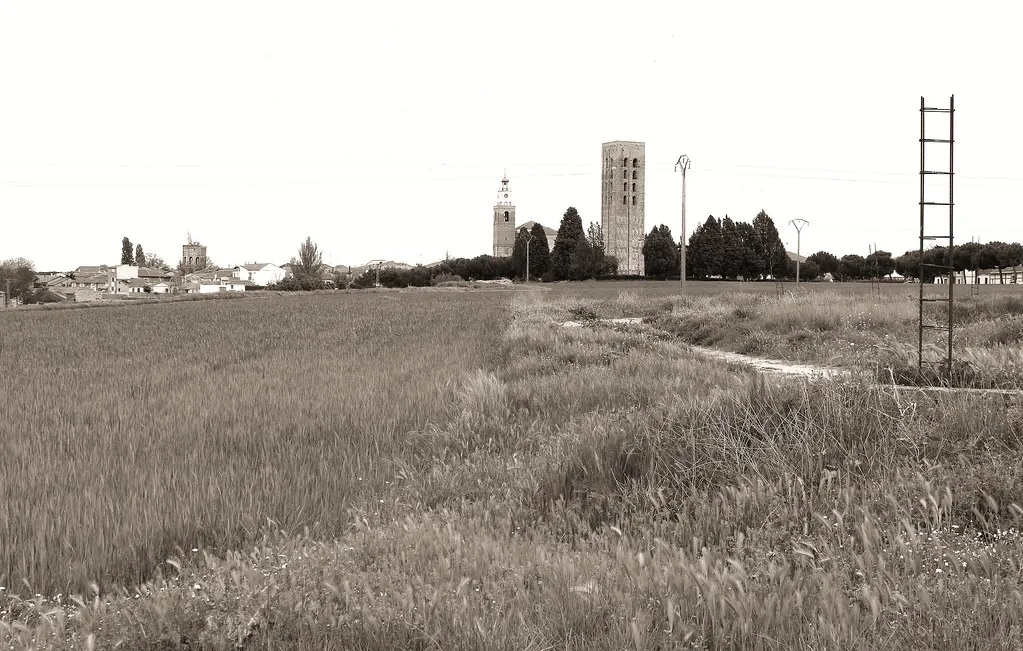
By late afternoon, when the sun begins to drop over the Campiña Segoviana, the fields around Los Huertos turn a muted, dusty gold. Wind brushes through dry ears of grain with a steady murmur. In the village itself there is little else to hear: a door closing somewhere, the distant engine of a tractor heading back along a track, the sharp knock of shutters as night approaches.
Los Huertos has just over a hundred residents and a size that can be covered on foot in a matter of minutes. Moving slowly through its streets reveals small signs of daily life: stacks of firewood by façades, chicken coops tucked into back yards, dried mud marks at the entrances of houses after a day spent working the land.
The church at the centre
The parish church of San Juan Bautista stands at the centre of the village. It does not try to draw attention from afar. Its stone is pale and slightly uneven, and the tower rises only modestly above the surrounding tiled roofs.
The building is generally dated to around the 16th century, although it has undergone repairs and changes over time. Inside, the light comes in softly filtered, illuminating wooden altarpieces and restrained walls in keeping with many rural churches across the Segovian countryside.
At the height of the day, especially in summer, the square around the church becomes almost empty and very quiet. It is one of the few places in the village where the sun falls without obstruction.
Adobe houses and old enclosures
The streets are short and slightly irregular. Most houses have one or two storeys, with adobe walls strengthened by stone at the base. In some stretches, the plaster has fallen away, exposing the earthy texture of dried mud beneath.
There are still corrales, small stables and wide gateways once used by carts. Many are no longer used as they were in the past, yet they remain part of the structure of the homes.
Beyond the last houses, the village opens suddenly onto the plain. Tractors are parked beside agricultural sheds, with plots left fallow and others sown with barley or wheat. There is no gradual transition. The countryside begins almost at the final wall.
Tracks through the cereal fields
Several rural tracks and old livestock routes cross the land around Los Huertos. They are compacted dirt paths used by farmers and by the occasional resident heading out for a walk in the afternoon.
There is no visitor-focused signage, so it helps to have a clear idea of the route or to rely on GPS if planning to go beyond a short stroll. The terrain is almost entirely flat, which makes it easy to explore on foot or by bicycle without significant climbs.
With a bit of patience, some of the common birdlife of the Campiña can be spotted: partridges running across the track, quail hidden among the cereal, and at times birds of prey circling above the open fields.
A landscape shaped by the seasons
Here, the landscape depends strongly on the time of year.
In spring, the fields take on a clean, vivid green, and the air often carries the scent of damp earth after storms. Summer brings a drier, more golden scene. The sun is intense, and at midday there is hardly any shade outside the village. In autumn, ochre tones arrive and the land seems even more expansive beneath a high sky.
For photography or a simple walk, the light in the early morning or towards the end of the day tends to work better. At midday, the sun flattens the landscape and softens most of its contours.
At night, when the sky is clear, the limited artificial lighting in the area becomes noticeable. Stars appear with striking clarity, especially on moonless nights.
Eating and practicalities
Commercial activity within the village is minimal and not always consistent throughout the year. For meals or supplies with more choice, it is common to drive to nearby towns in the Campiña or to larger centres in the province.
The local cuisine follows Castilian tradition. Roast lamb, legume stews and pork products are staples of the rural pantry.
When to pass through Los Huertos
Spring is often the most pleasant time to explore the area, with mild temperatures and fields still green.
In summer, the heat builds from midday onwards. Walking along the dirt tracks is best done early in the day or towards evening. Winter leaves the landscape more bare, yet clear days bring a crisp light across the plain.
Los Huertos is not a place defined by constant activity. It works better as a brief pause within the Segovian countryside: a handful of quiet streets, open land in every direction, and that sense of space that comes when the horizon always feels far away.