Full Article
about Martín Muñoz de las Posadas
Historic town with a striking Renaissance palace; historic-artistic site
Hide article Read full article
The wind moves slowly across the cereal fields in the afternoon. A tractor hums somewhere in the distance. A door shuts. In this stretch of the Segovian countryside, silence is not a performance. It is simply how things are in Martín Muñoz de las Posadas.
The village keeps to its agricultural rhythm. You become part of the landscape for a while, another quiet presence among fields and low houses.
The streets combine dirt sections, patches of asphalt and façades where rammed earth, timber and more recent repairs sit side by side. There are no grand architectural gestures. Look instead for wide gateways once designed for carts, dark beams visible beneath the eaves and thick walls that hold cool air in summer.
The Plaza Mayor and San Juan Bautista
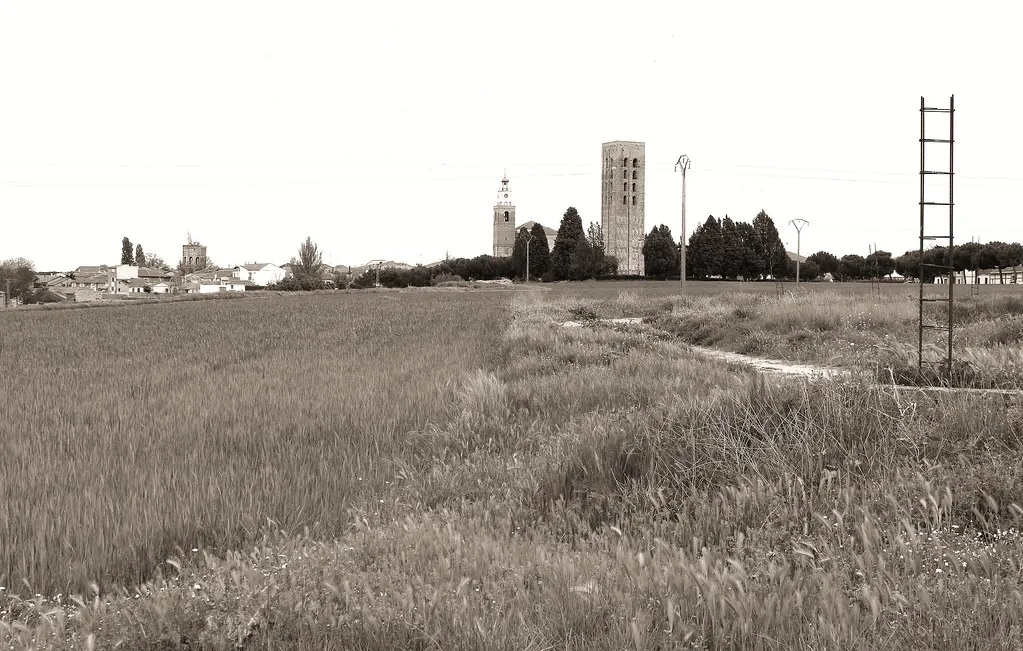
The Plaza Mayor forms the centre of the village. As evening approaches, two iron lampposts cast long shadows across the square. From here, the church of San Juan Bautista rises above the rooftops, its square tower standing out against the low line of houses.
Built in the 16th century, the church is solid and restrained. The interior is often closed, which is common here. If that is the case, walk slowly around the exterior. The houses lean closely against one another and the church sits integrated within this compact cluster, as if it has always occupied that central place. It feels woven into daily life rather than separated from it.
Rammed Earth and Timber: Everyday Architecture
Much of the appeal lies in vernacular architecture. It does not reveal itself all at once. You notice a curved beam beneath a roofline. A large wooden gate with worn planks and heavy hinges. Plaster marked by repairs from different decades.
Many houses retain their original teja árabe, the curved terracotta tiles typical across much of Spain. Others show later repairs in brick. The contrast tells a story of generations mending what was already there.
A slow walk through the side streets often reveals more than remaining in the square. There is no set route to follow.
Fields, Tracks and Open Sky
Step beyond the last houses and the open countryside begins almost immediately. Large plots of wheat and barley stretch outwards, shifting in colour with the seasons. In summer the land turns dry and golden.
On clear days, looking north, the distant outline of the Sierra de Guadarrama appears as a faint bluish silhouette.
Several rural tracks lead from the village into the fields. These are working paths rather than marked hiking routes, yet they can be walked without difficulty for an hour or two. Ask a local resident about the main tracks before setting out, particularly after rain, as some sections can become very muddy.
The landscape rewards a quiet pace. In spring and autumn, birds of prey are sometimes seen circling above the fields if you keep noise to a minimum.
Light at the Edges of the Day
Those who visit with a camera often find the most interesting moments at dawn or dusk.
At sunrise, a low layer of mist sometimes settles over the wheat fields, giving the landscape a muted, silvery tone. In the late afternoon, as the sun drops towards the west, the earth turns ochre and the rammed earth façades take on a soft warmth.
Midday, particularly in summer, is different. The light becomes harsh and the heat intense. During July and August, walk early or wait until the sun is lower.
Food and Rhythm
The food follows the traditions of the Segovian countryside. Expect substantial dishes built around pulses, lamb or pork. When the season of matanzas arrives, homemade embutidos appear as part of the local diet.
There are no establishments designed specifically for tourism. You will usually find straightforward food served in the village bars.
The annual rhythm is tied to agriculture and the religious calendar. At the end of August, festivities dedicated to San Juan Bautista are usually held. Residents who live elsewhere return, there is music in the square and more movement after dark.
For the rest of the year, life is much quieter. In winter the silence becomes even more pronounced, with empty streets and smoke rising from a few chimneys.
When to Visit
April and May often show the countryside at its greenest. October can also offer good days, with softer light and less heat.
Summer can be demanding from midday onwards. Early starts or late afternoon walks are more comfortable in July and August.
There are no headline attractions here. The experience lies in paying attention: to thick walls built for climate rather than style, to fields that define the horizon, and to a pace of life shaped by seasons rather than schedules.