Full Article
about Muñopedro
Surrounded by holm oak and pine woods; noted for its church and devotion to the Christ
Ocultar artículo Leer artículo completo
At 08:00 the only sound is the grain drier coughing into life behind the grocer’s. By 08:05 half the village is awake, curtains twitching. Muñopedro, population 285, sits 1,050 m above sea level on a rolling Castilian plateau where the wheat meets the pine. Madrid lies 110 km south-west, but it feels farther: the air is thinner, the sky wider, and the night sky still belongs to Orion rather than streetlights.
The village that forgot to hurry
Stone, adobe and the occasional brick wall make up the one-storey houses that lean politely into narrow lanes. Timber balconies carry last year’s onion strings; a 1950s tractor, paint blistered, blocks half the street while its owner debates fertiliser prices with the postwoman. There is no postcard-perfect plaza, no gift shop, no medieval arch to pose beneath—just the everyday architecture of a farming community that has kept its head down since the 1500s.
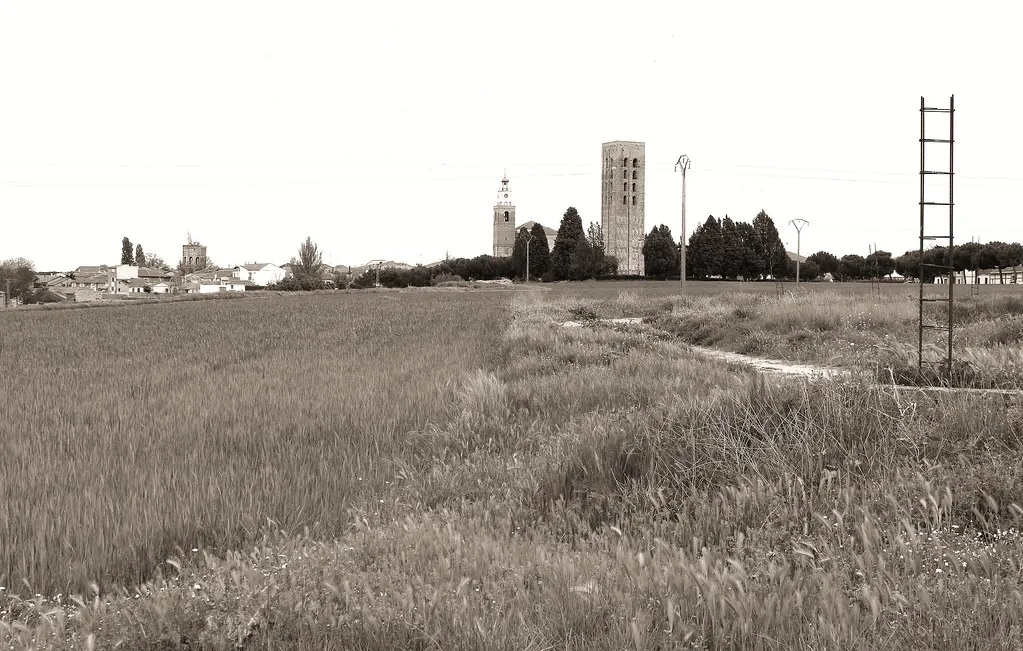
The parish church of San Miguel rises at the top of the slight incline, its rough ashlar tower visible from every approach road. Step inside and you’ll find a single-nave interior, nineteenth-century paint flaking from the cornice, and the smell of beeswax that never quite masks damp stone. Sunday mass is at 11:00; turn up at 10:55 and you’ll probably unlock the door yourself.
A five-minute circuit on foot will pass the bread oven—still fired twice a month by volunteers—the stone watering trough now planted with geraniums, and the social club whose metal shutter lifts only for weddings, funerals and the August fiestas. Expect nothing monumental; the appeal is the absence of clutter, not the presence of sights.
Walking without way-markers
North of the last house the tarmac dissolves into a grid of farm tracks that double as the local walking network. No ticket office, no interpretation board: just follow the widest track and within fifteen minutes the cereal fields open into a natural viewpoint where the Sierra de Ayllón appears as a jagged graphite stripe on the horizon. Spring brings flocks of calandra lark; after October rain the verges flush with parasol mushrooms—locals carry a folding knife and a paper bag, and will happily identify species if asked (in Spanish).
Circular routes exist but you’ll need an app or the 1:50,000 Adrados map from the tobacconist in Riaza. A gentle 8 km loop eastward drops into the Arroyo de Milano, climbs through holm oak, and re-enters the village past an abandoned threshing floor where swallows nest in the rafters. Gradient is minimal; boots are overkill, but take water—shade is scarce and cafés nonexistent.
What you’ll eat (and when you won’t)
The grocer opens 09:00–13:00, stocks UHT milk, tinned tuna and, on Fridays, three legs of jamón ibérico that disappear before noon. Fresh bread arrives from a neighbouring village at 11:30; queue early because by midday only baguettes remain. There is no bar, no bakery, no Sunday roast alternative—self-catering is compulsory unless you book a table 25 minutes away.
For a blow-out, Casa Rural Arroyo Milano will serve chuletón de Ávila (T-bone for two, €42) if you reserve before 18:00 the previous day. The owner brings chips in a metal pail, salad dressed with local honey, and a jug of young Tempranillo that costs €8 and tastes like chilled Beaujolais with the edges left on. Vegetarians get a plate of pisto—Spain’s answer to ratatouille—topped with a fried egg.
Breakfast options? Buy honey from the grocer (€5, mild, floral) and spoon it onto supermarket crackers. Cheese lovers should try the queso de oveja curado—firm, not over-salty, sold vacuum-packed so it survives the flight home in hold luggage.
Seasons and silence
Summer days hover around 30 °C but drop to 14 °C after midnight; the altitude keeps humidity low and mosquitoes away. August fiestas bring temporary noise—brass band, football tournament, open-air dance that finishes promptly at 04:00 because the band has to work the fields next morning. Book accommodation early; every cousin returns and spare rooms vanish.
Winter is sharp. Night temperatures slip below –5 °C and the CL-124 can ice over; carry chains if you visit between December and February. The compensation is crystalline light: wheat stubble frosts silver at dawn and the Sierra de Guadarrama sparkles 60 km away. Central heating is not universal—check before you commit to a long let.
Spring and early autumn offer the best compromise: mild afternoons, green or golden fields depending on the month, and prices 30% lower than August. Rain is possible but usually arrives as a two-hour clearing shower rather than day-long drizzle—think Yorkshire Dales without the sodden socks.
Getting here, staying here
Fly to Madrid, pick up a hire car at Terminal 1, and stay on the A-1 north for 90 minutes. Leave at junction 115 (Riaza), then follow the CL-124 for 19 km of pine forest and sudden wheat plains. Public transport is the school bus—one departure, one return, neither timed for travellers.
Accommodation is limited to four casas rurales, only one with a swimming pool. Casa Rural Arroyo Milano has three en-suite bedrooms, thick stone walls and British-standard Wi-Fi (rare). Price is €90 per night for the whole house mid-week, €140 at weekends. If you need a pool, book early—there is no municipal option and July temperatures make the absence noticeable.
Mobile coverage is patchy: EE users get two bars on the main square; Vodafone and O2 struggle everywhere. The village has no petrol station—fill up in Riaza before the final climb.
The catch
Even enthusiasts admit the quiet can tip into vacancy. After 22:00 the only illumination is a single streetlamp outside the church; footsteps echo like tap shoes. If you crave conversation beyond “¿Qué tal la cosecha?” plan day trips to mediaeval Sepúlveda or the royal palace at La Granja, both within 40 minutes’ drive. And remember: no shop opens on Sunday afternoon, no pharmacy exists, and the nearest cash machine is 18 km away. Pack paracetamol, bring euros, and download offline maps before arrival.
Muñopedro will not entertain you. It will, however, hand over the keys to its grain silo sunset, its star-loaded sky, and its stubborn continuation of a life that guidebooks keep predicting will vanish. Come prepared, come curious, and the village might—quietly—let you in.