Full Article
about Ortigosa de Pestaño
Small village in the countryside; known for its rock carvings and quiet.
Hide article Read full article
A village where time stretches
At the hour when the sun is still low, the adobe façades of Ortigosa de Pestaño take on a toasted, almost matte tone. A door opens, someone sweeps the entrance, and the sound of bristles on dry ground carries further than expected. In a place this small, even the simplest gestures seem louder.
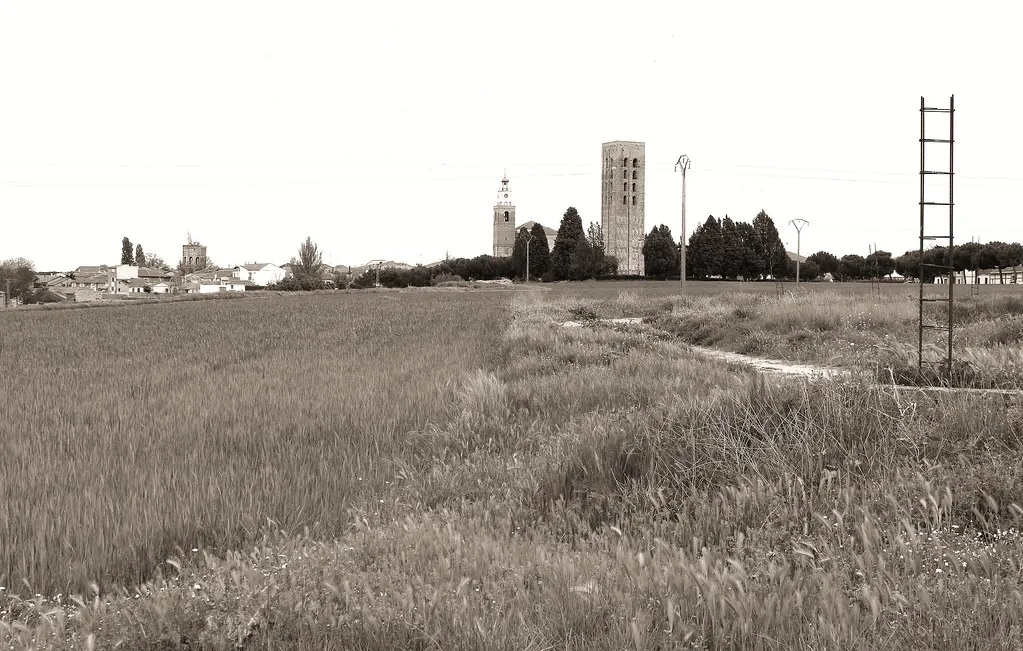
Tourism in Ortigosa de Pestaño has little to do with ticking off sights. It is more about pausing, looking around, and letting the landscape settle in. This part of the Campiña Segoviana, a wide agricultural plain in the province of Segovia, stretches out without interruption. Long plots of cereal crops, straight farm tracks, and a clean horizon define the view. The colours shift with the seasons, but the sense of openness stays constant.
Early hours in Ortigosa
The streets combine compacted earth with uneven cobbled sections. Houses are low and solid, many with thick walls and wooden gates that have endured years of winter weather. Some façades are whitewashed, while others reveal dark adobe beneath, rough to the touch.
Early in the day, there is little sound beyond birds and the occasional car passing slowly through. After that, quiet settles again. With just over fifty residents, daily life appears in small, scattered moments: a tractor starting up, a brief conversation leaning against a wall, the faint smell of firewood when the air cools.
Nothing feels hurried. Movement is sparse, and the village seems to hold its rhythm without effort.
The church and its square
At the centre stands the village church, its plain tower visible from several of the roads leading in. The square around it is simple and unadorned. A stone fountain runs with a steady thread of water, which in summer becomes one of the coolest points in the village.
Inside, the air often carries the scent of wax and aged wood. Light filters through small windows, creating the warm golden tone common in many rural churches at midday. The effect is quiet rather than dramatic, shaped by modest materials and soft light.
The space reflects the scale of the village itself. Nothing feels oversized or arranged for display.
Living in a very small place
There are no year-round shops or services aimed at visitors passing through. It makes sense to arrive with water and some food, rather than expecting to find anything open. This is part of the everyday reality in many villages across the campiña.
Everyone knows each other here. A slow walk through the streets often brings a greeting from a doorway or from the seat of a tractor. Traffic is minimal, and time seems to stretch rather than press forward.
In some yards, animals are still part of daily life. Chickens, geese or the occasional horse appear behind low walls or simple enclosures. Near the church, small vegetable plots stand out where the soil looks darker and more damp than the surrounding land.
Tracks through the cereal fields
Several agricultural tracks lead out from Ortigosa de Pestaño into the surrounding fields. They are not marked as formal routes, but they can be followed on foot or by bicycle, provided tractors are given space to pass.
The landscape changes noticeably with the calendar. In June, the cereal fields are green and move with the wind like a fluid surface. By July, they turn a dry yellow that reflects strong light across the plain. Shade is scarce, so carrying water and some form of sun protection becomes important in the warmer months.
Between some of the fields, small groups of holm oaks remain. These scattered trees break the uniformity of the crops. Birds that favour open countryside can sometimes be seen taking flight if approached quietly.
After sunset
As evening falls, the village becomes almost completely dark. There are few streetlights, and artificial light barely reaches the sky. On clear nights, far more stars are visible than in urban areas.
The soundscape changes as well. Crickets take over, a dog may bark in the distance, and the wind moves across the rooftops. The stillness of the day gives way to a different kind of quiet, shaped by these softer, more dispersed sounds.
When to come and getting there
Spring and early summer are usually the most comfortable times to walk through the campiña. In high summer, the heat builds from mid-morning and the streets are very exposed to the sun.
Some summer weekends bring a livelier atmosphere. Residents who live elsewhere return, and traditional celebrations take place around the church and the square. These moments briefly alter the pace of the village without changing its character.
From Segovia, the most practical way to reach Ortigosa de Pestaño is by car. The roads cross open countryside and pass through small villages before arriving here. Public transport does exist in the area, though services tend to be limited, so checking ahead is advisable.
Ortigosa de Pestaño does not present itself with attractions in the usual sense. Its appeal lies in scale, silence, and the steady presence of the surrounding fields. It invites a slower kind of visit, one shaped by observation rather than activity.