Full Article
about Roda de Eresma
On the banks of the Eresma River; noted for its church and riverside landscape.
Hide article Read full article
A Small Village on the Campiña Segoviana
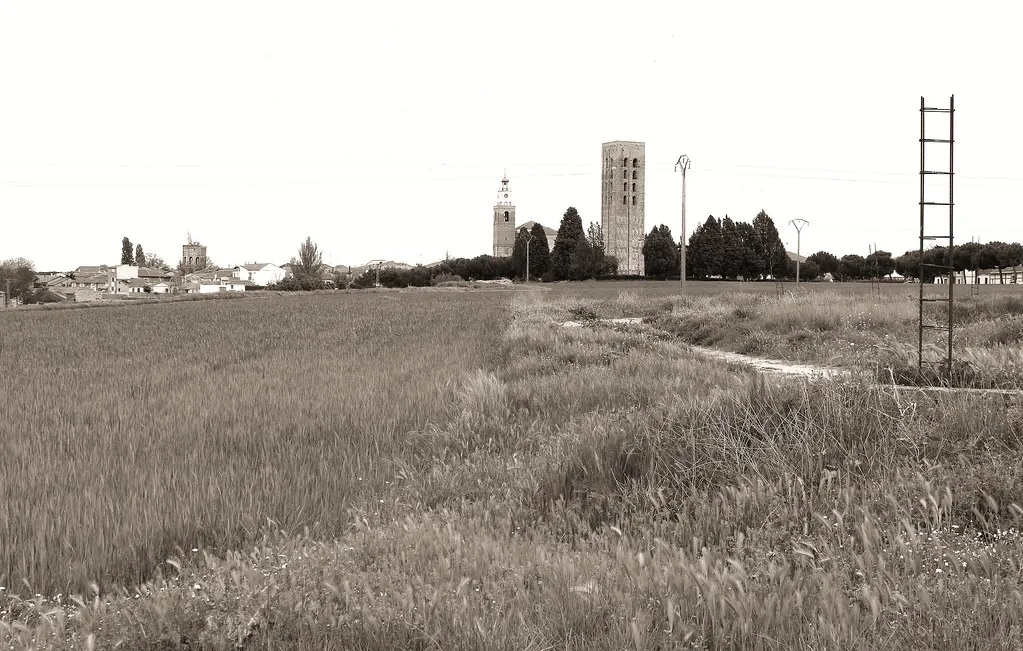
Roda de Eresma sits in the Campiña Segoviana, a few kilometres from the city of Segovia, on a stretch of flat land defined by cereal fields and scattered patches of trees. With around 260 residents, it remains a very small settlement. Daily life still follows the rhythms of agriculture and the pace typical of a rural municipality.
Its proximity to Segovia has shaped its more recent development, yet the layout of the village continues to reflect its origins as a traditional farming settlement. This part of the province has been inhabited for centuries, closely linked to the medieval repopulation of the Segovian plain. Many nearby villages share the same pattern: compact clusters of houses surrounded by cultivated land stretching across the open countryside.
On clear days, the line of the Sierra de Guadarrama can be seen to the south. From this distance it appears as a bluish band on the horizon, its tone shifting with the seasons and the quality of the light. The contrast between the flat farmland and the distant mountains gives a clear sense of place, even if the landscape itself is understated.
The Church and the Shape of the Village
The parish church is the most recognisable building in Roda de Eresma. Constructed in stone and sober in style, it is in keeping with many religious buildings across the Campiña Segoviana. It is not monumental in scale, yet it acts as a spatial reference point around which much of the housing is arranged.
From the church atrium, it is easy to grasp the proportions of the village and its immediate relationship with the surrounding fields. The transition from the last houses to open farmland happens quickly. Within a short walk, the built environment gives way to cultivated land.
Walking through the streets reveals features typical of local vernacular architecture: masonry walls, granite plinths and large gateways that once led into courtyards or agricultural outbuildings. The street plan is simple and practical, shaped by function rather than decorative intent.
In just a few minutes on foot, agricultural tracks appear at the edge of the village. These paths are still used by residents working nearby plots. They form part of the everyday landscape, linking homes to fields in a direct and unembellished way.
Walking the Surrounding Countryside
The main interest of Roda de Eresma lies in its immediate surroundings. The network of tracks around the village makes it possible to walk across largely flat terrain, passing cultivated parcels, small wooded areas and stretches of riverside linked to the Eresma, which flows relatively close by.
These agricultural paths connect with other villages across the Campiña. There is not always specific signposting for hiking, so it is advisable to use a map or a route app if planning a longer walk. Orientation is generally straightforward thanks to the openness of the landscape, but distances can be deceptive on the plain.
The wide fields are favourable for observing birdlife typical of cereal-growing regions. Birds of prey can often be seen circling above the fields, while flocks of corvids move between crops. Along field boundaries and hedgerows, smaller species find shelter among the vegetation.
In autumn, when conditions have been favourable, some of the nearby pinewoods and wooded patches attract people interested in mushroom picking. As in the rest of Castilla y León, there are usually specific rules and permits governing mushroom collection, and these should be checked before gathering anything. The activity forms part of a seasonal routine across the region, tied closely to weather patterns and local regulation.
The landscape here does not rely on dramatic features. Its character comes from scale, light and continuity. Fields extend towards the horizon, broken by occasional tree lines and farm buildings. The experience of walking is defined by open views and the steady presence of cultivated land.
Local Life and Summer Celebrations
Roda de Eresma’s patron saint festivities take place in summer, usually in August, when many people who live elsewhere return to the village for a few days. These celebrations are organised by residents themselves and combine religious events with communal activities centred around the square and shared spaces.
Throughout the year there are also smaller religious celebrations connected to the parish calendar. In a village of this size, such gatherings still have a clear role. They are moments when the community comes together and public space regains prominence.
The seasonal return of families in summer slightly alters the village’s rhythm. Houses that remain closed for much of the year reopen, and public areas see more activity. Even so, the scale remains modest and the setting continues to feel rural and close-knit.
A Practical Note for Visitors
Roda de Eresma can be explored quickly. The built area is compact, and the church and surrounding streets can be seen in a short time. The greater interest lies in walking through the surrounding countryside and observing how a small municipality on the Campiña Segoviana functions.
For broader services such as eating out, shopping or planning additional visits, it is common to travel to Segovia or to larger nearby villages. The short distance to the provincial capital makes it easy to combine a quiet rural setting with access to a historic city.
Roda de Eresma does not present itself as a destination of major monuments or striking landmarks. Its appeal rests on its scale, its agricultural setting and the continuity of rural life on the Segovian plain. For those interested in understanding this landscape and the settlements that shape it, the village offers a clear and unembellished example.