Full Article
about San Cristóbal de la Vega
A countryside municipality with a brick church; peaceful setting
Hide article Read full article
A village shaped by the land
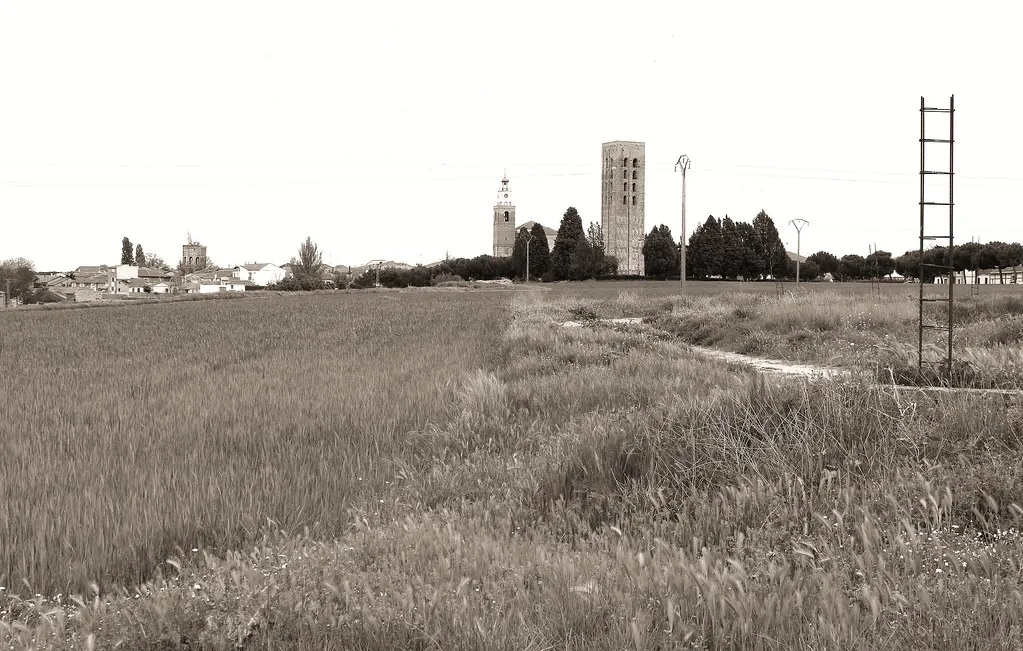
Some places make sense almost as soon as you arrive. Not because there is nothing to see, but because the landscape sets the tone for everything else. San Cristóbal de la Vega works like that. Low houses, quiet streets, and all around, kilometres of cereal fields that turn a dry yellow in summer, the kind that seems to crackle when the wind moves through it.
Set in the Campiña Segoviana, San Cristóbal de la Vega has around 80 residents. Life here has never followed a tourist rhythm. It follows the fields instead. Wheat, barley, and whatever the season brings have always been at the centre of daily life. This is the kind of place where the main reference points are still the square, the church, and the tracks leading out towards the farmland.
The Campiña Segoviana itself does not try to impress. It is an open, very horizontal landscape where the sky feels almost as weighty as the earth. Anyone arriving in search of grand monuments may find it underwhelming. But for those curious about how cereal-growing Castilla functions, it becomes clear quite quickly.
The quiet details of the village
The parish church is the most recognisable building from a distance. Not because it is especially large, but because in such flat surroundings any tower stands out immediately. It is dedicated to San Cristóbal and, like many churches in the area, it shows signs of gradual change over time, shaped by repairs and small alterations rather than a single defined style.
Inside, it is simple. Wooden benches, devotional figures, and a modest altarpiece give it the feel of a space that has remained largely unchanged for decades. More than a monument, it continues to act as a meeting point, especially during local celebrations.
Walking through the village, much of the interest lies in the houses themselves. There are still plenty of walls built from adobe or tapial, traditional earth-based construction methods common in central Spain. Wooden gates open into interior courtyards that remain hidden from the street. Some façades have been restored, while others reveal layers of earth and lime as if there were no urgency to conceal their age.
Old animal enclosures and underground cellars also appear here and there, typical of this part of Segovia. These spaces were once used to store wine, grain, or simply to keep food cool before modern refrigeration. On the edges of the village, it is not unusual to spot a circular dovecote, low structures where pigeons were raised for both meat and fertiliser.
Moving through the landscape
San Cristóbal de la Vega works best as a short stop within a wider route across the Campiña Segoviana. The approach is simple: walk for a while, take in the surroundings, and get a sense of how this plain behaves when there is no rush.
The agricultural tracks leading out of the village are long and straight, typical of the area. They are easy to follow by bicycle since there is hardly any change in elevation. These paths often connect with nearby villages through secondary roads where tractors are more common than cars.
Light changes the experience more than anything else. Early morning and late afternoon soften the landscape, making the fields feel even more expansive. In summer, midday is best avoided. The sun is intense and there is very little shade to retreat to.
For those who enjoy watching wildlife at a slower pace, this stretch of countryside has its moments. In the open fields, great bustards or birds of prey can sometimes be seen taking advantage of air currents. It is not something that reveals itself immediately. It requires stopping, looking carefully, and giving it time.
When it comes to food or basic shopping, it is common to rely on slightly larger nearby villages. San Cristóbal itself is small, and services are limited.
Times of year and local traditions
Festivities dedicated to San Cristóbal usually take place towards the end of July. This is when the village changes most noticeably. Relatives who live elsewhere return, and many houses that remain closed for much of the year open again.
During these days, the streets become more active. Processions pass through the village, neighbours gather outside, and conversations stretch into the evening as the temperature drops. Nothing especially grand, but a clear shift in atmosphere, with more voices and a stronger sense of shared space.
Outside of these moments, San Cristóbal de la Vega returns to its steady pace. A small settlement surrounded by cereal fields, where life continues to revolve around agriculture much as it always has. A short walk of half an hour is enough to understand how things fit together here. And that, in itself, can be part of the appeal.