Full Article
about Sangarcía
Town of brick mansions and a grand Baroque church; history in the countryside
Hide article Read full article
A village shaped by the Campiña Segoviana
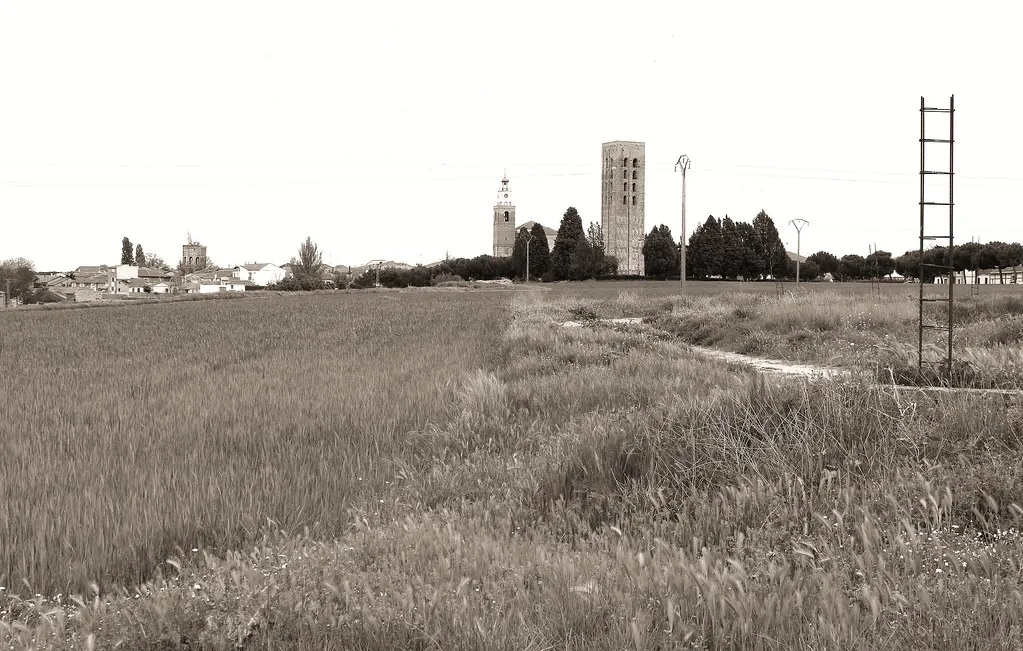
Tourism in Sangarcía begins with understanding where you are. The village stands in the heart of the Campiña Segoviana, a wide agricultural plain that occupies much of the centre of the province of Segovia, in Castilla Leon. The land barely rises or folds. Cereal fields, straight tracks and open horizons have defined the landscape for centuries.
With just over two hundred inhabitants, Sangarcía follows the logic of its surroundings. It is a compact settlement encircled by farmland. At around 940 metres above sea level, the village sits high on the Meseta, Spain’s central plateau, where weather and landscape both tend towards extremes.
The layout of the urban centre is typical of many villages in this part of Segovia. Simple streets, irregular blocks and the parish church claiming the most visible position. Agriculture remains the main activity. A short walk beyond the last houses leads directly to plots of wheat or barley stretching out in every direction.
The church at the heart of the village
The Iglesia de Nuestra Señora de la Asunción organises the space of the historic centre. The present building is usually dated to the 16th century, although, as with many rural churches, later alterations are likely.
This is not a monumental church. Its importance lies less in artistic elements and more in the role it has played within the community. Inside, there are simple altarpieces and a functional architectural style consistent with parish churches across the Segovian plains. The atmosphere reflects practicality and continuity rather than grandeur.
From the area around the church, the scale of Sangarcía becomes clear. Low houses cluster nearby, and the open countryside begins only a short distance away. The relationship between village and farmland is immediate and easy to read.
Streets built for agricultural life
Sangarcía’s street plan is direct and unadorned. Roads link the main square, the church and the exits towards the agricultural tracks. The houses combine masonry and brick, materials commonly used in the area.
Several properties still show wide entrances designed for carts or access to interior courtyards. Some patios remain enclosed by high walls. These details recall a time when daily life revolved around fieldwork and livestock.
Old domestic ovens can still be spotted, along with outbuildings that once served as stables or storage spaces. Many buildings have been adapted over time to suit modern needs, yet the village as a whole preserves its traditional scale to a considerable degree. There is little sense of expansion beyond what the agricultural setting requires.
Walking through these streets does not involve ticking off major sights. The interest lies in observing how form follows function. The built environment reflects a community shaped by seasons, harvests and practical concerns.
The wide horizons of the Campiña Segoviana
The landscape surrounding Sangarcía is an almost continuous cereal plain. Isolated holm oaks, occasional patches of pine and streams that carry water only at certain times of year interrupt the uniformity.
The appearance of the countryside shifts markedly with the seasons. In spring, young cereal crops create intense greens across the fields. At the beginning of summer, the land turns golden and the horizon appears sharper and more defined. On clear days, the sky occupies half the view.
Birdlife typical of dry farmland is common in these open areas. Activity tends to increase at dawn and again towards evening. The setting remains largely agricultural, with tractors working the fields depending on the time of year.
Several agricultural tracks lead out from Sangarcía towards neighbouring settlements in the plain, including Valdevacas and La Cuesta. These routes are flat, with barely any gradient. For decades they have connected parcels of land and nearby villages.
A walk along these paths quickly leaves the village behind. Open countryside dominates, and the scale of the territory becomes apparent. These tracks are still working routes, so agricultural vehicles may be present. The experience is less about reaching a particular landmark and more about understanding the relationship between settlement and farmland.
Festivals rooted in the traditional calendar
Festive life in Sangarcía revolves above all around the Virgen de la Asunción, the village’s patron saint. Celebrations take place mainly in summer and combine religious ceremonies with popular activities held in the square.
In January, the feast of San Antón is usually marked with the blessing of animals. This custom is closely linked to the area’s livestock-raising past. Holy Week also features processions that are sober in tone, in keeping with what is seen in many villages across the province.
These events reflect a rhythm tied to the traditional calendar. They bring together religious observance and social gathering in ways that remain central to village identity.
A practical note for visitors
Sangarcía can be explored in a short space of time. The most rewarding approach is to observe the village as a whole and then head out along the surrounding tracks to see the agricultural landscape that explains its existence.
Spring and autumn are often the most pleasant seasons for walking in the area. Summer heat can be intense at midday, while in winter the wind that sweeps across the plateau makes itself felt. A visit here has more to do with the tempo of the countryside than with individual monuments. The appeal lies in the coherence between village, fields and horizon.