Full Article
about Santa María la Real de Nieva
Town known for its Gothic monastery and cloister; capital of the farmland
Hide article Read full article
A Quiet Arrival in the Segovian Countryside
The bells ring slowly as evening falls. Their sound lingers above red-tiled rooftops and blends with the dry scent of grain drifting in from the fields. This is often how a visit to Santa María la Real de Nieva begins, with silence all around and the monastery rising quietly among low houses.
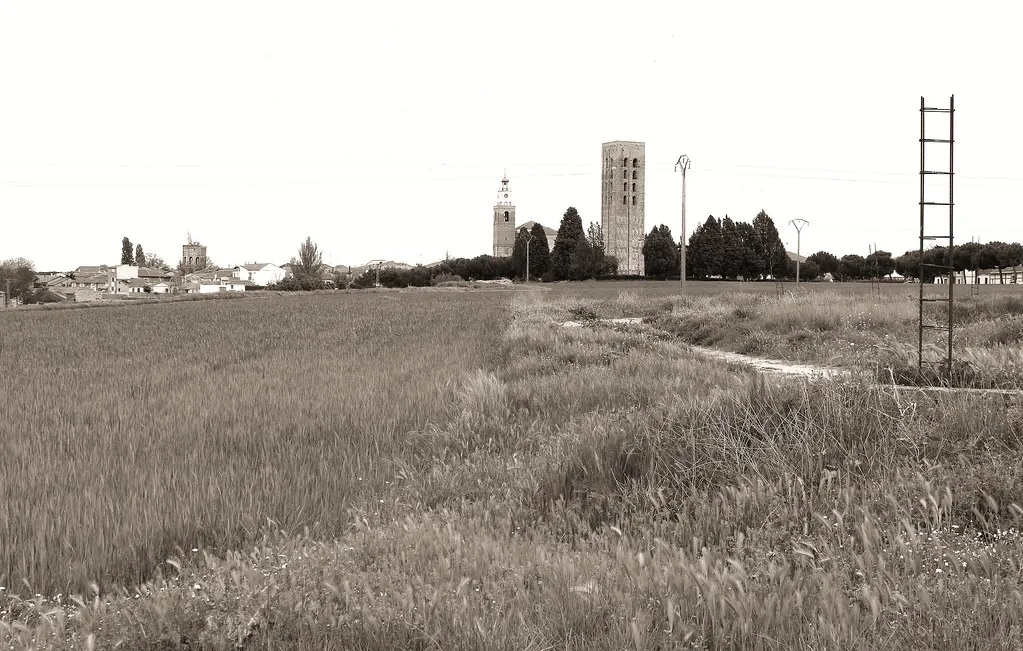
The village lies around 35 kilometres from Segovia, in the heart of the Campiña Segoviana. The road crosses open farmland without drama, passing plots of wheat and barley that stretch towards a wide horizon. On arrival, what stands out is the scale. The streets are broad, the buildings built in adobe and brick, and at certain corners the wind lifts a little dust when a car goes by.
The name Santa María la Real de Nieva is tied to a story that has been told here for centuries. In the 14th century, according to local tradition, an image of the Virgin appeared in the snow. Following that event, a monastery was built on the site. It remains the physical and symbolic centre of the village today.
The Monastery of Nuestra Señora de la Soterraña
The Monasterio de Nuestra Señora de la Soterraña dominates the main square. Its walls combine brick and stone in a style associated with Mudéjar architecture, a form that developed in parts of Castile where Islamic artistic influence continued under Christian rule. The exterior is solid rather than imposing. Inside, the church is not especially large, yet it encourages a slower look.
It is the cloister that holds attention the longest. No two columns are quite the same. Some capitals are carved with narrative scenes, others with simpler, almost geometric figures. The variation invites close inspection, moving from one to the next. When late afternoon light enters the courtyard, the stone takes on a warm golden tone. At that hour the space falls into partial shadow and footsteps echo clearly beneath the arches.
The image of the Virgen de la Soterraña remains a point of reference in the religious life of the village. At certain times of the year there is noticeably more movement around the monastery, as local devotion draws people back to this building that shaped the town’s origins.
Life Around the Plaza Mayor
Directly in front of the monastery opens the Plaza Mayor. Stone arcades line part of the square, offering shade in summer. In the morning, the scrape of chairs and brief conversations bounce under the arches.
Several houses around the square display coats of arms on their façades. They recall periods when agricultural trade brought greater activity to the area. The surrounding countryside has long defined the local economy, and there were times when that commerce gave the village a busier rhythm.
Today the pace is different. A van might cross the square, neighbours pass through on foot, and people sit on benches watching the afternoon move along. The atmosphere remains unhurried, shaped more by routine than by visitors.
Wandering without a fixed route reveals simple corners. An old oven, worn wooden gates, inner courtyards barely visible from the street. There is no grand route to follow, just small details that appear when walking slowly.
Out into the Campiña Segoviana
It takes only a few minutes to leave the built-up area and step into open countryside. The land here is flat and the horizon feels distant. In spring the fields show a soft green; by early summer everything turns gold.
Agricultural tracks connect Santa María la Real de Nieva with nearby settlements. Some pass beside small hermitages or old fountains. They are not marked as formal walking routes. They are working paths, used for generations by local people tending their land.
Wind is common in this part of Castilla y León. When it blows, the sound of grain moving in waves is constant, a low rustle across the fields. The landscape feels exposed and expansive at the same time.
In winter the sensation shifts. Temperatures drop quickly once the sun goes down. The open terrain offers little shelter, and it is wise not to linger too long outdoors as evening approaches.
Choosing the Right Moment
Santa María la Real de Nieva changes depending on the day of the week. During weekdays it is usually quiet. At weekends there is more movement in the Plaza Mayor and around the monastery, as visitors and residents gather.
Summer on the Castilian plateau can be intense at midday. For those who want to walk through the village or spend time in the cloister without haste, early morning or late afternoon are better options. The light is softer then, and the village returns to the stillness that continues to define its character.
In those hours, the bells once again become part of the atmosphere. Their slow rhythm carries across rooftops and into the surrounding fields, linking the monastery, the square and the farmland beyond. Santa María la Real de Nieva does not rely on spectacle. Its appeal lies in proportion, texture and quiet continuity between village and countryside.
For travellers exploring Castilla y León beyond its larger cities, this small settlement near Segovia offers a measured pace and a clear sense of place. The monastery, born from a medieval legend of snow and devotion, anchors a community that still moves in time with the seasons of the Campiña Segoviana.