Full Article
about Sauquillo de Cabezas
A farming village with an interesting church; it keeps rural traditions alive.
Hide article Read full article
A small village on the Segovian plain
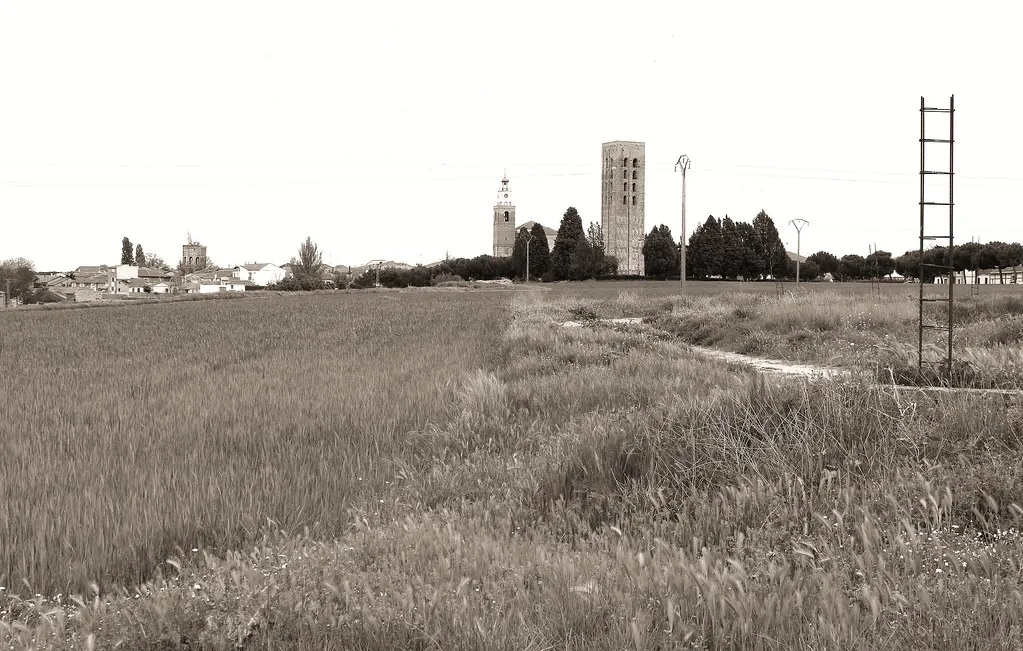
Sauquillo de Cabezas sits in the Campiña Segoviana, about 50 kilometres from Segovia. It is a very small place, with just over a hundred residents. The scale is easy to grasp almost immediately. A handful of streets, a church, and open countryside in every direction.
Getting around is simple. Parking is not an issue, as cars can be left on any wide street near the square. There is no traffic to speak of and no regulated parking. For a short walk or a few photos, early morning or late afternoon works best. At midday the sun is strong and the landscape loses much of its contrast.
The village as it is
There are no major monuments in Sauquillo de Cabezas. What defines it is its housing, typical of this part of Segovia. Many buildings have adobe walls, with stone used around doors and windows, and roofs covered in old clay tiles. Some houses have been restored, while others remain much as they were decades ago.
The main square is small and plain. Here stands the church of San Juan Bautista, the most visible building in the village. It is a sober structure, with little decoration. Its purpose is clear at a glance: a church built for an agricultural community, functional above all else.
Within the village itself there is little more to explore. In ten or fifteen minutes it is possible to get a full sense of the place. That brevity is part of its character rather than a drawback.
Fields, tracks and wide horizons
The surroundings are where Sauquillo de Cabezas becomes more interesting. This stretch of the Campiña Segoviana is defined by open farmland, with large cereal plots, long agricultural tracks and very clear horizons.
The landscape changes noticeably with the seasons. In spring the fields are green. By summer they turn yellow and dry, with dust rising from the tracks. In winter the land looks more stripped back, and the wind is more noticeable.
There are no marked walking routes or dedicated hiking facilities. Even so, the tracks can be followed on foot or by bicycle without difficulty. They are wide paths, mainly used by farmers, and easy to navigate.
Wind is a constant presence here. Even on days that seem calm from a distance, it often blows steadily across the plain. For longer walks it is worth bringing an extra layer, even if the sky is clear.
Birdlife and the rhythm of the plain
The area around Sauquillo de Cabezas is suitable for spotting wildlife typical of open farmland. Partridges are commonly seen. Birds of prey can also be spotted flying over the fields. The river Eresma passes nearby, although it does not run through the village itself. Around that area there is usually more bird activity.
This is not a formally organised birdwatching destination. There are no hides or designated observation points. The experience is more informal: walking along the tracks, stopping occasionally, and watching what appears across the fields and sky.
Daily life and local rhythms
Services in Sauquillo de Cabezas are limited, and they are not always open. For food or shopping with certainty, people generally head to larger nearby villages.
Life here revolves around agriculture, especially cereal farming. The pace of the year follows sowing and harvest cycles. Outside those periods, the atmosphere is very quiet.
The village festivals usually take place in summer. They are simple events, centred around the church and often including a verbena, an open-air evening celebration with music. This is when the population increases, as residents who live elsewhere return for a few days.
A short stop on a wider route
Sauquillo de Cabezas works best as a brief stop within a wider journey through the countryside between Coca, Cuéllar and other nearby villages. There is not enough in the village itself to fill several hours.
It suits a slower kind of visit. Park, walk through the streets, then head out along one of the tracks and look across the fields. Anyone expecting large monuments or a developed tourist scene will not find it here. For those interested in seeing what a small agricultural village in this part of Segovia is like, Sauquillo de Cabezas offers a clear and direct picture.