Full Article
about Tabanera la Luenga
A farming village on the plain; noted for its church and simple life.
Hide article Read full article
Early in the morning, before the sun has begun to warm the fields, Tabanera La Luenga appears as a line of stone and adobe houses stretched across the plain. The light at that hour is cold and clear, drawing out the ochres and reddish tones of the façades. There is little sound: a metal door lifting, a car engine starting, wind moving through the stubble beyond the last houses.
The village has just over fifty residents. It follows the road and the agricultural tracks rather than gathering around a compact centre. The name “la Luenga” suggests length, and it fits. Houses, yards and farm buildings form a long row shaped by practical needs rather than any decorative plan.
There are no ornamental touches. Stone walls sit alongside adobe, large gates open into courtyards where tools are still kept, and some wine cellars are dug into slight dips in the land. Everything points to a way of life tied to cereal farming and livestock, a rhythm that continues to define the place.
The parish church and working houses
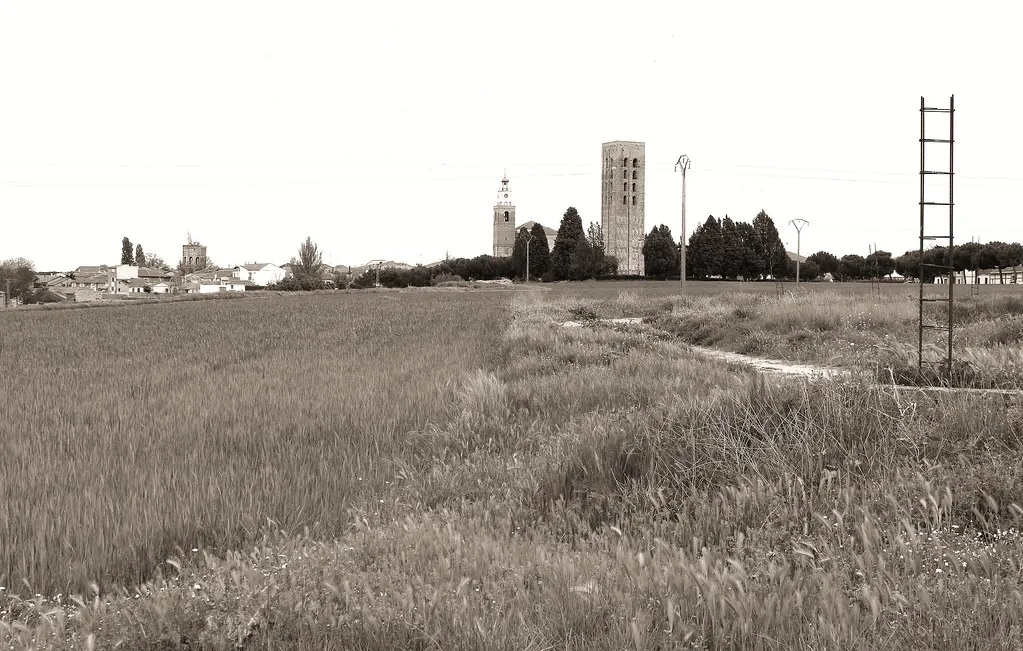
The parish church retains the sober character of rural Romanesque architecture in the province of Segovia. Thick walls, a compact structure and a tower visible from the approach roads mark it out. It does not dominate the surrounding countryside, but it offers a clear reference point when arriving across the open fields.
Walking along the streets, the traditional working houses stand out. High gateways once allowed carts to pass through. Walls of irregular stone and mud enclose interior courtyards where much of daily life used to unfold.
In a few corners, dovecotes and small auxiliary buildings remain. They have not been restored or prepared for visitors. They are simply part of everyday surroundings, much like the livestock pens or the more recent agricultural sheds.
All around the village lies cereal farmland. In spring the countryside turns green. By summer the fields are golden and fine dust lifts from the tracks. At sunset the light drops low across the plain and lengthens the shadows of houses over the pale earth.
Tracks across the cereal fields
Several dirt tracks leave Tabanera La Luenga and link it with nearby settlements. They are straightforward routes, mostly flat, and can be covered on foot or by bicycle without much difficulty.
A slow walk makes the landscape of this part of the Campiña Segoviana easy to read. Large plots, straight cultivation lines and an expansive sky define the view. With a little patience it is common to spot birds associated with agricultural environments, particularly small birds of prey gliding low over the ground.
For anyone carrying a camera, the interest lies in details rather than landmarks. Worn wooden doors, cracked adobe walls, old machinery resting against a façade. In summer it is best to avoid the middle of the day. The heat on the plain can be intense and the light becomes harsh. Early morning or late afternoon work far better.
A small village, a steady rhythm
Local celebrations tend to gather in summer, when many residents who live elsewhere during the year return. The patron saint festivities are usually held in August. At that time the village sees more movement, with music, gatherings in the square and processions that move slowly through the streets.
For the rest of the year, life is quiet. Those who remain through winter follow routines closely linked to the fields and to the care of family houses. There is very little commercial activity. Anyone planning to spend several hours in the area should arrange food or accommodation in nearby villages.
Tabanera La Luenga is not presented as a place of major monuments or lengthy sightseeing. It works better as a pause, a way to understand what these elongated villages of the Campiña are like: few streets, a wide horizon and the constant sound of wind moving through the cereal.
Getting there and choosing the moment
Tabanera La Luenga lies in the Campiña Segoviana, a little over half an hour by car from the city of Segovia, reached by local roads that run between cultivated fields. Access is straightforward, and it is easy to park along the wider streets of the village.
Those who want to see it at a calm pace should aim for the first hours of the day or towards sunset. At midday, especially in summer, the sun falls directly onto the plain and there is barely any shade.
This is a place defined by space and routine rather than by attractions. A short stop is enough to grasp its character: a long line of houses, working buildings that still reflect agricultural life, and fields that stretch outward in every direction.