Full Article
about Tolocirio
On the border with Ávila and Valladolid; noted for its Romanesque-Mudéjar church.
Hide article Read full article
A place you don’t plan for
Some places sit firmly on an itinerary. Others appear when you take a wrong turn on a local road and decide to keep going. Tolocirio belongs to that second group. It is a very small settlement in the Campiña Segoviana, with only a few dozen residents, where daily life still revolves around the land rather than weekend visitors.
There is little here aimed at people arriving from elsewhere. The streets are few and short. Walking through them, it is easy to pass someone stepping out onto their doorstep or returning from the fields by car. Conversations drift around the weather, the harvest, how much rain has fallen this year. The same kind of exchanges repeated over decades.
The houses combine adobe, pale stone and curved roof tiles. There is no attempt at decoration. These are homes built for living in, not for display. At the centre of the village stands the church of San Pedro. From the street it feels larger than expected for such a small place, with solid stone and thick walls. Inside, everything is quite restrained. A Baroque altarpiece adds a note of contrast to that overall simplicity.
Walking out into the fields
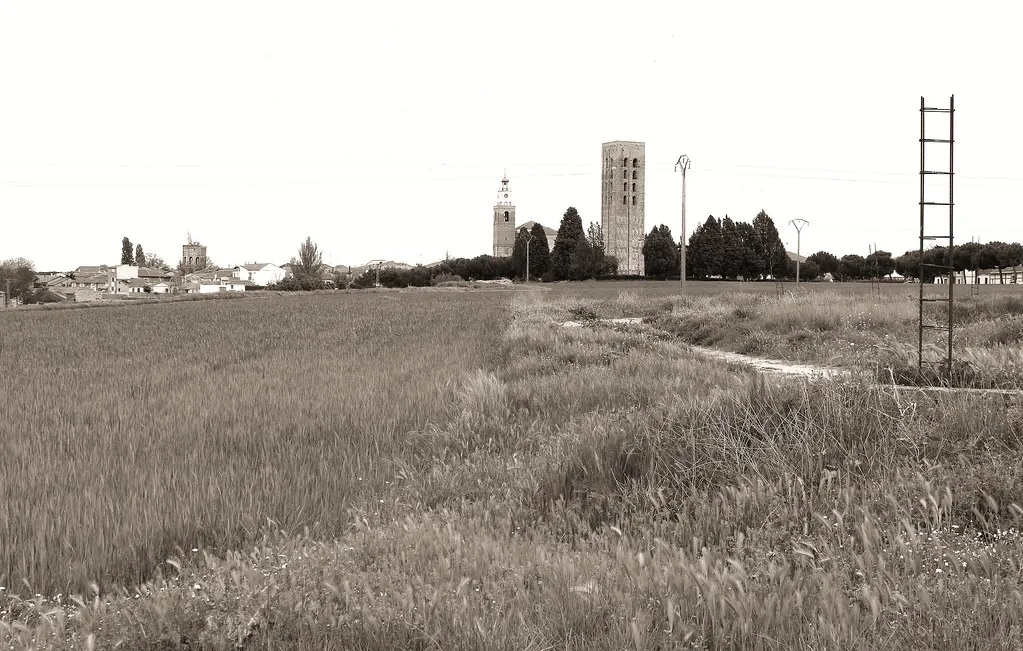
The landscape around Tolocirio is direct and unembellished. Open fields, dirt tracks and long horizons define it. There are no marked walking routes or viewpoints with railings. Instead, there are agricultural paths linking this village to others nearby, some of them equally small.
For anyone who enjoys walking, it is enough to pick a path and follow it. Within minutes the village falls away and the surroundings turn into cereal fields. In summer, the wheat creates a pale band that can be seen from any corner of the settlement. At other times of year, the colours shift quickly, sometimes from one week to the next.
At the edges of the tracks, poppies appear from time to time. On hotter days, dry tumbleweed rolls across the ground when the wind picks up. It is not a landscape that aims to impress. Yet there is something familiar about it, like seeing an old photograph of the Spanish plateau and recognising that it still looks much the same.
Birdlife across open land
This part of Segovia also draws steppe bird species. With binoculars and some patience, it is possible to spot great bustards, known in Spanish as avutardas, or sandgrouse, called gangas, moving between the fields. There are no facilities set up for birdwatching and no information panels explaining what you are seeing. It happens simply because the land remains agricultural and largely open.
That absence of infrastructure shapes the experience. Encounters depend on timing, quiet observation and a bit of luck rather than on designated viewpoints.
Eating and planning ahead
Tolocirio itself has no bars, restaurants or shop. It is worth being aware of that before setting out. The usual approach is to stop for a meal in one of the larger villages nearby or head towards places where services are available.
The food associated with this area comes straight from the surrounding countryside. Dried pulses from the province, cereals and livestock all play their part. In nearby villages, it is common to find dishes based on beans or cheeses produced in the Duratón area, a neighbouring region known for its agricultural output.
Festivities and the pace of the year
The main local festivities take place in August. At that time, some residents who live elsewhere return, and the village becomes a little more lively. There are processions, shared meals and gatherings of families who have known each other for generations.
Outside those days, the rhythm of the year is set by the agricultural cycle. Sowing, harvesting, tractors moving in and out of the village. Not much else happens, and there is no real sense that anything more is needed.
When to come
Spring and autumn tend to be comfortable times for walking along the agricultural tracks. In summer, the sun is strong and there are few shaded spots beyond the village itself. Winter makes its presence felt with dry cold and wind that crosses the open fields without obstruction.
Tolocirio can be covered quickly. In about an hour, it is possible to walk through all its streets. The interest lies less in ticking off sights and more in understanding the place. It is a village that continues to function much as it always has, without adjusting itself too much to outside curiosity. That, in itself, says quite a lot.