Full Article
about Villeguillo
Village on the steppe with seasonal lagoons; crossed by the Cañada Real
Ocultar artículo Leer artículo completo
The only sound on the approach road is tyres crunching over fallen pine needles. Then the village appears—stone houses huddled round a modest church tower, the whole ensemble levitating 760 m above the surrounding plateau. Villeguillo sits so squarely in the middle of nowhere that even Spaniards need a second to place it: Segovia province, southern tip of the Tierra de Pinares, 24 km from the nearest petrol station.
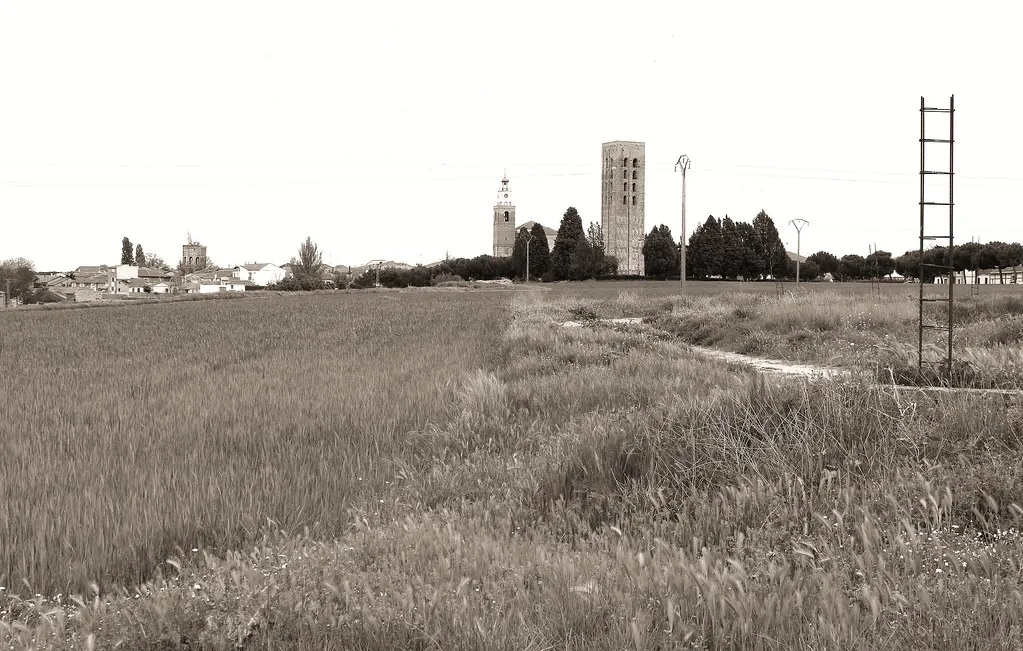
A landscape that forgets to undulate
The Campiña Segoviana doesn’t do drama. It stretches, it yawns, it occasionally rolls like a sleeper turning over. From the village edge the view is a chessboard of cereal plots—green wheat in February, gold stubble in July, brown furrows in November—broken only by the dark green spears of stone pines. There are no dramatic sierras, no river gorges, just horizon on horizon and a sky that feels fractionally bigger than regulation size. Photographers arrive hoping for postcard moments and leave with memory cards full of sky; the land is so flat that sunrise and sunset last half an hour each, the clouds lit from below like slow-burning coals.
Walking options follow the agricultural grid. A morning loop south-east on the camino vecinal to Coca gives you 8 km of sandy track between wheat and fallow, with crested larks for company and the occasional tractor raising a dust plume. Stout shoes are advisable: the surface is part sand, part pea-sized gravel left over from centuries of grain cleaning. There is no shade; carry more water than you think reasonable—temperatures touch 38 °C in July and the breeze only dries sweat faster.
Stone, adobe and the winter wind
Villeguillo’s houses are built for thermal swings. Walls a metre thick, timber doors painted the colour of dried blood, and tiny upper windows set deep into the stone all speak of a climate where nights can be 20 °C cooler than the day. Many roofs still carry the original curved terracotta tiles, heavy enough to resist the wind that scours the plateau from October to April. The overall palette is earthy rather than pretty: ochre plaster, grey granite corners, the occasional surprise of sky-blue balconies left over from a 1980s facelift. Tourists looking for honey-coloured quaintness will be disappointed; the village makes no concessions to Instagram.
Inside, the layout is defensively simple. A front door opens straight onto a short hallway that once gave access to stable, kitchen and grain store; upstairs, one large room provided sleeping space for the entire family during winter when the ground floor was given over to animals. Several houses retain the original bodega hatch—a square hole in the floor leading to a hand-dug cellar where wine was kept at a steady 12 °C. Peek through the grill and you may still see the clay tinaja half-buried in beaten earth.
What passes for a centre
The Plaza de la Constitución measures barely 25 m across. One bench, one stone cross, one locust tree that lost a fight with lightning twenty years ago and has grown back at a tipsy angle. The bar, Casa Roque, opens at seven for the farmers’ breakfast—coffee with a splash of anis, chunk of fried pork belly, bread rubbed with tomato and a price tag of €2.80. It is also the village shop: tinned tuna, torch batteries, balls of yarn and, behind the counter, a ledger where regulars still chalk up credit. Close at noon on Monday and you’ll walk hungry until Thursday; the nearest alternative is in Coca, a 25-minute drive on a road shared with wild boar after dusk.
Opposite the bar stands the parish church of San Miguel. The façade is 16th-century plateresque tacked onto a 12th-century nave, the bell-tower rebuilt in 1948 after a lightning strike. The interior is dim, echoing and almost barren: a single polychrome altar piece, two side chapels with peeling frescoes, and a 14th-century font so shallow that babies were obviously more compact in the Middle Ages. Mass is held at eleven on Sunday; turn up any other day and the sacristan—who lives three doors down—will lend you the key if you can pronounce “clave” without sounding English.
Eating without flourish
There is no restaurant, no tasting menu, no chef interpreting grandmother’s recipes through a foam gun. Instead, ask at the bar by Thursday morning whether anyone is roasting a lamb at the weekend. If the answer is yes, you’ll be handed a scrap of paper with a mobile number. Call after nine that evening, walk round to the house with the green gate, and you’ll be served lechazo castellano—milk-fed lamb slow-roasted in a wood-fired clay oven—alongside the family. Going rate is €18 a portion, wine included; vegetarians receive a plate of pisto and an apology.
Winter brings the matanza, the home slaughter of a pig. Visitors who flinch at the sight of blood should stay away in January; those curious about food provenance can watch every stage, from the first shot to the final looping of sausages over the kitchen rafters. The reward is a bowl of chorizo fresh from the pot, still warm and tasting faintly of smoked paprika and mountain oak.
When to come, and when to stay away
April and late September give you mild days (18–23 °C) and cold nights that smell of wet thyme. Spring adds green lupin strips between the wheat; autumn paints the stubble fields copper and brings migrant cranes overhead, their rattling call audible long before you spot the V formation. Accommodation is the obstacle. There are no hotels, no rental cottages, nowhere officially to sleep. Pilgrims on the Camino de Madrid sometimes doss down on the school floor—ask the mayor’s office for the key—but most walkers press on to Coca where there is a hostel. Day-trippers base themselves in Segovia (45 minutes by car) and drive in for the afternoon.
Avoid August. The village empties as families retreat to ancestral houses in the mountains; the bar reduces to holiday hours and the only other humans are German motorcyclists following GPS tracks across the plain. January and February bring razor wind and the occasional snow flurry that melts by lunchtime but leaves the dirt roads impassable without four-wheel drive.
Leaving without a souvenir
There is nothing to buy beyond a bottle of local anis or a packet of garbanzos grown two fields south of the church. Villeguillo offers instead a calibration check for urban clocks: the realisation that an entire morning can pass with no sound louder than a pigeon landing on the church roof, that bread tastes better when the wheat was threshed within sight of the table, that flat country can feel mountainous if you simply stop walking and listen. Drive away and the village shrinks instantly in the rear-view mirror, swallowed by the cereal ocean. Ten minutes later the asphalt straightens, the radio regains signal, and the 21st century resumes.