Full Article
about Alconaba
Municipality near the capital, surrounded by cereal fields and low hills.
Hide article Read full article
A village on the Sorian plateau
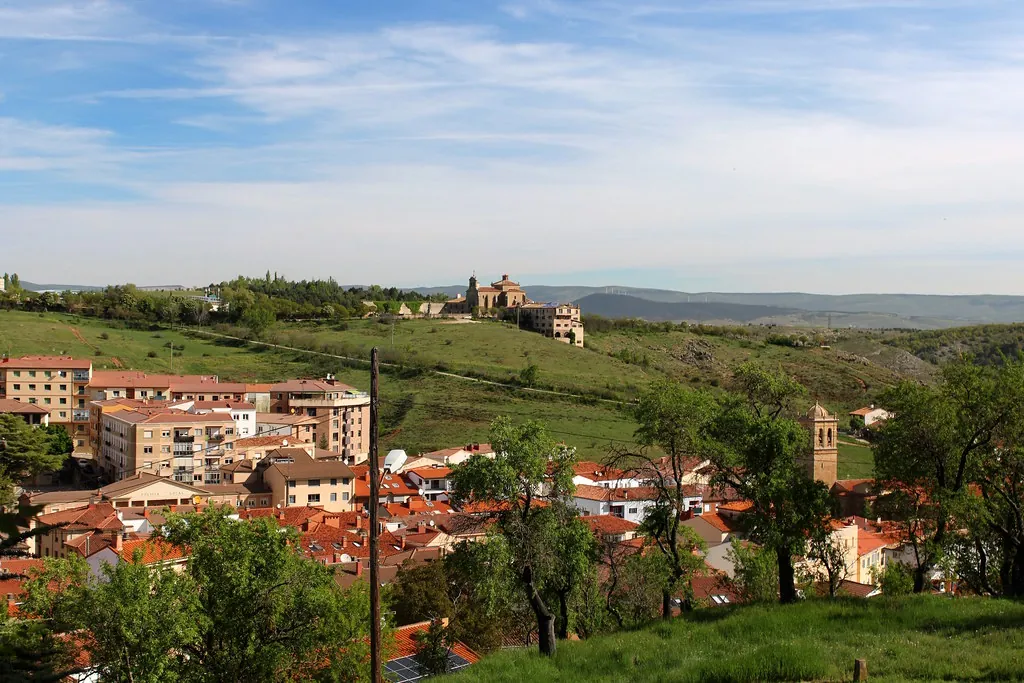
Alconaba sits at the northern edge of the province of Soria, within the comarca known as Campo de Gómara. The village stands on a high plateau at around 1,000 metres above sea level, part of a landscape that defines much of inland Soria. Wide cereal fields stretch out in every direction, broken only by occasional holm oaks and the long, uninterrupted line of the horizon.
Agriculture has shaped this setting for centuries. The surrounding land still reflects that history, even though the village today has a small population of fewer than 200 people. Life here remains closely tied to the rhythms of the land, and the layout of the territory continues to follow agricultural needs.
Alconaba lies away from the province’s more travelled routes. That relative isolation helps explain why the village has retained a built form that is still recognisable across this part of Castile. The streets and buildings reflect continuity rather than reinvention.
The church at the centre
The parish church of the Visitación is the main landmark. Its origins date back to the 16th century, with later alterations, probably in the 18th century, that reshaped parts of the structure. Like many churches in Soria’s rural areas, it has a restrained appearance. Built in masonry, its volumes are simple and solid rather than elaborate.
Inside, there are altarpieces and decorative features linked to the rural Baroque style found across the region. These elements connect the church to a wider artistic tradition, though always adapted to the scale and resources of small communities.
The layout of Alconaba radiates from this building. Moving through the village streets, the organisation becomes clear. Houses cluster around the church and extend outwards, forming a compact nucleus shaped by practical needs rather than formal planning.
Houses, materials and everyday architecture
The streets reveal features typical of the Campo de Gómara. Many houses are built with thick walls, designed to protect against the cold winters of the plateau. Windows tend to be small, conserving heat, while roofs are covered with tiles and punctuated by distinctive conical chimneys.
Construction materials are simple and local. Masonry and adobe dominate, giving the buildings a muted, earthy appearance that blends into the surrounding landscape. Alongside the houses, there are corrals and agricultural spaces that reflect the village’s long connection to farming.
Some streets remain unpaved, with stretches of earth rather than asphalt. This detail adds to the sense that the village has changed gradually rather than undergoing major transformation.
Beneath certain houses lie underground cellars. These spaces, excavated below ground level, were traditionally used to store wine and food. Their presence points to a time when small vineyards existed in the area, something that has largely disappeared today. Even so, many of these cellars are still used on a domestic scale, maintaining a link with past practices.
The open landscape of the meseta
The surroundings of Alconaba are defined by cultivated fields that shift in appearance with the seasons. In spring, cereal crops cover the rolling ground in a consistent green. By summer, the palette turns to yellows and ochres as the fields dry under the sun.
Between the cultivated plots, patches of holm oak woodland appear, along with small ravines that interrupt the otherwise even surface of the plateau. These variations break the uniformity and add subtle contrasts to the landscape.
From the edges of the village, the characteristic parameras of Soria are easy to recognise. These are high, open expanses typical of the province, marked by their breadth and exposure. On clear days, visibility extends for many kilometres, a common feature of this type of terrain.
The low population density becomes especially noticeable at night. With little artificial lighting, the sky is often clear when clouds are absent, allowing for unobstructed views overhead.
Tracks, walks and quiet routes
A network of agricultural tracks spreads out from Alconaba, used primarily by farmers to reach their fields. These paths also offer opportunities for walking or cycling, particularly for those interested in understanding the landscape of the Campo de Gómara.
They are not signposted routes, and intersections can be confusing without guidance. A map or GPS is useful when exploring beyond the immediate surroundings of the village.
The flat terrain makes for gentle routes without significant changes in elevation. Movement across the plateau tends to be steady and unhurried. Along the way, it is common to spot birds typical of these cereal-growing areas. Larks are frequently seen, as are birds of prey that take advantage of the air currents above the open fields.
Traditions and moments of return
Local traditions in Alconaba are closely tied to its calendar of festivities. These are usually held in summer, when many former residents return for a few days. The celebrations combine religious events with activities organised by the villagers themselves.
In a place with such a small population, these gatherings take on particular importance. They serve as moments of reunion, when the village briefly recovers the livelier atmosphere it once had decades ago.
During these periods, the quiet rhythm of everyday life shifts. Streets that are often still become more animated, and the sense of community becomes more visible. Even if only temporarily, the population grows and the village reconnects with those who have moved elsewhere.
Alconaba remains a place shaped by its environment and its past. Its buildings, its landscape and its traditions all reflect a continuity that has adapted slowly over time, without losing its essential character.