Full Article
about Castrillo de Duero
Bordering Segovia and birthplace of El Empecinado; set at the foot of Pico Cuchillejo with a wine-growing tradition.
Hide article Read full article
A pause in the Ribera del Duero
Some places are built for lingering, others work better as a pause along the way, like pulling over on a quiet roadside and realising the view alone was worth it. Castrillo de Duero sits somewhere in that second category. With just over a hundred residents and surrounded by vineyards in the Valladolid stretch of the Ribera del Duero, life here follows the rhythm of the harvest, the winter cold and the pruning of the vines rather than any tourist calendar.
There are no major landmarks or streets lined with shops. What you find instead is a working agricultural village, one that still lives from the land and from wine. It also happens to be very close to Peñafiel and its well-known castle, so many people pass through while exploring the wider area.
Walking through the village
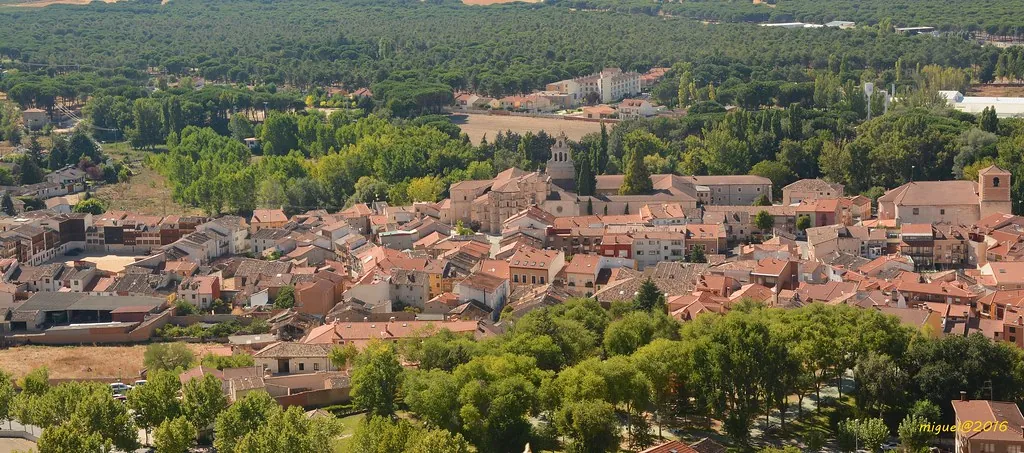
The centre is small and easy to cover in a short stroll. Stone and adobe houses line the streets, with wide gateways once built for carts and façades that mix recent updates with walls that have been standing far longer. Streets rise and dip gently, and sooner or later a tractor will appear, part of the everyday scene.
The parish church acts as a reference point. It is not a monumental building, but it helps you get your bearings. From several streets you can see it peeking above the rooftops, a simple way to know where you are within the village.
Looking more closely reveals small details that might otherwise go unnoticed. Old wooden doors, ventilation openings in façades that hint at what lies below, and entrances that are half hidden. Beneath many houses are underground wine cellars, known locally as bodegas, dug into the earth. This is a common feature in this part of Valladolid. For generations they were used to store wine and food, taking advantage of the constant temperature below ground. Some are still in use today, although most are not open to casual visits.
Step beyond the last houses and the landscape takes over. Vineyards stretch out in all directions. In autumn the valley shifts in colour, with vines turning shades of red and gold and the land forming a broad patchwork. From some of the higher tracks, on clear days, the outline of Peñafiel castle appears in the distance.
Paths across vineyards and open land
Several agricultural tracks branch out from Castrillo and can be followed on foot or by bike. This is not a place of high peaks. The terrain rolls gently, with steady rises and dips between vineyard plots, the occasional holm oak and open stretches where the wind can be strong.
Early in the morning or towards sunset, birds of prey are often seen gliding over the fields. Partridges are also common here, part of the everyday wildlife rather than something unusual.
The Senda del Duero, a long-distance path that follows the course of the River Duero, passes relatively close by and links several riverside villages. It is often combined with short climbs towards the nearby plateaus, known as páramos, which changes the scenery without requiring complicated routes. One moment you are near the river environment, the next you are on higher, more exposed ground.
Wine culture and nearby villages
Castrillo de Duero sits firmly within the Ribera del Duero, one of Spain’s best-known wine regions, so wine is not a staged attraction here but part of daily life. Vineyards, tractors and trailers loaded with grapes during harvest season form the backdrop.
For those looking for more structured visits, many travellers head to nearby towns such as Peñafiel, Pesquera or Roa. These places have wineries that receive visitors more regularly. Some are family-run, and it is often best to ask in advance or arrange a visit, as not all operate on fixed schedules.
Food in the surrounding villages follows a similar line of tradition. Around lunchtime, it is common to find roast suckling lamb, cordero lechal, cooked in a wood-fired oven and served with Ribera del Duero red wine. It is a classic pairing in this area and fits naturally after a morning spent on quiet roads and tracks among the vines.
Castrillo itself remains understated. It does not try to draw attention or compete with larger destinations nearby. Instead, it offers a brief, grounded look at a landscape shaped by agriculture and wine, where the pace is set by the seasons and the work that comes with them.