Full Article
about Quintanilla de Onésimo
A key wine town on the Duero, noted for its Renaissance bridge and Golden Mile wineries.
Hide article Read full article
A village that appears between the vines
There is a particular moment on certain roads through Castilla y León when the landscape feels endless. Vineyards stretch out on either side, the horizon sits low and wide, and then a village appears as if it has always been there. No dramatic entrance, no grand announcement. That is the first impression of Quintanilla de Onésimo.
It sits within the Ribera del Duero, one of Spain’s best-known wine regions, yet the atmosphere is different from places that have leaned heavily into wine tourism. Here, the emphasis still feels firmly on daily work rather than on staged experiences. Many residents make their living from the vineyard or from agriculture more broadly, and that steady routine shapes the mood of the place.
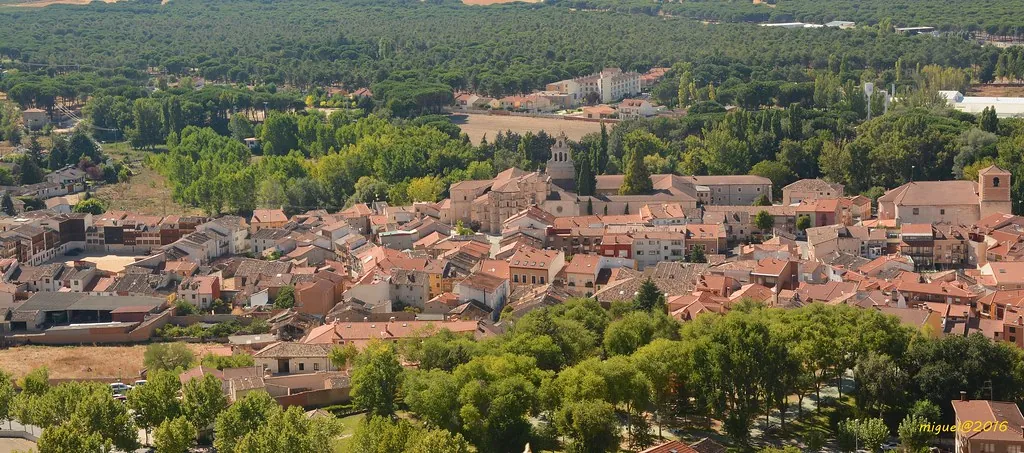
Quintanilla de Onésimo stands at around 726 metres above sea level, between the Duero valley and open fields that seem to run for miles. The setting is expansive rather than dramatic. The village itself is straightforward in layout: narrow streets, houses built from adobe and stone, thick walls designed for the climate. Many homes have been restored, though without altering their traditional appearance too much. There are no showy façades demanding attention. Instead, the interest lies in how the houses fit together, in old wooden gateways, in the courtyards half glimpsed behind solid walls.
This is a place that makes sense quickly. A short walk is enough to understand what defines it: wine, farmland and a noticeable calm.
Walking through visible history
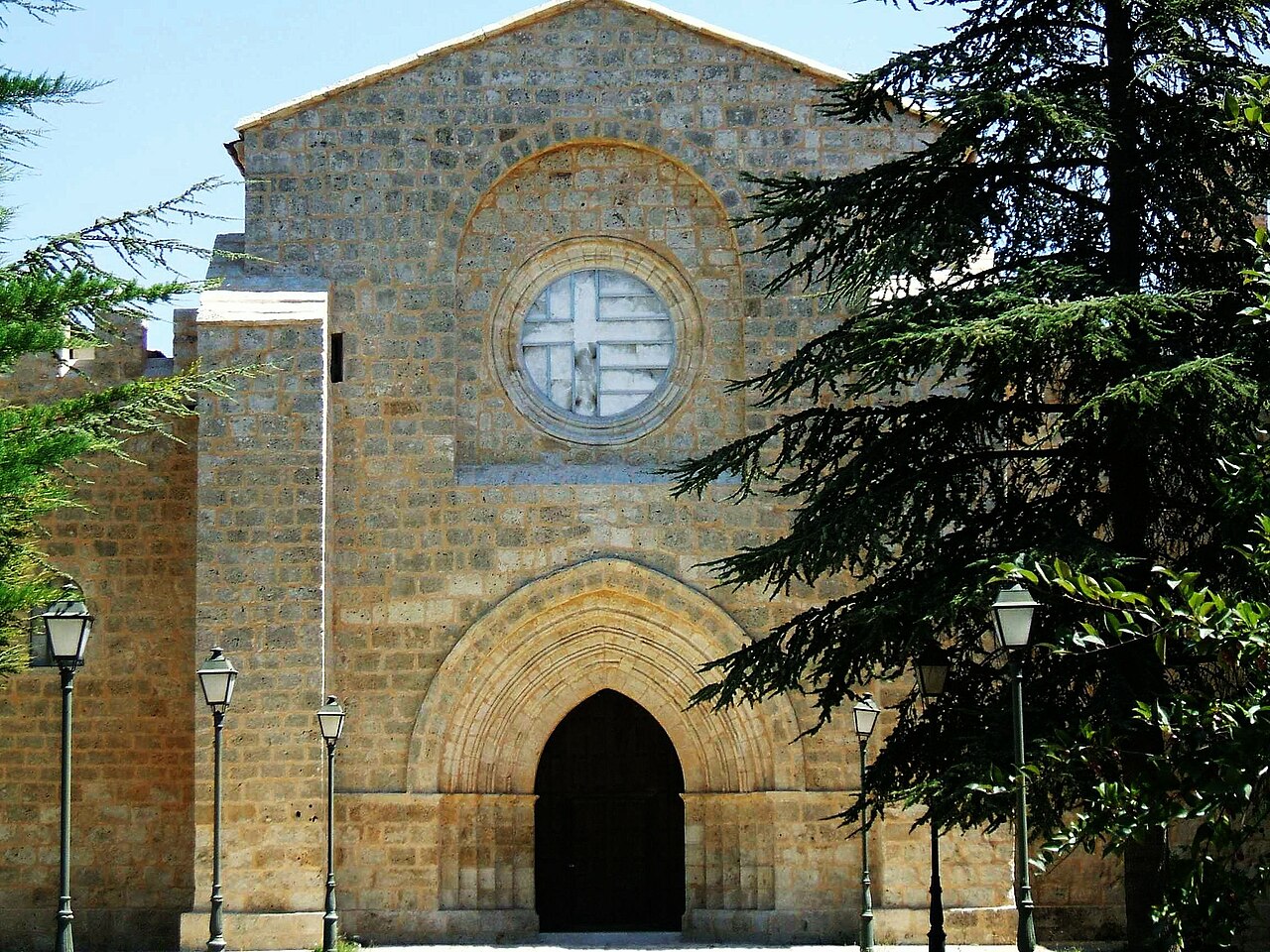
At the centre stands the church of San Pelayo. Its origins date back to the 12th century and are Romanesque, a style common in this part of Spain, although it has later additions. That mixture of periods is typical in villages across the region, where buildings have been adapted over centuries rather than rebuilt from scratch. The tower rises above nearby streets and works as a useful reference point when wandering through the older part of town.
Beneath the village lies another story, less visible but deeply connected to local life. A network of underground wine cellars has been carved into the earth. Many of them are old, though exact dates are not always clear. Some remain in use, while others open at specific times of year, particularly during the grape harvest or for gatherings of local groups. These cellars maintain a constant temperature, which has long made them suitable for storing wine.
Entering one of these caves is not always a formal tour. Often it is a matter of conversation. Someone explains how wine used to be made, or how it is produced now. The focus is practical rather than theatrical. Barrels are shown, differences between plots are discussed, and the pace remains unhurried.
Close to the built-up area, there are also remains of older constructions linked to historic paths and crossings over local streams. They do not form a monumental complex. Still, a walk around the outskirts reveals that Quintanilla de Onésimo has long been connected to agricultural and trading routes running through the Duero valley.
The historic centre itself can be covered quickly. A handful of cobbled streets, traditional houses, and the occasional stone arch or gateway that appears without warning. It rewards slow attention more than a checklist.
Vineyards in every direction
Step beyond the last houses and the vineyards take over. The surroundings of Quintanilla de Onésimo are defined by vines, and the landscape shifts noticeably with the seasons.
In spring the fields turn green and fresh. Summer brings the dry golden tones typical of the Castilian countryside, where the sun gives the land a pale, almost dusty quality. Autumn changes everything again. As the grape harvest approaches or comes to an end, the vines take on reds and ochres, and the valley looks different from one week to the next.
Agricultural tracks link the village with others in the valley. Some are used by walkers or cyclists, though they are not mountain trails or technical routes. They are simple paths between vineyards, with an open horizon ahead. Shade is limited, particularly in summer, so the conditions can feel exposed.
From several higher points near the village, the scale of the Duero landscape becomes clearer. Gentle slopes roll away towards the river basin. Vineyards extend across large areas. Small villages sit at intervals, separated by kilometres of cultivated land. The impression is one of space and continuity rather than dramatic contrasts.
Wine without spectacle
Being in this part of the Ribera del Duero makes it easy to find a winery, though experiences vary depending on where you end up. Not every bodega offers structured visits or carefully prepared tours. In some cases, the encounter is simple: a look at the workspace, a glimpse of the barrels, a discussion about how different vineyard plots produce different characteristics in the wine.
The dominant grape variety here is tempranillo, which forms the base of most wines in the area. Its presence shapes both the local economy and the identity of the landscape. Rows of vines are not decorative. They are central to everyday life.
Food follows the same practical logic. Traditional Castilian cooking is hearty and designed for people who have spent the day outdoors. Dishes such as lechazo al horno, roast suckling lamb typical of the region, sit alongside substantial soups, cured sausages and cheese. The flavours are direct and rooted in local produce.
Quintanilla de Onésimo works best with the right expectations. It does not offer a long list of major monuments or a packed cultural calendar. Its appeal lies elsewhere. A pause on a quiet street, a short walk past stone houses, a view over vines that have shaped the valley for generations. Within a few minutes, the character of the place becomes clear.
This is a village tied closely to the Duero and to the rhythms of viticulture. The absence of spectacle is part of its identity. For those interested in how wine regions function beyond their labels, and how rural communities continue to revolve around the land, Quintanilla de Onésimo provides a straightforward, unpolished glimpse of the Ribera del Duero. Often, that is more than enough.