Full Article
about Roturas
Tiny village in the Duratón valley; known for its church and total quiet.
Hide article Read full article
The wind arrives first. In Roturas it is often heard before anything else comes into view: a steady brush against stubble, against adobe walls, against the metal sheets of a shed. As afternoon begins to fade, the village seems almost still. Roturas has just over two dozen residents and a handful of streets where silence does not feel unusual, only ordinary.
A family chats by a doorway. Dogs lie close to a wall, holding on to the last strip of shade. Beyond that, there are fields.
A small village in the Campo de Peñafiel
Roturas belongs to the Campo de Peñafiel, in the province of Valladolid. The approach follows a quiet road between cultivated land. There are no roundabouts or grand entrances. Just a turning, a little dust in summer and the sense of entering a place that has never been in a hurry.
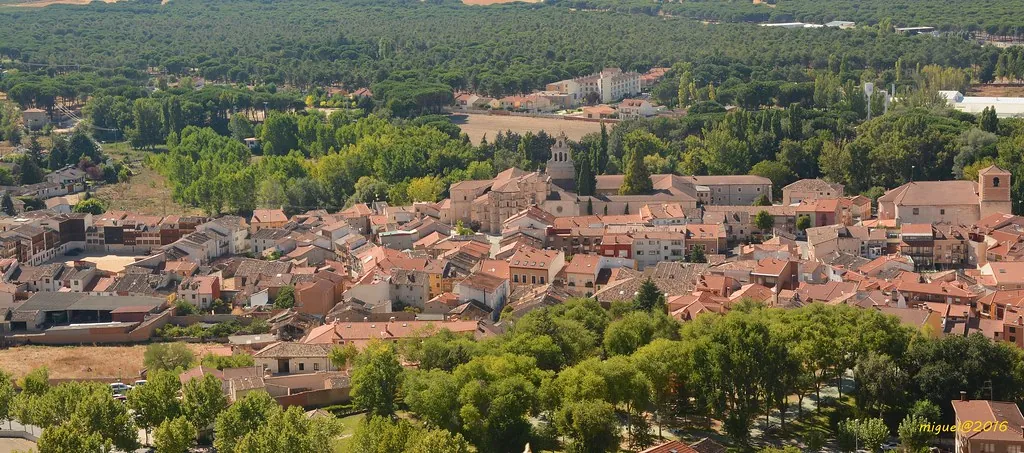
Many of the houses are built in tapial and adobe, traditional techniques using compacted earth and sun-dried bricks. The walls are thick, designed to withstand long winters and dry summers. Some façades still carry that earthy tone which shifts with the light: muted grey in the morning, more reddish as the sun lowers.
With a population of around 26 inhabitants, daily movement is minimal. It helps to arrive knowing that. There are no open shops and no services arranged for visitors. Roturas functions on its own terms, at its own pace.
The layout is simple. A few streets, low houses, open sky. Nothing distracts from the landscape pressing in on every side.
The church of San Esteban
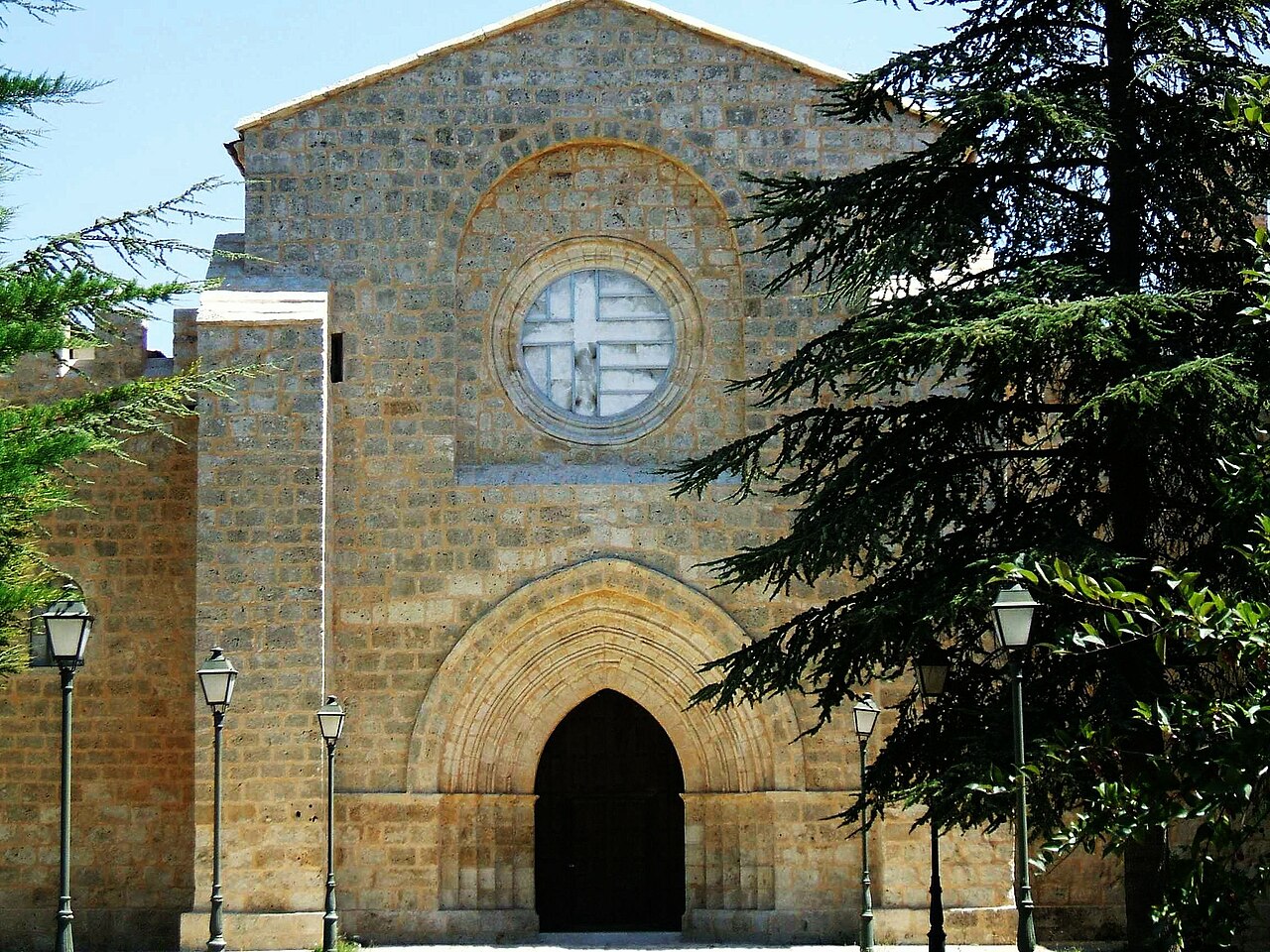
At the centre stands the church of San Esteban. It does not tower dramatically above the village, yet its square bell tower can be seen from almost any street.
The current building is generally dated to around the 16th century, although it has undergone repairs over time. Inside, the atmosphere is restrained. Thick walls, sparse ornamentation and that cool half-light which feels welcome in summer. For generations this was the place where the village gathered for nearly everything: Mass, announcements, meetings.
It still sets the rhythm of Roturas, even if the calendar is now much quieter. In a settlement of this size, the church is less a monument than a point of reference, something constant in a place where change comes slowly.
The landscape around Roturas
Step beyond the last cluster of houses and the páramo begins. The word refers to a high, open plain typical of parts of inland Spain. Here it means clay soil, cereal fields and a wide horizon. There are no mountains or forests to close the view. Instead there are straight lines of plots and the occasional farm track disappearing between crops.
In spring the air carries the scent of young grain and damp earth. Summer turns the fields a dry yellow. Autumn brings ochres and reddish tones that cling to the dust on the paths.
It is an austere landscape. Yet when the sky shifts, with low clouds, a distant storm or the clear blue of cold days, everything sharpens. Light and weather shape the scene more than any building could.
The openness can feel almost overwhelming at first. There is little to interrupt the eye. Over time, subtler details emerge: the slight undulation of the land, the changing texture of the soil, the way wind moves across the surface of the crops.
Walking the agricultural tracks
Several rural tracks lead out directly from the village. They are not marked as hiking routes. These are working paths used by farmers to reach their plots.
Some run between fields of wheat or barley. Others pass near old agricultural buildings that have not been used for some time. Now and then a tractor can be heard working slowly in the distance.
Anyone planning a walk would be wise to carry a map or GPS. Crossroads look very similar to one another, and it is easy to lose direction when the terrain is so uniform.
In the more open stretches, field birds are common. Larks, pipits and the occasional bird of prey circle high once the air begins to move. Their presence adds movement to an otherwise restrained scene.
Walking here is less about reaching a viewpoint and more about adjusting to the scale of the plain. The ground is firm, the tracks straightforward, but the horizon seems to recede with every step.
When to come and what to bear in mind
Roturas changes noticeably with the seasons. In winter the wind cuts through the streets and days can pass with barely anyone outside. Summer brings a little more life when residents who live elsewhere return for a time.
During that period the festival linked to San Esteban usually takes place. It is not a large event. Rather, it is a village gathering: Mass, traditional music at some point during the day and a shared meal among neighbours and relatives. In a community of this size, celebration is measured and close-knit.
A visit to Roturas works best when combined with other stops in the Campo de Peñafiel or with a trip to Peñafiel itself, which lies a short distance away and has more activity. Roturas can be covered quickly. Half an hour is enough to walk its streets.
The real interest, however, lies in staying a little longer. Listen to the wind moving across the plain. Watch how the light shifts slowly over earthen walls. The landscape speaks quietly here, and it requires time.
Roturas does not offer attractions in the usual sense. What it offers is space, continuity and the experience of a village shaped by climate and land. In a region where distances are wide and settlements are small, it stands as one more example of rural Castilla Leon: modest in scale, defined by earth and sky, and untroubled by the need to impress.