Full Article
about Berlanga del Bierzo
Municipality in a transitional mountain area, known for its chestnut forests and old coal mines.
Hide article Read full article
A hillside village shaped by land and climate
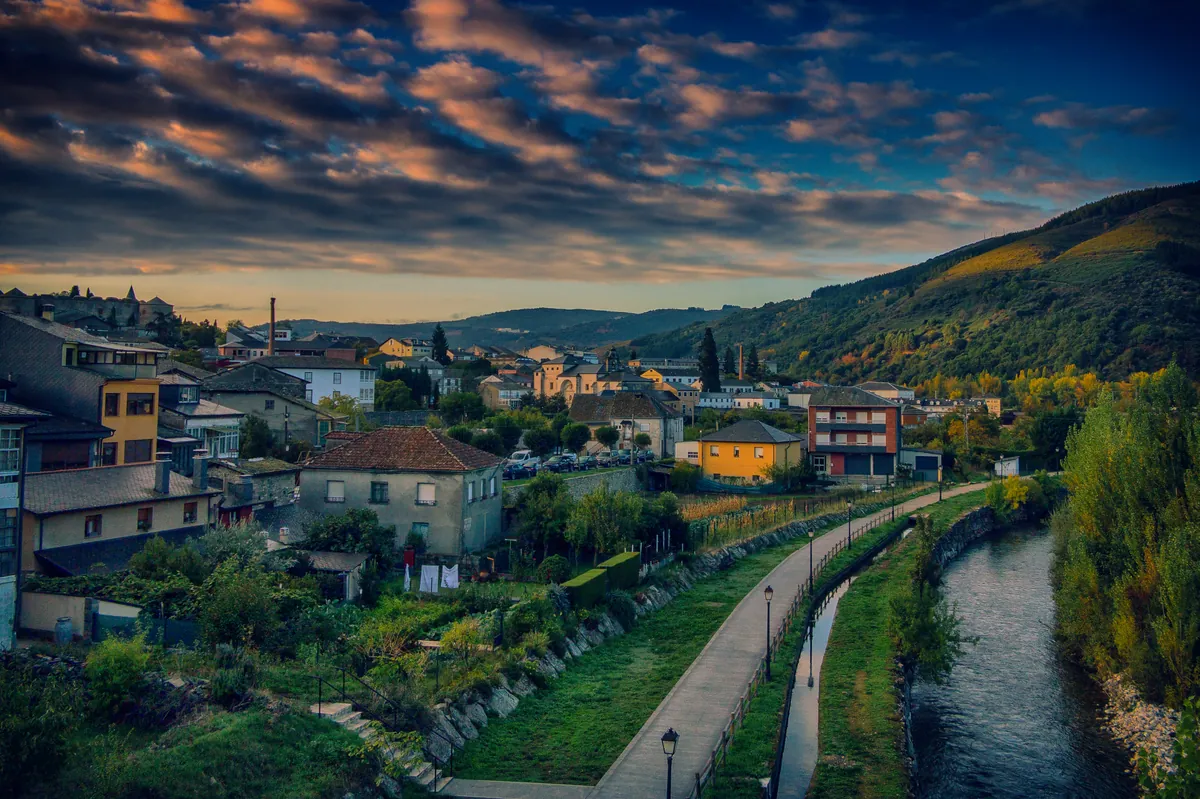
Tourism in Berlanga del Bierzo starts with a simple question: where exactly is it? The village sits on the southern slope of the mountains of El Bierzo, in a landscape where chestnut groves and vineyards have shared the hillsides for centuries. With just over 300 residents and an elevation of around 800 metres, it remains closely tied to agricultural life. Its layout reflects that reality rather than any aesthetic ambition: narrow streets, stone-built houses and slate roofs designed to cope with the local climate.
Berlanga belongs to the wine-producing area of El Bierzo, although vines are only part of the picture. Chestnut trees cover much of the surrounding slopes and have long been a key resource for the local economy. Many soutos, the traditional managed chestnut groves, are still in use today. Activity increases noticeably in autumn, when the harvest begins.
Vineyards appear in small plots, often arranged on terraces or gentle inclines. The dominant grape variety here is mencía, well suited to poor soils and a climate marked by cold winters and dry summers. This combination of conditions shapes both the landscape and the rhythms of work throughout the year.
At the centre of the village stands the parish church of San Pedro. Its origins date back to the 16th century, although it has undergone later alterations. Like many rural churches in the area, it is restrained in style: thick stone walls, minimal decoration and a simple bell gable that serves both as a belfry and as a visual reference point within the village.
Houses, cellars and traces of rural life
Walking through Berlanga offers a clear sense of how domestic life was organised in an inland village of El Bierzo. Many houses still retain their original features, including masonry façades, wooden balconies and steep slate roofs built to withstand rain and winter snowfall.
Some properties include south-facing galleries designed to catch the sun, while others reveal small wine cellars carved into the rock or partially buried. These cellars were tied to family-scale wine production, a common practice in the area long before the current denomination of origin became established.
There are also remains of old lagares, traditional wine presses, as well as agricultural outbuildings attached to homes. Together they point to an economy that revolved almost entirely around the land: vineyards, kitchen gardens, chestnut groves and a small amount of livestock.
The overall impression is not of a place that has been reshaped for visitors, but one that still reflects its original purpose. The built environment follows practical needs, with materials sourced locally and structures adapted to seasonal demands.
The landscape beyond the streets
The immediate surroundings of Berlanga consist of agricultural tracks, meadows and patches of oak woodland interspersed with chestnut groves. Infrastructure has not heavily altered this terrain, so it retains the logic of older routes that once connected nearby villages and cultivation areas.
Some of these paths are now used for walking or exploring the hills, although they are not always signposted. In this part of El Bierzo, it is advisable to carry a map or a track if planning to go beyond the most obvious routes.
Autumn brings a noticeable increase in activity in the surrounding countryside due to the chestnut harvest. This is not simply a seasonal task but one that still holds importance for many households. The landscape, at that time of year, becomes more active without losing its essentially rural character.
Traditions that continue
Local customs in Berlanga remain closely tied to the calendar. Patron saint festivals are usually held in summer, when many families who have moved away return to the village for a few days. During this period, the streets regain a level of activity that is less visible at other times of the year.
Autumn centres on the chestnut harvest and on gatherings known as magostos. These are informal events, typically among family or neighbours, where chestnuts are roasted over an open fire and accompanied by the first wine of the season. Rather than being organised for visitors, magostos form part of the traditional rhythm of the region.
Holy Week is also observed, though in a modest way. As is common in small villages of El Bierzo, celebrations consist of short processions with participation mainly from local residents. The tone remains simple and closely connected to community life.
Getting there
Berlanga del Bierzo lies a short distance from Ponferrada, the main city in the comarca. The usual route is via the A-6 to reach Ponferrada, followed by regional roads that lead into the interior of El Bierzo.
The final stretch runs along local roads. These are generally quiet, though they include curves and changes in gradient typical of the area’s terrain.