Full Article
about Borrenes
Municipality near Las Médulas; landscape shaped by Roman history and ancient gold mining.
Ocultar artículo Leer artículo completo
At 550 metres above the Bierzo valley floor, Borrenes keeps a different clock. The first engine noise usually belongs to the baker’s van at half-seven; by eight the church loudspeaker crackles, plays a short hymn, and the village day begins. Visitors who stayed the night in the municipal albergue step outside blinking, phones held skyward, hunting for the single bar of signal that lets them WhatsApp home: “Still alive, still walking.”
The Geography of Quiet
The village sits on a shelf where the last granite ridges relax into slate-coloured soil and small vegetable plots. Chestnut and oak climb the slopes behind; in front, the land falls away to a patchwork of allotments, then the wider valley that feeds Ponferrada twenty minutes’ drive to the south. The altitude difference is modest by Pyrenean standards, yet it is enough to shave three or four degrees off the valley thermometer. In July that matters: you can walk the surrounding lanes at midday without wilting, something that cannot be said for the Camino Francés on the plain below.
Winter is a different contract. Night frosts arrive in October, and January can block the road up from Carracedelo with a hand-span of snow. The village is never cut off for long—local farmers keep a tractor with a plough at the ready—but if you are planning a Christmas escape, bring proper chains. The reward is air so clear that the Sierra de los Ancares looks an arm’s reach away, and a sky that stays dark enough to read Orion like a map.
What Passes for a Centre
There is no plaza mayor in the postcard sense, only a widening of the main lane where the church, the former school and the only bar face one another. The church of San Vicente is 16th-century at its core, patched in the 18th, re-roofed after a fire in 1973. Inside, the wood smells of beeswax and dust; outside, the stone is the colour of weathered cider. No ticket office, no audioguide, just a list of Mass times taped to the door and, on Saturday evening, a handful of parishioners who will greet strangers with the same nod they give their cousins.
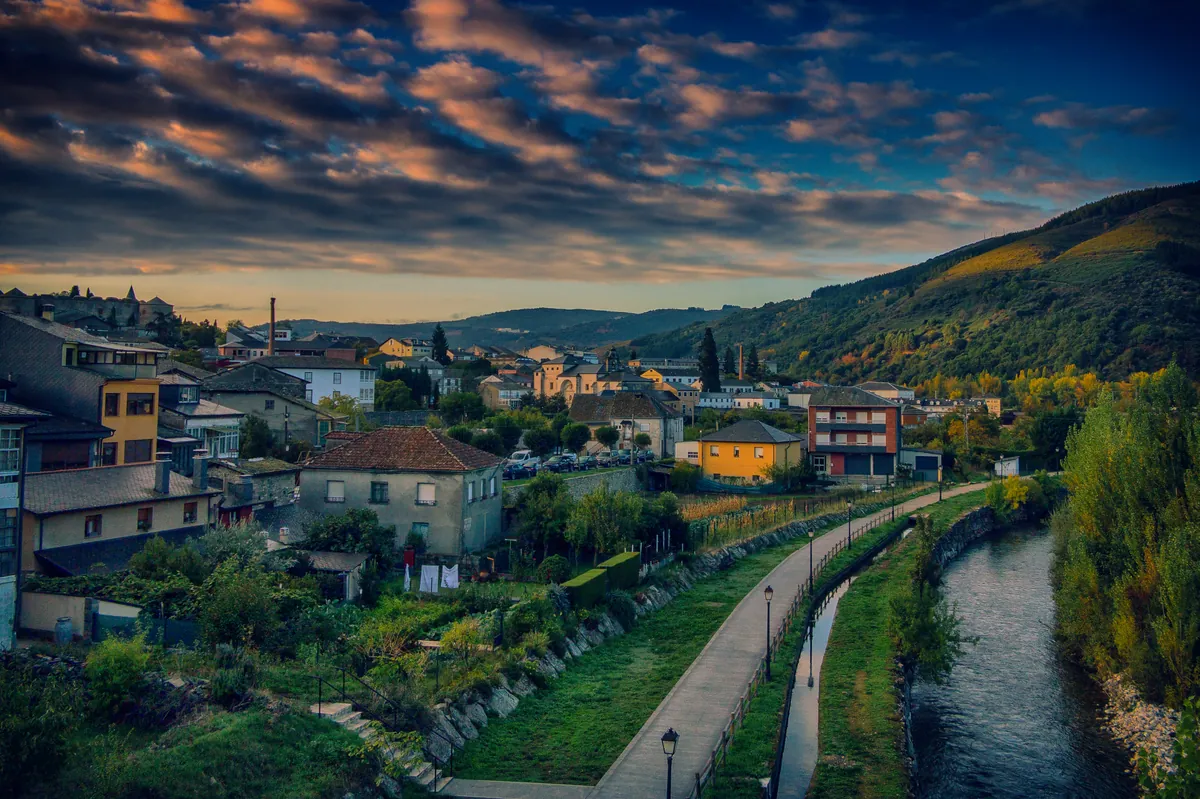
Most houses are two-storey, stone below, timber gallery above, balconies deep enough for a geranium pot and a chopping board of peppers left to dry. A few have been bought by weekending families from A Coruña or Madrid; their façades are suddenly immaculate, shutters painted a self-conscious teal. Walk fifty metres and you are back to flaking ochre, a cat asleep on a tractor seat, chickens negotiating the pavement. The mix is matter-of-fact rather than quaint, and none of the owners seem interested in offering artisan jam.
Eating (or Not)
The bar opens when the owner, Toño, gets back from delivering firewood. If the metal shutter is still down at eleven, knock at the house next door; his wife will ring him. Once inside you will find one tap running, three types of crisps, and a chalkboard that still advertises cocido even in August because nobody has bothered to erase it. What appears on your plate depends on what Toño’s sister has cooked for the family: perhaps a bowl of caldo with a slab of cabbage, perhaps a plate of chorizo de culín—the short, fat Bierzo sausage that needs no chewing. A glass of local Mencía costs €1.80; the wine comes from a cooperative in Valtuille and is lighter than most Riojas, the reason many British walkers describe it as “dangerously drinkable at lunchtime.”
If the shutter never rises, your options are the tins you carried in. There is no shop, no bakery, no cash machine. The nearest supermarket is in Carracedelo, 12 km down the hill; the nearest reliable restaurant is in Las Médulas, surrounded by coach parties photographing ochre cliffs. Stock up before you arrive, and bring euro notes—the albergue donation box does not accept Revolut.
Paths that Expect Boots
Three walking routes leave the village without ceremony. The shortest climbs north-east through chestnut woods to the tiny settlement of Compludo, where a 12th-century monks’ forge sits beside a stream just wide enough to cool a bottle of wine. Allow an hour up, forty minutes back; the path is signposted but rough, expect stones the size of cricket balls after rain.
A longer circuit heads south on the old camino real to Borrenes de Arriba, now a scattering of barns and a chapel kept locked except for the fiesta of San Blas. From there you can drop into the valley, cross the river Cúa on a steel girder bridge, and return along the lane that once carried Roman gold carts. The whole loop is 11 km, negligible ascent, good for birdwatching: black redstarts on the walls, Iberian magpies yelling from the vines.
The third option is to pick up the winter variant of the Camino de Santiago which passes straight through the village. Pilgrims usually skip it in summer, but in January it becomes a lifeline when the mountain pass at O Cebreiro is snowed under. If you meet walkers in February they will have muddy gaiters and grateful eyes; give way on the path, they have another 190 km to Santiago.
When the Village Decides to Wake Up
The last weekend of January is the fiesta of San Vicente Mártir. Emigrants drive back from Barcelona or Basel, cars polished and full of grandchildren. Friday evening starts with a torch-lit procession that is really just half the village carrying battery lamps and a brass band that has rehearsed twice. Saturday is the comida del pueblo: long tables in the school patio, €12 a ticket, bowls of callos (tripe) followed by botillo, the local stuffed pork parcel that weighs in at roughly a kilo per serving. Vegetarians should claim they are fasting; nobody will believe you, but they will find you cheese.
At dusk the bar relocates its sound system to the doorway, and couples who last danced together in 1983 attempt a pasodoble. Midnight brings a fireworks display that three teenagers set off from a wheelbarrow. The noise ricochets off the granite and sets every dog in the valley barking; if you are staying in the albergue, accept that sleep is cancelled. By Sunday lunchtime the cars are loaded, cheeks kissed, and Borrenes slips back into its weekday skin before the sun has cleared the ridge.
Getting Here, Getting Out
Fly to Madrid or Santiago, then take the high-speed train to Ponferrada (2 h 40 min from Madrid, 1 h 45 min from Santiago). From the station a rural taxi charges €45–50 to Borrenes; book in advance because drivers do not wait on spec. There is no bus, and Uber does not recognise the postcode. If you are hiring a car, the A-6 from Madrid is fast but toll-free only until Benavente; after that the autopista charges €12.50, or you can duck onto the old N-VI and add twenty minutes.
Accommodation is limited. Casa Rural San Vicente has three doubles and a twin, €65 a night including towels, Wi-Fi that flickers when someone microwaves supper, and a terrace that catches the evening sun. The municipal albergue (donation €8, mattress, blanket, kitchen) has 14 beds; ring when you see signal, leave your name on the list taped to the door, and pay in the honesty envelope. If both are full, the nearest hotel is in Las Médulas—close for geography, a world away in atmosphere.
Worth It?
Borrenes will not change your life. You will not find a Michelin plate, a Roman theatre or a gift shop selling recycled slate. What you will find is a place where the post van still merits a pause in conversation, where the evening light turns the stone walls the colour of English Cotswold honey, and where a stranger asking for water is given wine instead. Come for two nights, walk the chestnut woods, eat what is put in front of you, and leave before the village reverts to mistrust of outsiders. That moment is still a generation away, but it is coming—Teal shutters seldom lie.