Full Article
about Oencia
Municipality bordering Galicia in the Sierra de la Encina de la Lastra; karst landscape and chestnut trees.
Hide article Read full article
Arriving in the Sil valley
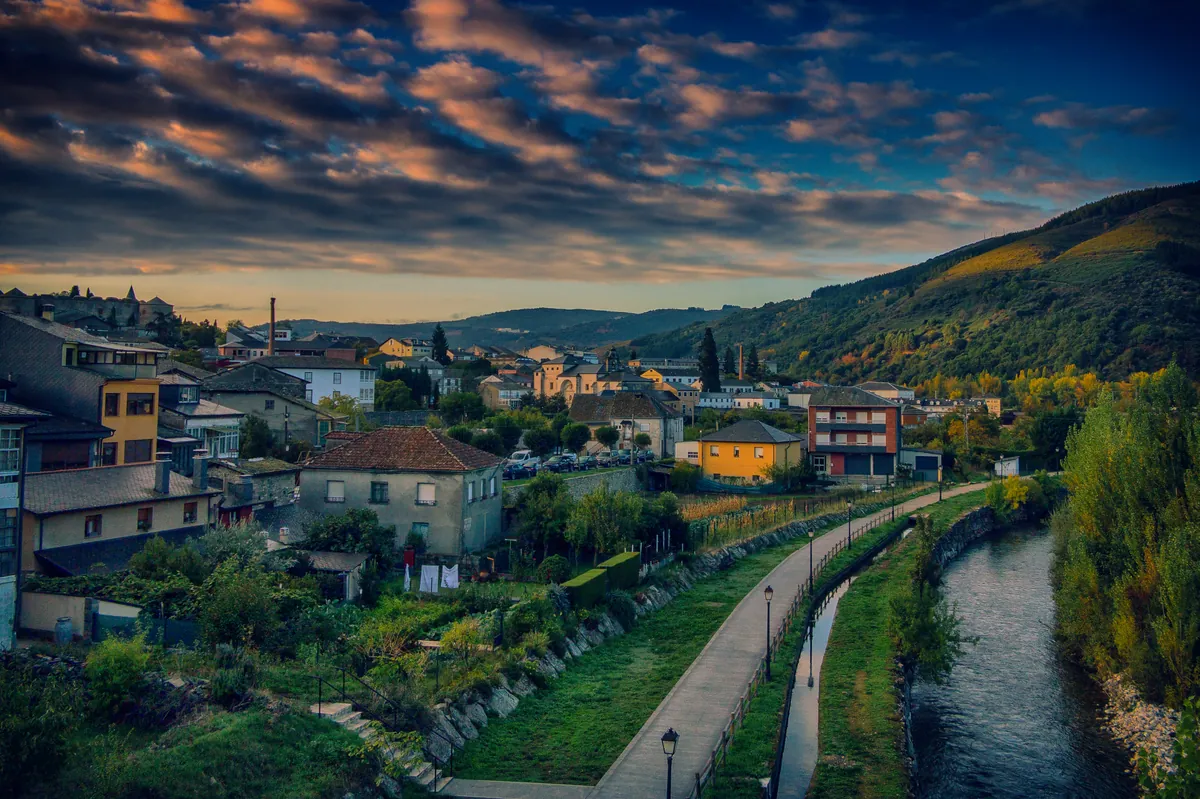
The road drops slowly towards the valley and, just before the bridge over the Sil, Oencia comes into view. Early in the morning the air often smells of damp firewood and turned earth. There are no shopfronts or streets designed for unhurried strolling. Instead, there are dark stone houses, slate roofs slightly skewed by years of winter weather, and walls marked with dried mud after rain. Tourism in Oencia begins with that feeling of a place that still functions as a village first and a destination second.
The layout follows the slope. Streets climb and dip without much order, narrow and shaped by runoff channels that carry water and leaves in winter. It is common to hear a cockerel or the metallic rattle of a trailer early in the day.
A small municipality in the hills of El Bierzo
Oencia has just over 260 inhabitants spread across several villages within the municipality. It lies at the western edge of El Bierzo, close to Galicia, in an area where hills press in around the valleys and the landscape shifts quickly between chestnut groves, oak woods and vineyard slopes.
Farming and livestock are still present, though on a smaller scale than decades ago. Kitchen gardens sit beside houses and fenced meadows hold grazing animals. In many yards, old tools remain propped against walls, half covered in moss.
Traditional buildings reflect what the climate demands: thick stone walls, small windows and heavy slate roofs built to withstand wind and snow. The ground floor was typically used for animals or storage, with living quarters above. In some villages, raised structures for storing chestnuts or grain can still be seen. These small constructions of wood and stone point to a time when autumn set the pace of the year.
Churches, chapels and old routes
In the centre of Oencia stands the parish church of San Juan Bautista. The building has undergone alterations, something quite common in the area, yet it still retains older sections in its walls and some interior elements that hint at earlier periods.
Across the municipality there are also small hermitages and chapels linked to nearby villages. Many are set on low hills or beside paths that now seem secondary. Looking at a map makes their position clearer, as these were once regular routes between settlements.
These are not large buildings. What stands out is where they are placed. From some of these points, the Sil valley opens up clearly, especially on cold winter days when the air is crisp.
Chestnut woods and vineyard slopes
Very old chestnut groves surround Oencia. Some trunks are so wide they are difficult to encircle with both arms. In summer the woodland offers deep shade and the ground remains covered with dry leaves even in August.
Autumn is when more people come to walk here. The ground fills with split chestnut husks and the smell of damp nuts mixes with that of wood. It is also mushroom season, though caution is needed. The hills are not signposted and not everything growing from the ground is safe to eat.
On several sun-facing slopes there are small vineyard plots. These are old vineyards, planted on inclines that require manual work. The usual varieties of El Bierzo, such as mencía, appear here as well, though production tends to be small and closely tied to local consumption.
Walking between villages
One of the clearest ways to understand the municipality is to follow the paths connecting its villages: San Vicente do Monte, A Baña and other scattered settlements across the valley.
These are not routes marked every few metres. Many are traditional paths still used by residents, farmers or hunters. They can split without warning, so carrying a map or a track is advisable if the area is unfamiliar.
The reward comes in the form of quiet. There are stretches where the only sounds are wind moving through chestnut leaves or the distant ring of a bell around an animal’s neck.
When to go
Autumn is often the most rewarding time to explore the area. Temperatures are mild, the forests show strong colour and there is noticeable activity around the chestnut harvest.
In summer the landscape is very green, though some days can be hot in the middle of the day. Starting early makes walking more comfortable. Winter brings a different atmosphere altogether: fewer people, more smoke rising from chimneys and a cold light that reveals the mountains enclosing the valley with clarity.
Oencia is not defined by large monuments or heavily signposted routes. It is a place understood gradually, by noticing how houses sit on the slope, how the hills smell after rain and how paths remain in use after generations.