Full Article
about Trabadelo
Jacobean village in the Valcarce valley, ringed by chestnuts and a pilgrims' stop.
Ocultar artículo Leer artículo completo
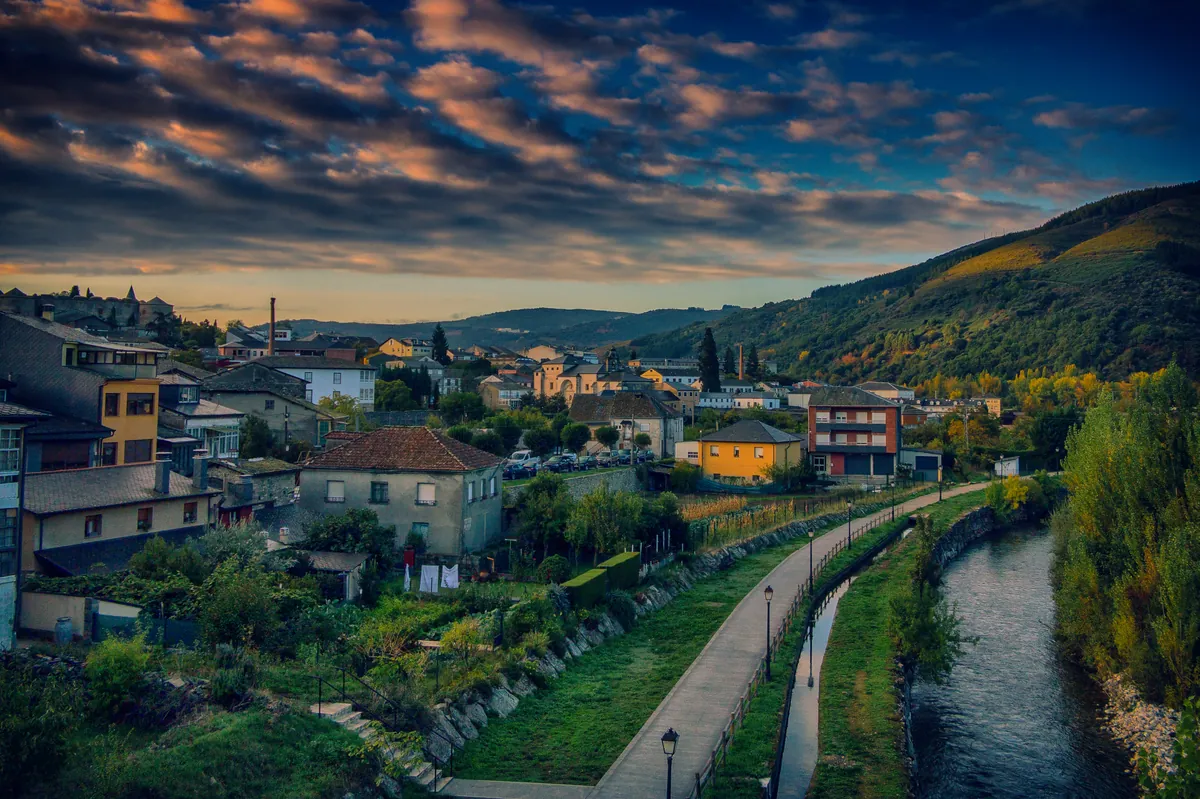
The yellow arrow appears first, painted on a stone wall beside the road. Then comes the sound of rucksacks scraping through the village gateway, a narrow stone arch built centuries before wheeled luggage existed. Trabadelo doesn't announce itself with fanfare; it simply materialises at 593 metres above sea level, halfway up the Valcarce valley, as if the mountains have stepped back just enough to let a few houses and a church tower squeeze in between chestnut trees.
Most maps mark the place with a dot the size of a coffee stain. Yet for the 300-odd souls who walk the Camino Francés each spring day, this dot is a lifeline—one of the last places to sit down, fill water bottles and steel calves before the 600-metre haul to O Cebreiro. The statistics are brutal: twelve kilometres of steady climb, no shade after La Faba, and nothing but cow bells until the border. Little wonder that Trabadelo's single grocery does a roaring trade in bananas and ibuprofen.
Stone, Slate and the Smell of Woodsmoke
Architecture here is practical, not pretty. Granite walls two feet thick keep bedrooms cool in July and cosy in November. Roofs are layered with quartz-grey slate that clangs like a xylophone when hail arrives. Balconies—more functional than decorative—provide drying space for the weekly wash and a perch for keeping tabs on passing pilgrims. A handful of façades have been sand-blasted back to wedding-cake perfection, but most retain the patchwork of centuries: a 1700s doorway here, 1970s terrazzo there, satellite dish bolted on top because Netflix travels better than the daily papers.
The church of San Pedro occupies the highest point, not for spiritual grandeur but because the flat ground was needed for vegetable plots. Its bell still rings at 08:00, 13:00 and 21:00, a reminder that even villages too small for a petrol station keep ecclesiastical time. Inside, the air carries beeswax and damp stone; the single stained-glass window throws cobalt light across a statue of Santiago in pilgrim garb, scallop shell tilting like a disco ball.
A Fork in the Road and a Full Stomach
Two minutes beyond the church the lane splits. The old camino veers right, climbing a stony mule track through sweet-chestnut woods. The newer, tarmacked variant continues straight, fenced off from traffic and mercifully wide enough for two walking poles abreast. Both meet again at La Faba, but choose wisely: the forest route adds 30 minutes, saves sunburn and offers a natural spring whose water tastes of iron and moss. The road option has no water until Trabadelo's fountain—marked, with Spanish honesty, "calidad no garantizada". Locals drink it; Brits usually purify it; nobody admits to problems.
Either way, arrival coincides with hunger. El Puente Peregrino, housed in a former smithy beside the medieval bridge, serves the best vegetarian menú del día on this stretch of the Camino. Lentil stew comes spiked with pimentón, the grilled aubergines are slick with local olive oil, and the almond-orange cake has converted more than one carnivore. Meat-eaters should still try cecina, the Bierzo version of air-dried beef—milder than bresaola, cut translucent, and tasting faintly of oak smoke. Pair it with a glass of Mencía; the regional red is light enough for lunch yet sturdy enough to numb blistered feet.
Accommodation divides into two camps. Casa Susi, 200 metres up a farm track, offers small dorms with actual single beds (no triple-tier bunks), towels included, and a garden where Susi grows the lettuce that ends up on your plate. Evening guitar sessions migrate onto the terrace if the weather behaves. If that's full, Hotel Rural Nova Ruta across the river has smarter rooms and a swimming pool that feels Olympic after 20 km in 35-degree heat. Both places will stamp credentials and organise next-day breakfast from 06:30, because nobody wants to climb to O Cebreiro on an empty stomach.
Seasons When the Village Belongs to Locals—or Doesn't
April and May turn the valley emerald. Hawthorn foams along field edges, nightingales shout over the river, and the air smells of wet grass and manure. It's also when Trabadelo belongs to its 338 registered inhabitants. Elderly men in flat caps walk cows to pasture at dawn; women gossip by the washing trough, smartphones tucked into pinny pockets. Conversation switches between Castilian and Galician—linguistic foreshadowing that the regional border lies only 8 km away.
July and August flip the ratio. Pilgrims outnumber locals four to one, rucksacks block the bar entrance, and the grocery runs out of sunscreen. Fiesta week around 15 August cranks volume up further: brass bands, fireworks, and a procession where San Roque is carried through potato fields to bless the crop. Fun, yes, but book beds early and bring earplugs.
Autumn is the sweet spot. Chestnut leaves the colour of burnt sugar drift onto the path, daytime temperatures drop to walking-friendly 20°C, and the magosto festival celebrates the harvest with open-air roasts. Locals hand out paper cones of charred chestnuts; the trick is to peel them before fingertips blister. October can also bring week-long rain that turns the river café-au-lait and sends earthworms onto the road. Waterproof gaiters suddenly feel essential.
Winter is when Trabadelo remembers it's a mountain village. Night frosts start in November; January snow sometimes cuts the valley road for 24 hours. The albergue closes, bars shorten hours, and the camino becomes a solitary affair of misty breath and squeaky boots. Still, the same granite walls that repel August heat trap log-fire warmth, and the sound of the river rises to a roar after heavy rain. If you fancy a cheap Christmas rental—€250 a month for a two-bedroom house—this is the time.
Beyond the Yellow Arrows
You don't have to be a pilgrim to use Trabadelo as a base. A 6 km circular track leads to Vega de Valcarce, past terraces of Mencía vines and abandoned horreos (grain stores on stilts) that look like tiny chapels. Go early and you might spot wild boar prints in the mud; go late and the sunset ignites the quartzite peaks. Serious walkers can continue up to the Alto de San Roque where a steel statue of a weary pilgrim faces Galicia, coat flapping in the wind that almost always blows.
Drivers arrive via the A-6 and N-VI, but be warned: the village centre is a 5 km detour off the motorway, single-track for the final stretch, and reversing skills are tested when a tractor rounds the bend with a trailer of hay. There is no petrol station; the nearest ATM is back in Villafranca del Bierzo. Mobile signal hops between Spanish and Galician providers; most bars offer Wi-Fi that works until three pilgrims start streaming Match of the Day.
Leaving Without Looking Back—Or Not
By 07:30 the next wave of walkers is already strapping on boots outside the albergue, head-torches flickering like a miniature festival. Some linger over café con leche, postponing the moment when calves must confront the first 12% gradient. Others march off without breakfast, trusting in banana power and the promise of tortilla at La Faba. Within an hour Trabadelo falls quiet again, the only sound the Valcarce river sliding over stones and the church bell marking quarters.
Stay longer and you notice rhythms newspapers never report: the grocer unlocking at 10:00 sharp, the postwoman's van coughing uphill, the way sunlight creeps across the plaza slowly enough to follow with a coffee. Trabadelo won't change your life, but it might reset your cadence. And when the path finally climbs out of the valley, chestnut woods give way to gorse and heather, Galicia starts to feel like a neighbour rather than a destination. One last look back reveals slate roofs glinting like fish scales. Then the mountain bends, the village disappears, and the only thing ahead is another yellow arrow scratched onto a granite boulder, pointing you upwards.