Full Article
about Vega de Espinareda
Gateway to Los Ancares; known for the San Andrés Monastery and its large historic river beach.
Hide article Read full article
Vega de Espinareda, a junction in the Cúa valley
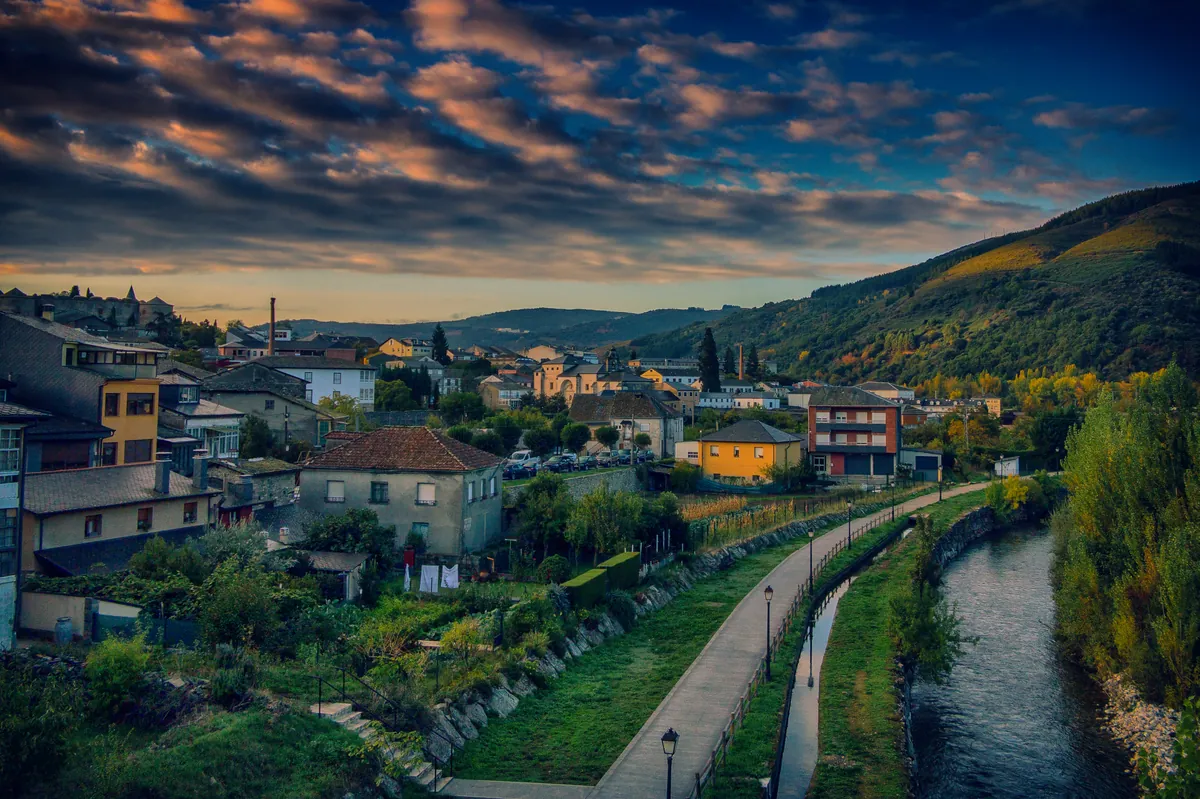
The road from Ponferrada follows the River Cúa upstream. Where the valley widens enough for fields, you find Vega de Espinareda. The bridge at the southern entrance is often cited as Roman, though its current form is the result of later work. Its true age matters less than its function: for centuries, this was the main crossing for moving livestock and goods between the high valleys and the plains of León.
The settlement grew because of this geography. Medieval records mention fairs here, a natural stop on routes connecting Galicia with the Meseta. That history of passage is still perceptible in the layout of the place.
San Andrés, a monastery of scale
The monastery of San Andrés dominates the village centre. What you see is largely an 18th-century reconstruction, a Benedictine project that echoed the site’s earlier medieval influence. Its origins are older, traceable to a 10th-century foundation linked to Astorga.
For centuries, it was a major landowner in the valley. The ecclesiastical confiscations of the 19th century redistributed its properties, a shift that altered local power structures. The church interior is sober, with a neoclassical altarpiece. The building’s significance lies in its location: it commands a point where water, arable land and the valley route converge.
It remains an active parish church. Part of the complex now houses a visitor information point.
A municipality of scattered villages
The modern municipality is a collection of small settlements. In the 1970s, it absorbed the former council of Finolledo, extending its reach across the upper valley. This is not one village, but many.
Each hamlet sits according to its own logic—a sun-facing slope, a spring, a patch of workable land. Ancient chestnut trees persist in some areas, remnants of an economy where the tree provided both food and timber. The landscape here is not wilderness; it is the product of sustained use, part of the Ancares Leoneses Biosphere Reserve since 2006.
The monthly fair at El Espino
The Feria del Espino happens on the 1st and 15th of each month, a schedule maintained since the Middle Ages. It was once a key livestock market for the valley. While smaller now, that character persists.
On fair days, the ground near the chapel fills with stalls selling tools, second-hand goods, and sometimes animals. The rhythm is slow, dictated by local need rather than tourism. For many here, it functions as a social rendezvous, a reason to come down from the outlying villages.
Schematic figures on stone
Near the village of Sésamo, schematic paintings survive on an open rock face. Shepherds have known of them for generations. Archaeological study suggests a broad date between late prehistory and the early Iron Age.
The figures are rendered in red pigment: archers, animals, geometric shapes. A marked path leads to the site. There are no glass cases or detailed panels; the art is exposed to the weather, as it has been for millennia. You must look closely.
Moving through the valley
Vega de Espinareda is about a 50-minute drive from Ponferrada via the A-6 and local roads that climb the Cúa valley.
The core of the village is walkable. A straightforward route connects Vega de Espinareda with El Espino and loops back along the other side of the river, giving a clear view of how the settlements relate. Paths lead to other hamlets, though some dirt tracks can become impassable with deep mud after heavy rain, particularly those approaching older sites like the castro of Piñera.
Local lore mentions the Fuente de la Vida. Tradition advises taking seven sips from its water. It’s a custom without grand claims, simply something passed down among those who live here.