Full Article
about Hérmedes de Cerrato
A village in a Cerrato valley, known for its lone tree (la Castañera) and quiet natural setting.
Hide article Read full article
If you are planning to see Hérmedes de Cerrato, leave the car in the square beside the church or in one of the nearby streets. The village is small and there is no traffic to speak of, but there are not many spaces if several cars arrive at once. Everything can be covered on foot in a short time.
Hérmedes de Cerrato has just over fifty residents throughout the year. It stands on a low rise in the Cerrato area of the province of Palencia, surrounded by cereal crops and some vineyards. The landscape is typical of this part of Castilla León: open fields, long horizons and very few trees.
There are no shops or visitor services here. It is an agricultural village, and that defines its character.
San Juan Bautista Church
The most visible building is the parish church of San Juan Bautista, located in the centre. From the outside it is plain, much like many rural churches in the area. The main structure is usually dated to the 16th century, with later alterations.
Inside there is a simple altarpiece and several religious images. It is not always open. The usual arrangement is that it opens when there is Mass on Sundays or feast days.
The church sets the tone for the rest of the village. It is modest, practical and closely tied to local life rather than to tourism.
Stone, Adobe and Underground Cellars
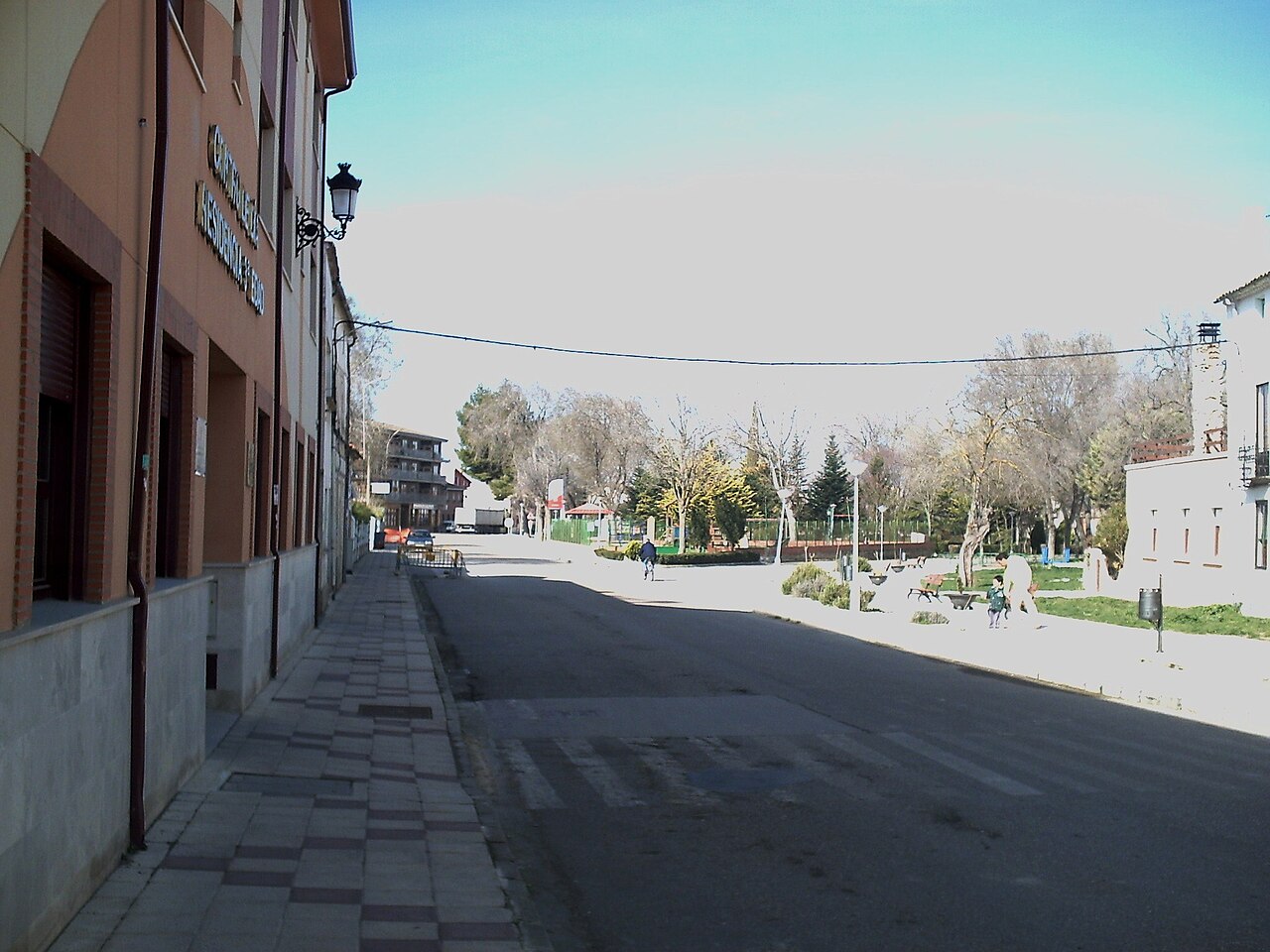
The rest of Hérmedes de Cerrato is best understood by wandering slowly along its main streets. Houses combine stone and adobe, many with large gateways once used for storing machinery or for former stables. Windows are small, with simple iron grilles, and roofs are covered with clay tiles.
Some plots still preserve underground bodegas. In this part of El Cerrato, such cellars were common for storing wine or grape must over the winter months. They do not form a coordinated site that can be visited as a group. Instead, they appear here and there between houses, part of the everyday fabric of the village.
The overall impression is of a place shaped by agricultural needs. Large doors, enclosed yards and solid walls respond to practical concerns rather than aesthetics. There are no decorative façades or grand townhouses. Hérmedes de Cerrato has grown according to what its residents required at different moments in time.
The Cerrato Landscape
The setting around the village is open and rather dry. There are no forests and no dramatic hills. Just fields that change with the seasons: cereal crops at the right time of year, stubble afterwards, and some sunflowers when the season allows.
Walking along the agricultural tracks that leave the village gives a clearer sense of the Cerrato landscape. Birds of prey such as red kites and kestrels can often be seen gliding above the plains. It is not a designated birdwatching destination, nor is there any infrastructure for that purpose, but if you pause for a while there is usually some movement in the sky.
The horizon feels wide and uninterrupted. The lack of trees and steep relief makes the changing light more noticeable, especially in the late afternoon. This is a countryside defined by cultivation, with nature and farming closely intertwined.
Festivals and Village Life
The main festivities are usually held in August. This is when people who still have a family home in Hérmedes de Cerrato, but live elsewhere during the year, return for a few days. The population increases, and the atmosphere shifts.
There are processions, shared meals among neighbours and the familiar rhythm of a small Spanish village in summer. These are not large-scale events designed for outsiders. They revolve around local ties and traditions.
For the rest of the year, life is quiet and largely silent. With so few permanent residents, daily activity is limited. The pace is slow, and much of the social life revolves around agricultural work and family connections.
A Short Stop in El Cerrato
It is best not to arrive expecting major monuments or a full day’s programme. Hérmedes de Cerrato can be seen quickly: a walk through the streets, a look at the church and little more.
If you are exploring El Cerrato as a wider region, the village works well as a brief stop to understand what many settlements here are like. Park, stroll around and continue your route. The interest lies in the rural atmosphere rather than in collecting sights.
Hérmedes de Cerrato reflects a type of village that is common across inland Castilla León. Small population, agricultural surroundings and simple architecture. For travellers unfamiliar with this part of Spain, it offers a straightforward example of everyday life in the Meseta, the high central plateau that shapes much of the country’s interior.
There are no viewpoints marked out, no interpretation panels and no curated routes. The experience consists of observing the details: the texture of adobe walls, the heavy wooden doors, the silence of the streets outside August. It is a place that does not attempt to impress.
As part of a longer journey through Palencia and the Cerrato countryside, Hérmedes de Cerrato provides context. It shows how communities have adapted to an open, dry landscape focused on cereal farming and small-scale viticulture. A short visit is enough to take in its scale and setting.
In practical terms, that is all that is required here. Leave the car near the church, walk for a while and move on. The value of the stop lies in understanding the environment and way of life, rather than in ticking off attractions.