Full Article
about Quintana del Puente
Strategically located beside the Arlanza river and the motorway; noted for its historic bridge and riverside setting.
Hide article Read full article
A village shaped by land and river
Quintana del Puente sits in the Cerrato area of Palencia, a part of Castilla y León defined by gentle relief. Broad plateaus alternate with small cultivated valleys, creating a landscape that shifts quietly rather than dramatically. Fewer than three hundred people live here, and the scale of the place reflects that. Fields of cereal stretch outwards, agricultural tracks cut across the land, and the built-up area remains close to its original core without much expansion.
The name of the village points directly to the feature that determined its location: a stone bridge over the river Arlanza. In a region where crossing water was not always straightforward, such a structure carried real importance. It provided a reliable passage and helped organise movement through the area.
A crossing that became a settlement
The bridge explains much of the village’s origin. For centuries, dependable river crossings shaped local routes and small trading paths. Pinning down an exact date for these structures is not always easy, but the current stone bridge is generally placed in the modern period. It was likely built or reshaped at a time when farming and livestock activity required stronger, more consistent connections.
A small settlement grew around this crossing point and gradually became what is now Quintana del Puente. Like many places in the Cerrato, its economy has long depended on cereal farming and the use of nearby land. The relationship between the village and its surroundings remains clear, with little separation between daily life and agricultural work.
Santa María and the marks of time
The parish church of Santa María stands in a prominent position within the village. Much of the current building dates from the early modern period, although, as with many rural churches, it has undergone several changes over time.
Some older elements can still be seen on the outside. The pointed-arch doorway hints at earlier phases, and small corbels sit beneath the eaves. Inside, there is a Baroque altarpiece with simple lines. Its interest lies less in decoration and more in what it represents: the kind of church that accompanied everyday life in agricultural communities. It reflects continuity rather than grandeur.
Streets, houses and underground cellars
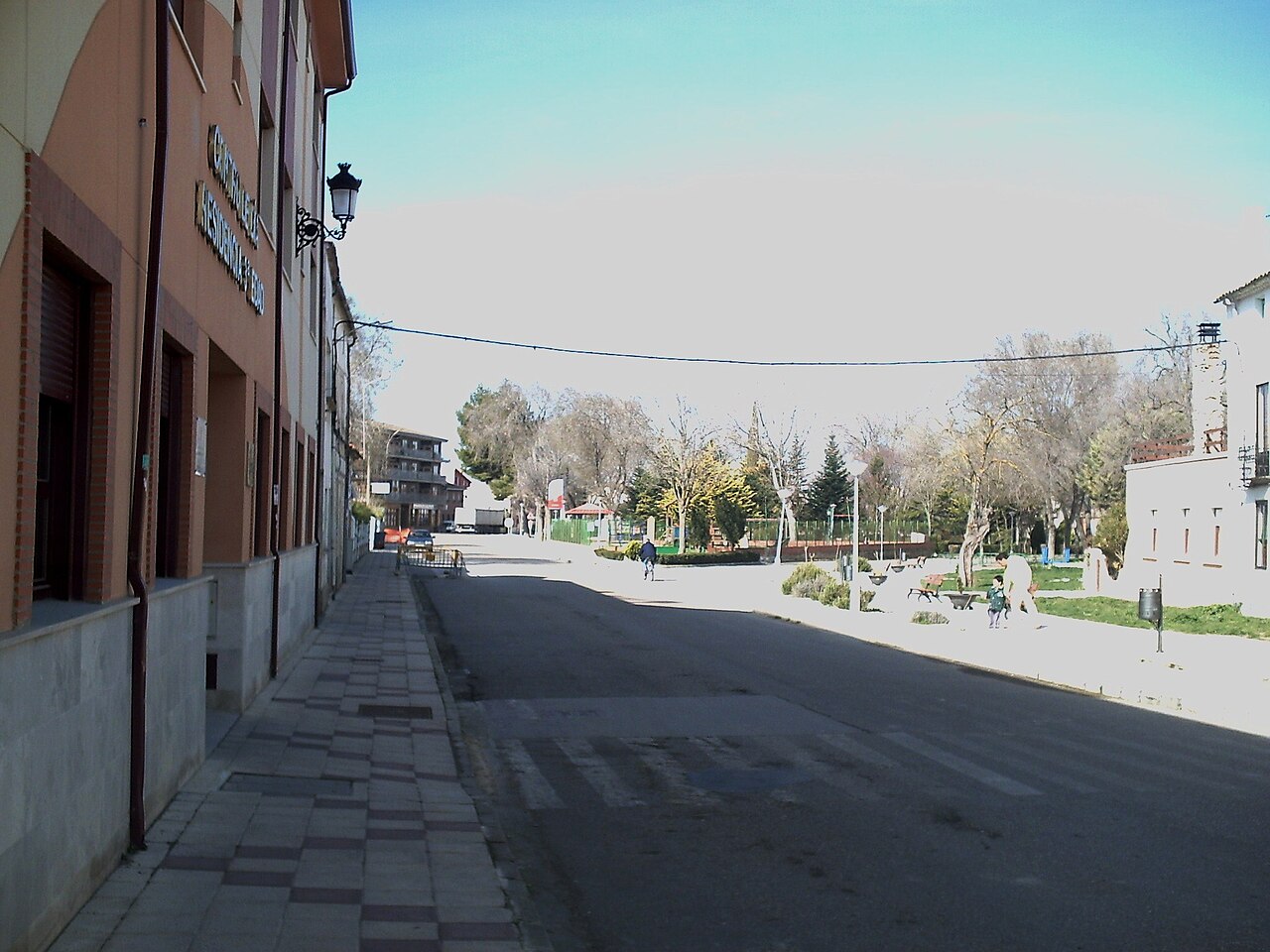
The layout of Quintana del Puente is compact and fairly regular. A handful of straight streets organise the houses, which are built using materials typical of the Cerrato. Stone appears alongside adobe and brick, often combined within the same structure. This mix gives the village a consistent but understated character.
Some houses still retain older features such as wooden gates, traditional metal fittings, or simple iron grilles. These details are small but noticeable, and they link present-day buildings to earlier ways of construction and use.
Beyond the main streets, there are underground wine cellars dug into the ground. For generations, these spaces formed part of a domestic economy connected to wine production. Many of them are now closed, while others are used only occasionally. Even so, their presence points to a time when households relied on a wider range of activities tied to the land.
The open landscape of the Cerrato
The surrounding environment follows the typical pattern of the Cerrato. Open plateaus are given over to cultivation, broken by shallow depressions and strips of vegetation near the river. Over the course of the year, the colours of the land shift with the agricultural cycle. Spring brings green tones, while after the harvest the fields turn more ochre.
The banks of the Arlanza introduce a degree of moisture into an otherwise dry setting. Poplars and willows grow along the water, and certain areas make it relatively easy to spot birds associated with farmland. This is not a place defined by high biodiversity, but it offers a calm setting for those who enjoy walking or simply observing the countryside at a slower pace.
Paths and quiet movement
Tracks around Quintana del Puente are mostly wide agricultural paths. They do not involve steep gradients and can be followed without much difficulty. The terrain remains accessible, though conditions change with the seasons.
Shade is scarce across the Cerrato, and the summer sun can be intense, so planning a walk requires some care. Early morning and the end of the day tend to be the most comfortable moments. At those times, the wind often drops and birds of prey can be seen riding the air currents above the fields.
A brief practical note
The village can be explored in a short time. Attention tends to settle on a few key elements: the stone bridge that gives Quintana del Puente its name, the church of Santa María, and the open landscape that surrounds the settlement.
Those looking for more services or a livelier atmosphere usually turn to larger towns nearby, which is typical in this part of the Cerrato. A visit here is less about major sights and more about understanding the steady rhythm of an agricultural village and its connection to the land.