Full Article
about San Adrián del Valle
Small town known for its traditional underground cellars; set in a quiet valley
Hide article Read full article
A village shaped by the horizon
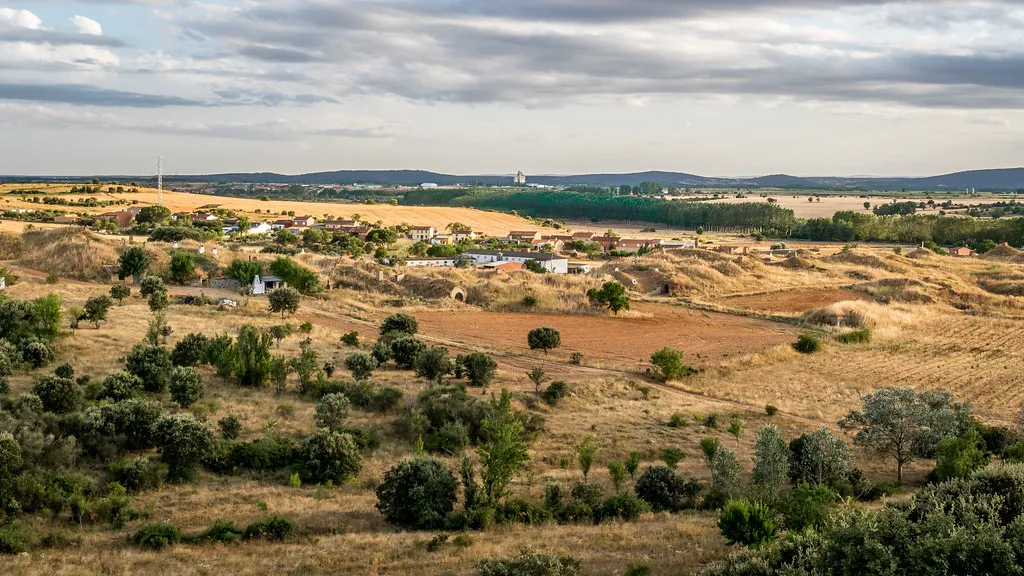
San Adrián del Valle sits in the Leonese comarca of El Páramo, a place best understood by looking beyond the village itself. The land stretches out flat and open, with agricultural plots extending towards a distant horizon. This landscape, level ground, long sightlines, and very few trees, has influenced daily life here for centuries.
With just over eighty residents, the village retains the scale of a small farming community. Traditional houses reflect the practical realities of the area. Adobe, brick and stone are the main materials, typical of this part of León where timber was scarce and clay was easy to work. Many homes still include inner courtyards or corrals, tied to agricultural routines. These features are common across villages in El Páramo and give a clear sense of how closely domestic space and farming activity were once connected.
There is no sense of expansion or urban growth. Instead, the layout remains compact and consistent with its rural function, shaped more by necessity than by design.
The church and the village layout
The parish church stands slightly above the rest of the village. Its origins appear to date from the early modern period, although later alterations have changed its appearance over time. It is not a large or elaborate building, yet it plays a central role in understanding how places like San Adrián del Valle were organised.
Around it, the structure of the village becomes clear: the church, a nearby square, and a handful of main streets forming the core of daily life. This pattern is repeated across many small settlements in the region.
The importance of the church lies less in its architecture and more in its role within the community. For generations, the religious calendar set the rhythm of rural life. Sowing, harvesting, local celebrations and social gatherings were all tied, in one way or another, to key dates in that calendar. Even in a place of this size, those shared moments helped shape a sense of continuity.
The landscape of El Páramo
Step outside the village and the defining feature of the area becomes immediately apparent: space. The Leonese Páramo is one of the province’s major agricultural plains, and its current appearance owes much to irrigation systems introduced in the twentieth century. These systems transformed the land, allowing a mix of crops to coexist where conditions had once been more limiting.
Today, cereal fields sit alongside other crops that depend on irrigation channels. The result is a working landscape, practical and orderly, with long straight lines marking out cultivation.
A network of agricultural tracks extends from San Adrián del Valle into the surrounding countryside. These are not designed as formal walking routes but are used daily by farmers and local residents, linking the village to nearby settlements. They are easy to follow and involve very little change in elevation.
Walking along these paths offers a clear sense of scale. The fields are wide, the terrain uninterrupted, and the atmosphere shifts noticeably with the seasons. At certain times of year there is activity and movement, while at others the quiet becomes more pronounced. The experience is less about landmarks and more about observing how the land is used and how it changes over time.
Seasonal rhythms and local gatherings
Like many small villages in the province, San Adrián del Valle sees its population increase during the summer months. This is when people who maintain family ties to the village return, often coinciding with the annual patronal festivities.
These celebrations are centred on religious events and informal gatherings among neighbours. The village square and streets become the main setting, reinforcing their role as shared spaces. There are no large-scale events or spectacles. Instead, the focus is on continuity, on keeping traditions alive through repeated gestures and familiar dates.
What stands out is not the scale of the festivities but their persistence. Year after year, the same moments bring people together, maintaining a connection between past and present.
Visiting San Adrián del Valle
San Adrián del Valle lies within El Páramo, not far from larger towns where more services are available. Access is via local roads that cross the agricultural plain, reinforcing the sense of openness that defines the area.
The village itself can be explored in a short time. Its interest lies in details rather than in major sights. Those drawn to rural architecture may find it worthwhile to look closely at the adobe buildings and the rear courtyards that many houses still retain. These spaces preserve the traditional layout associated with farming life in southern León.
More broadly, a visit offers an opportunity to understand how landscape and settlement are closely linked. In San Adrián del Valle, the flat terrain, the materials used in construction, and the organisation of the village all reflect a long-standing relationship with agriculture and with the particular conditions of El Páramo.


