Full Article
about Oña
A county town with a striking monastery that holds royal tombs; home of Las Edades del Hombre.
Hide article Read full article
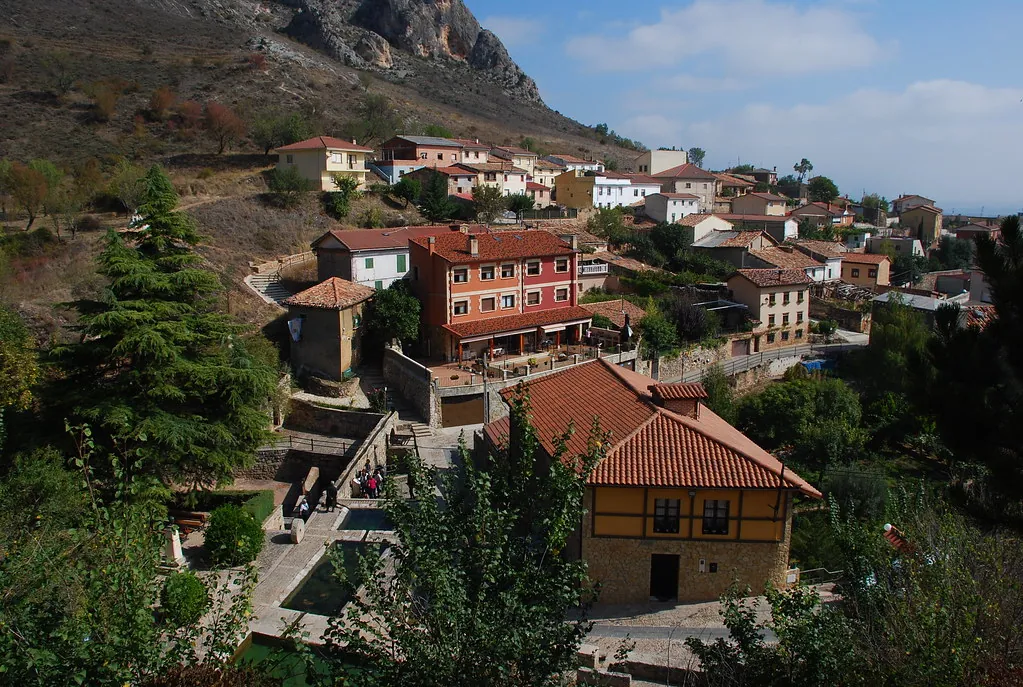
The river Oca has a particular sound in Oña, a low, constant murmur that comes up from the gorge and fills the spaces between the stone. You hear it from the bridge, looking at water the colour of old slate. And then you look up, and the Monasterio de San Salvador is simply there, a mass of grey limestone that seems less built than grown from the hill. It doesn’t dominate the village; it is the village, with everything else arranged quietly around its walls.
The air smells of damp earth and cut grass, of the valley opening out into La Bureba.
Calles que se doblan sobre sí mismas
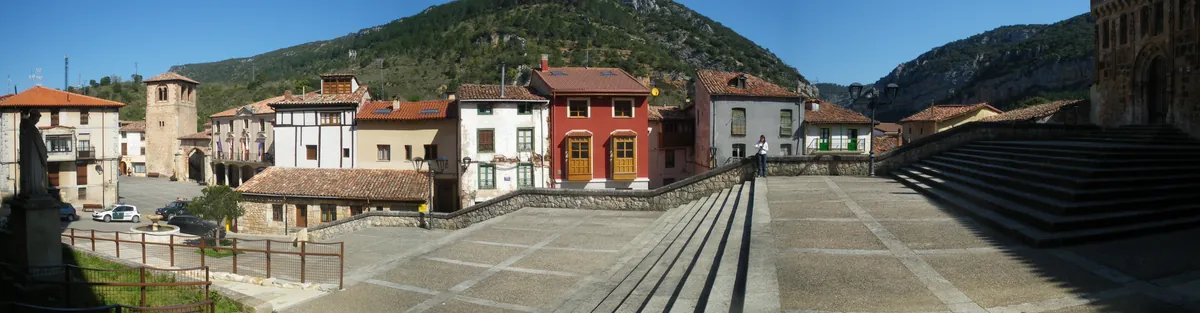
The streets follow the logic of old geography, not planning. They slope gently, turn without warning, and are lined with façades of the same pale stone as the monastery, though here it is patched and repaired. A carved coat of arms sits above a doorway, worn smooth by weather. An archway leads to an inner courtyard where geraniums grow in tin cans.
The Plaza Mayor is a place you cross, not a place you stay. People move through the arcades on errands, past the fountain that’s been running for centuries. There’s no stage set feeling. This is just where life has happened, for a very long time.
El peso del monasterio
To enter the Monasterio de San Salvador is to step into cool, still air and subdued light. It began in the 11th century. The tombs of Castilian royalty rest here, but so do simpler things: Romanesque capitals carved with worn figures, the sudden gold leaf of a Baroque altarpiece in a side chapel. It is not one style, but many layers pressed together by time.
Guided visits are available and useful. They explain why this place held such power, how it shaped the entire region. The history is complex, but the stone is straightforward.
A five-minute walk away, the Iglesia de San Juan offers a quieter contrast. Its Romanesque apse is plain and solid. Around it, moss grows on north-facing walls, and the only sound is often from sparrows in the eaves. There are few shops. In winter, you might have it to yourself.
Un paseo por la hoz
Leaving the last house behind changes everything. The path drops towards the river, into the narrow gorge the Oca has carved through soft rock. The walls close in, striped in beige and ochre. When the water is high, the sound echoes off the stone.
Wear shoes that can handle loose gravel and uneven steps. This isn’t a route for speed. You walk, you stop to watch the water swirl in a pool, you walk again.
If you climb a little towards the Peñas de Oña, the view rearranges itself. The monastery becomes a detail in a wider canvas of fields and distant hills. A good loop can be done in two hours, bringing you back to the village as the light begins to soften.
Ritmos locales y luz que cambia
The light here has different weights. At dawn, the monastery is a silhouette against a brightening sky, and mist hangs over the river. By noon, the sun bleaches the stone façades flat and white. But it’s in the last hour before sunset that Oña finds its colour: a brief, warm gold that lingers on the upper walls before fading to grey.
The food is from here: substantial, built for cold winters. Look for judiones, the large white beans stewed with sausage, or slow-cooked lamb. You’ll find them in bars around the village when the temperature drops.
The rhythm of festivals marks the year. San Tirso, at January’s end, is a winter gathering with bonfires. Summer brings celebrations for Santiago and Santa Ana, filling the plaza with music and voices for a few days before quiet settles again.
Oña doesn’t offer diversion. It offers scale—the scale of a single vast building against a valley, of deep time measured in stone and river sound. You come to see how a place can be built around one idea for a thousand years, and how that patience becomes a kind of quietness you can walk through.