Full Article
about Cañizal
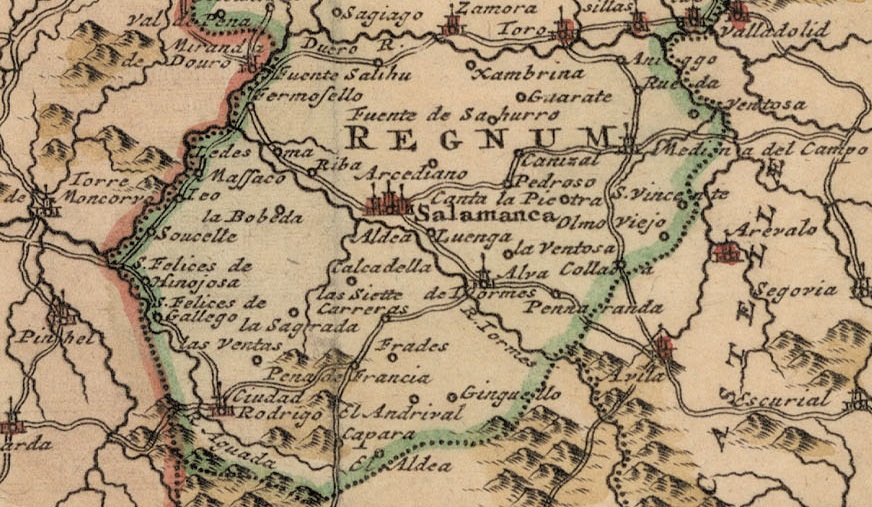
Border town with Salamanca, built of brick and adobe; noted for its Neoclassical church and its location on the Vía de la Plata.
Ocultar artículo Leer artículo completo
The church bell strikes noon, and everything stops. Not in the theatrical way of tourist-board Spain, but in the manner of places where time still serves agriculture rather than the other way round. A woman in house slippers waters geraniums on a balcony painted the exact blue of washing powder boxes. Two men in work boots stand beside a white van, discussing the price of barley with the intensity others reserve for football. This is Cañizal, where Castilla's great cereal ocean laps against human habitation, and where 400 souls maintain an uneasy truce with infinity.
The Horizontal City
At 770 metres above sea level, Cañizal occupies a slight rise that passes for topography here. The village squats on Spain's central plateau like a ship becalmed in an amber sea. Every road arrives via ruler-straight perspectives: wheat fields, fallow plots, wheat fields again, punctuated by the occasional pigeon loft crumbling back into earth. The horizon behaves differently where there's nothing to interrupt it. Cloud shadows migrate across the landscape like slow-moving livestock, and sunset becomes a geological event, the sky performing its daily colour shift with the reliability of a Swiss train.
The built environment reflects this horizontal imperative. Houses sprawl rather than soar, their single-storey profiles broken only by the parish church tower that serves as both spiritual and mobile-phone mast. Adobe walls up to a metre thick keep interiors cool during summers that regularly touch 35°C, though winter brings a different challenge. When the energía wind howls across these plains, temperatures can plunge to -10°C, and the 45-minute drive from Zamora city becomes considerably longer if snow arrives.
What Remains When Monuments Leave
Forget cathedrals and castles. Cañizal's architecture documents rural life with the honesty of a warehouse ledger. Walk Calle Real and you'll see houses that wear their centuries like faded work clothes: walls of mud and straw, brick dressings around windows, wooden gates wide enough for carts that no longer exist. Some properties have received the inevitable coat of modern render, but enough remain untouched to read the original construction logic. The grander establishments feature interior courtyards where chickens once scratched, now converted to car parking with concrete ramps that speak of Spain's late arrival to mass motorisation.
Below ground lies a different city. Cellars excavated into the compacted earth served as wine stores when every household produced its own. Today most stand empty, recognisable only by their ventilation chimneys poking through ground level like periscopes. The tourist office doesn't exist, so access depends on asking at Bar Nuevo during opening hours (7 am-3 pm, 6 pm-11 pm, closed Tuesday evenings). Proprietor José María might show you his grandfather's bodega, still stocked with dusty bottles of tinto from 1998, though he'll apologise for the damp walls with the embarrassment of someone showing a messy spare room.
The Economics of Absence
Cañizal's population graph tells a story repeated across Spain's emptied interior. The village supported 1,200 inhabitants in 1950, when mechanisation arrived late to these heavy clay soils. Today's 400 residents represent stability rather than decline; the exodus has simply reached equilibrium. What surprises visitors is the age distribution. Yes, pensioners dominate weekday streets, but weekends bring returning families. The infant school closed in 2008, yet the primary school somehow maintains 23 pupils through catchment area juggling that would impress a London education authority.
Work remains resolutely agricultural. Drive the EX-390 at 6 am and you'll meet tractors heading to fields that stretch beyond visual range. The dominant crops rotate between wheat, barley and sunflowers, with land prices hovering around €8,000 per hectare. Young farmers increasingly run GPS-guided combines worth more than their houses, though they still stop work at 2 pm for the extended Spanish lunch that tourism hasn't managed to eliminate here.
Eating According to the Calendar
Food arrives from the surrounding landscape with minimal intervention. The weekly market happens on Fridays in nearby Villaralbo, 18 kilometres distant, but most households maintain gardens that determine seasonal menus. Spring brings artichokes and broad beans, summer provides tomatoes that actually taste of tomato, autumn delivers game when local hunters succeed. The village's single restaurant, Casa Paco, opens only at weekends except during July and August. Expect roast suckling lamb for €18, served with potatoes that grew within sight of your table. Vegetarian options extend to tortilla or salad, full stop. Booking isn't necessary except during the September fiesta, when half of Zamora province arrives to drink queimada and pretend they still know the words to traditional songs.
For everyday provisions, the mini-market opens 9 am-1 pm then 5 pm-8 pm. Stock runs to tinned tuna, UHT milk, and churros on Sunday mornings. The freezer contains industrial ice cream and locally-made morcilla in a combination that somehow sums up modern rural Spain. Credit cards? "Maybe next year," says Conchi behind the counter, though the contactless machine sits wrapped in plastic like an unwanted gift.
When Silence Becomes Spectacle
The real attraction here costs nothing and arrives daily. At dawn, the eastern sky performs its colour temperature shift from industrial orange to daylight blue while larks provide soundtrack. The absence of light pollution makes Milky Way viewing possible on clear nights; bring a jacket even in August, as the plains radiate heat quickly once the sun disappears. Birdwatchers should pack patience along with binoculars: great bustards occasionally visit during winter months, though you'll need local knowledge and several hours of immobile waiting.
Walking options follow agricultural tracks rather than waymarked paths. The 7-kilometre circuit to Villarín de Campos takes 90 minutes across terrain so flat that Ordnance Survey would struggle to find contour lines. Navigation depends on keeping the mobile-phone mast in peripheral vision; lose sight and identical field boundaries quickly become disorienting. After rain, the clay soil clings to boots like fresh concrete, making cycling impractical despite the theoretical flatness.
The Honest Truth
Cañizal won't change your life. You won't discover yourself, find inner peace, or post images that break the internet. What you might grasp, briefly, is how most of Spain lived until very recently, and how some places refuse to perform for visitors. The village offers authenticity without romance, reality stripped of marketing gloss. Come if you're interested in how architecture adapts to climate, how communities survive post-industrial agriculture, or how horizon lines affect human psychology. Don't come seeking Instagram moments or artisanal gin.
Leave before 2 pm on Sundays unless you fancy staying until Tuesday. The weekly bus departed in 2012, and taxis from Zamora cost €45. Accommodation options extend to one rental house that sleeps four for €60 nightly, booked via the ayuntamiento website that still uses Hotmail. Bring cash, patience, and realistic expectations. Cañizal offers something increasingly rare: a place that simply exists, neither welcoming nor rejecting visitors, too busy with its own survival to care whether you understand it.
