Full Article
about Villamor de los Escuderos
Southern municipality with farming and livestock tradition; known for its church and bull-running festivals.
Hide article Read full article
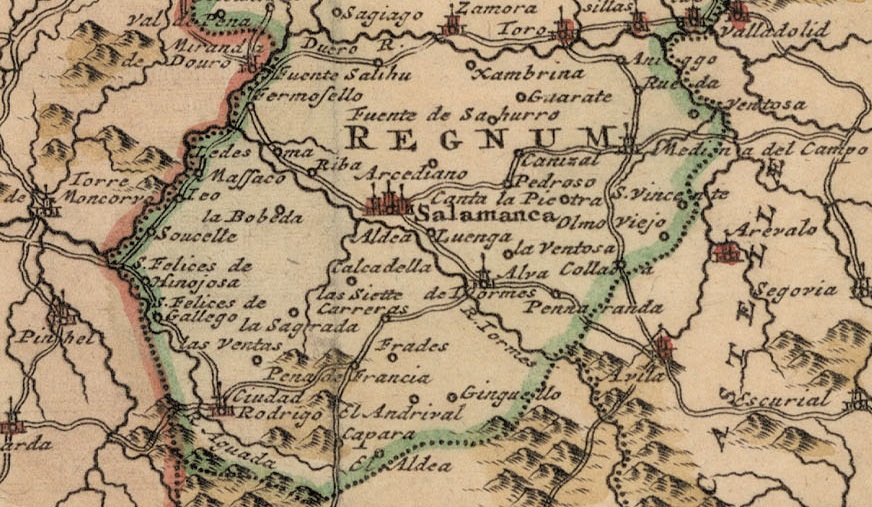
A Village on the Plains of La Guareña
To understand tourism in Villamor de los Escuderos, it helps to begin with geography. The village lies in La Guareña, in the south of the province of Zamora, part of Castilla Leon. This is a region of wide horizons where the land barely rises, and farmland stretches out in long, uninterrupted lines. Settlements appear after kilometres of cereal fields and vineyards. Villamor, with just over three hundred inhabitants, fits that pattern closely.
The village stands on flat terrain on the Meseta, Spain’s central plateau. For centuries these lands have been cultivated with grain and vines. Even the name Villamor de los Escuderos hints at a past linked to minor nobility. On some façades, carved stone coats of arms can still be seen. They are modest details, yet they suggest how rural communities here combined agricultural life with the presence of families of a certain standing.
Today the rhythm of Villamor is similar to that of other villages in the comarca. Agriculture and vineyards shape daily life, and the pace is calm. Rather than a place to visit with a long checklist of sights, it works better as a clear example of the human and agricultural landscape of La Guareña.
Parish Church and Vernacular Architecture
The most prominent building in the village is the parish church. Its origins go back to the medieval period, although what stands today reflects later alterations. As often happens in this part of Spain, the church has evolved over the centuries, incorporating additions and changes that mix styles without much concern for strict uniformity. Inside there are usually altarpieces and devotional sculptures of local character, though access depends largely on parish opening times.
Beyond the church, the rest of Villamor is best understood by wandering without a fixed route. Houses combine adobe, rammed earth and stone, materials typical of traditional architecture in Zamora. Many façades retain large gateways once used for carts, or lead into interior courtyards and corrals. These features make clear that home and agricultural work were once part of the same domestic unit.
In some streets, larger houses appear, distinguished by their carved heraldic shields. They are not grand palaces, but they do point to the presence of hidalgo families who managed land in the surrounding area.
On the outskirts of the village, scattered across the municipal territory, several dovecotes can be seen. Some are in poor condition, yet their circular or square shapes are still recognisable. For a long time pigeon breeding had a practical purpose here. The droppings, known as palomina, were used as fertiliser for the fields, an example of how closely agriculture and architecture were connected.
Walking the Agricultural Landscape
The area around Villamor de los Escuderos is crossed by broad agricultural tracks. These are the same dirt roads used by tractors to reach the fields. They are not signposted trails or mountain routes, but working paths that link plots of land, small streams and neighbouring villages.
The interest lies in the open landscape of the Meseta. In spring, cereal crops cover much of the surrounding land in green. By summer, the fields turn golden and the harvest sets the pace of activity. Later, the tones shift again to the browns of freshly worked soil. The changes are subtle yet constant, tied to the agricultural calendar rather than to tourism.
These plains are also home to bird species associated with steppe environments. Great bustards, little bustards and harriers still move across the landscape. Sightings depend heavily on the time of year and on patience when walking these tracks. The setting rewards those willing to slow down and observe.
Traditions and the Local Calendar
Like many villages in rural Zamora, Villamor de los Escuderos sees its population rise in summer. Patron saint festivities are usually held during this season, when many residents who live elsewhere for most of the year return. For a few days, the square and streets regain movement with open-air dances, communal meals and activities organised by the neighbours themselves.
The grape harvest also marks an important moment in the local calendar. In September, the surrounding vineyards enter a period of intense activity. This annual cycle recalls the long-standing relationship between this part of Zamora and wine production. The work in the vines links present-day life to centuries of cultivation on these plains.
Practical Notes for a Visit
Villamor de los Escuderos is small and can be explored in a short time. It is best approached on foot, paying attention to the details of the houses and agricultural buildings. The scale of the village becomes clearer when walking its streets slowly, noticing materials, gateways and the occasional carved shield.
To gain a fuller sense of the place, it is worth heading out along the tracks that encircle the village. From there, the agricultural landscape of La Guareña can be seen in its true proportions: wide expanses of cereal and vineyards under open skies. These are working paths where farm machinery circulates, so care is needed.
Villamor de los Escuderos does not present itself as a destination packed with monuments. Instead, it offers a direct view of rural life on the plains of Castilla Leon. The interest lies in understanding how land, architecture and tradition fit together in a small community shaped by agriculture over generations.