Full Article
about Adanero
A municipality on the Moraña plain with traditional brick-and-adobe architecture; noted for its quiet and farmland setting.
Ocultar artículo Leer artículo completo
The church bell strikes noon, yet nobody quickens their pace. A tractor idles outside the only bar; inside, two old men in flat caps study a domino hand as if the outcome might shift the seasons. This is Adanero, a single-street community perched at 910 m on the northern rim of the province of Ávila, and the Meseta's clock ticks differently here.
Horizon, Stone and Adobe
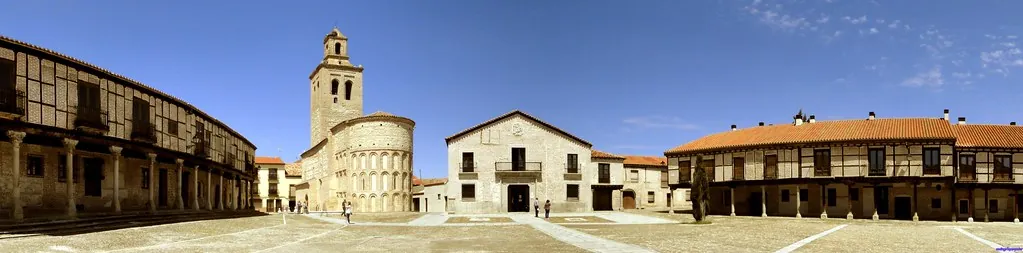
From the A-6 motorway you turn south across a chessboard of wheat and barley. Thirty minutes later the fields simply stop: stone houses, terracotta roofs, a sixteenth-century church tower that still leans a fraction after last century's lightning strike. No souvenir stalls, no interpretive centre—just the smell of straw and diesel drifting down the main road.
Architecture is the village's only museum. Granite quoins hold ochre adobe walls the colour of dry biscuits; wooden lintels, dark with tar and time, sit low enough to bang an unwary forehead. Peek into open doorways and you'll see paving stones worn into shallow saucers by decades of hobnailed boots. Half the houses are holiday homes now—Madrid families who arrive for August and discover that the bakery only opens on alternate days—so shutters clack open and shut according to weekend plans rather than harvest tides.
Walk the back alleys and you reach the paseo de la muralla, a five-minute circuit where no wall actually remains. Instead you get the full 360°: cereal plains rippling to the Sierra de Ávila in the south, the faint blue ridge of the Gredos massif sharpening when the celajes—those high-plateau heat haze—lift at dusk. Bring binoculars in April and you can watch male great bustards flopping their courtship displays among the sprouting rows.
What Passes for a Rush Hour
Birdwatching is the closest thing to entertainment. At first glance the landscape looks empty, but stay still for ninety seconds and the larks start up. Calandra larks rattle overhead; short-toed eagles slide along the thermals; in wet years temporary pools behind the grain coops attract glossy ibis and gull-billed terns that have somehow misplaced the coast. A pair of loaned binoculars from your hire car is enough—no hides, no entrance fee, just the risk of a farmer asking whether you've found his lost dog.
Cycling works too, provided you like your gradients horizontal. The CC-17 district road that loops north to Arévalo is tarmacked, flat and so lightly trafficked that pheasants wander across. A forty-kilometre circuit at sunset gives you wheat silhouettes, threshing barns converted into dove lofts, and the smell of chamomile crushed beneath tyres. Pack two litres of water: the next fountain is in the next village, and that may be closed for fumigation.
Lunch Without a Menu
Food options inside Adanero fit on one hand. The Cafetería Adanero (Calle Real 17) opens at seven for farmers and stays open until the cook runs out of coffee. Mid-morning tostadas come with grated tomato and a glug of olive oil; lunch is whatever María has simmering—perhaps roast-lamb judiones (buttery white beans) or a sopa castellana thick enough to stand a spoon in. Expect to pay €9-€11 including wine that arrives in a plain glass bottle. If the door's bolted, the owner is probably across the square feeding her grandson; knock twice, then wait. British notions of service dissolve here, but so does the bill when you try to tip.
Dinner is trickier. Street lighting switches off at 00:30 and the cafetería's stove goes cold soon after. Self-caterers should stock up in Arévalo (24 km) where the Día supermarket sells local chorizo flavoured with pimentón de la Vera; vegetarians will discover that even the frozen pizza has ham shavings. Alcohol rules are relaxed—you can walk out with a €3 bottle of tempranillo and drink it on the church steps, though the priest may tut if mass is still in progress.
When the Village Remembers It's a Village
Festivity arrives the second weekend of August. The population quadruples, the bakery remembers its opening hours, and a sound system appears in the plaza for orchestras that play Latin covers of eighties hits until the Guardia Civil suggest moderation. The programme is reassuringly small-town: Saturday parade with one gigante and one cabezudo (papier-mâché heads so old they look mildly haunted), Sunday lunchtime paella for 200 cooked in a pan the diameter of a tractor tyre, and midnight fireworks that illuminate the grain silos in primary colours. Visitors are welcome—somebody will press a plastic cup of tinto de verano into your hand—but accommodation within the village is impossible; book early in Arévalo or Ávila if you fancy the show.
Winter strips things back. Atlantic fronts whistle across the plateau; night-time temperatures drop to –8 °C and the stone houses, built for summer heat, demand an extra jumper. This is when Adanero feels most remote: cafés may close for days, the access road turns to slush, and the sky becomes a low pewter lid. Photographers call it "graphite season"—monochrome fields, black poplars scratched against mist, the occasional imperial eagle circling like a paper cut-out. If you're after solitude, January delivers it wholesale, along with the risk of being snowed in for twenty-four hours.
Getting There, Getting Out
No railway, no coach stop—Adanero is strictly drive-in. From Madrid-Barajas airport take the A-6 west for 90 minutes, exit at km 119 towards Arévalo/Ávila, then follow the CL-501 south for 22 km. Petrol is cheaper at the motorway services than in the provincial capital; fill up before you leave the ring road. A small car is adequate; a sat-nav is essential because signposts have a habit of disappearing at junctions.
Where next? Fifteen minutes south lies Arévalo, its brick-plaster mudéjar towers perfect for a coffee refill. Half an hour east, Medina del Campo hosts a vast Renaissance fair in July and a Wednesday flea market where you can buy obsolete tractor parts and 1970s Spanish vinyl. North-west, the Sierra de Gredos offers proper mountain air, glacial lagoons and the chance to swap wheat fields for granite cirques inside an hour's climb.
Worth the Detour?
Adanero will never muscle its way onto a "Top Ten" list. You come for the hush, for the pleasure of guessing a bird from its song alone, for the realisation that Spain can still feel empty once you abandon the coast. The risk is anticlimax: no castle, no gift shop, no postcard moment—just a village that continues because someone still needs to repair the harvester and someone else still bakes bread twice a week. Accept that rhythm and the Meseta gives you something busier Spain cannot: time that stays still long enough to notice it passing.