Full Article
about Albornos
Small farming town in the La Moraña region; it keeps the feel of the Castilian plain villages.
Hide article Read full article
A village set in open country
Albornos sits in the interior of La Moraña, one of the most open districts on Spain’s northern plateau. Tourism here is closely tied to that setting. This is a landscape of cereal fields that stretch with very few interruptions, where the horizon carries more visual weight than any building.
At around 900 metres above sea level and with just over 170 inhabitants, Albornos keeps the quiet scale typical of agricultural villages in the province of Ávila. Life moves at a steady pace, shaped by the rhythms of farming rather than by visitor numbers.
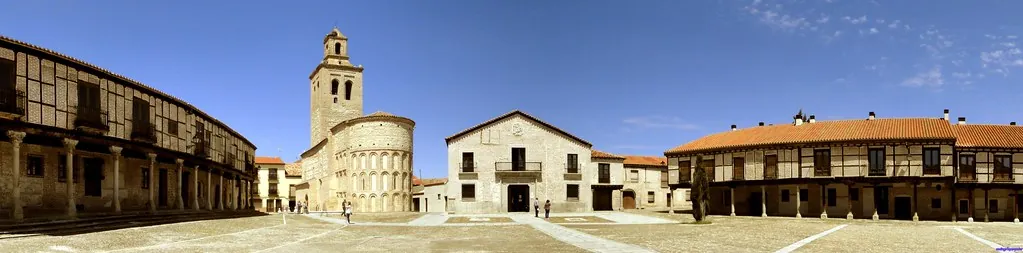
La Moraña developed historically around cereal cultivation and a network of nearby villages connected by paths that cut across working farmland. Albornos fits neatly into that long-established system. It is a compact settlement, with a central square, a parish church and short streets that open out towards the surrounding fields.
San Boal and the shape of the village
The main point of reference in the village centre is the parish church of San Boal. Like many rural churches in the area, the current building reflects different construction phases. Changes and extensions were added over time, depending on what each period could afford.
Its importance lies less in its size than in its position. The square around the church acts as a meeting place and organises the layout of the village streets. From here, the small network of roads spreads outwards in a simple, functional pattern.
Around the square, traditional houses remain in place. Some are built of stone, others finished with whitewashed walls. Their forms respond to the local climate, which brings cold winters and dry summers. Thick walls, compact layouts and modest openings reflect a practical approach to comfort rather than decoration.
The landscape of La Moraña
The main reason to come to Albornos is the landscape itself. La Moraña forms an almost continuous plain where cereal fields define the passing seasons. In spring the land turns green. By summer it becomes a wide expanse of gold. After the harvest, darker soil takes over until the cycle begins again.
There are no pronounced mountains or deep valleys. Interest comes from the sheer openness of the terrain and from the network of agricultural tracks that link one village to another. These paths trace routes that have been used for generations.
Walking or cycling through the area reveals small details that might otherwise go unnoticed. Old farm structures appear from time to time. Stone boundaries mark the edges of plots. An isolated tree occasionally breaks the long line of the horizon, offering a rare vertical element in an otherwise flat landscape.
With patience and a pair of binoculars, the area also offers opportunities to observe steppe birds. Species such as the sisón and the avutarda are still recorded in the district. Sightings are more likely in the early part of the day and in quieter areas where there is little disturbance.
Paths linking villages
Several rural tracks leave Albornos and connect it with nearby settlements across La Moraña. These routes are straightforward and almost entirely flat. They cross cultivated land and give a clear sense of how this agricultural territory is organised.
They are not signposted routes in the formal sense. Instead, they are traditional paths still used by farmers and local residents as they move between fields and neighbouring villages. This gives them a practical character rather than a designed one, and following them offers a direct way to understand everyday movement in the area.
Distances between villages are relatively short, which reflects the historic pattern of settlement across La Moraña. Each community developed within reach of the others, forming a loose but connected network spread across the plain.
A brief, practical visit
Albornos is small and can be explored quickly. A relaxed walk through its streets takes less than an hour, allowing time to pass through the square, see the church of San Boal and observe the local architecture.
Services are limited, which is typical for this part of the region. Visitors generally travel by car to nearby municipalities if they need a wider range of options or plan to stop for a meal. The village itself offers a quieter experience centred on its setting rather than on facilities.
The main appeal lies in the landscape of La Moraña and in the calm continuity of village life. Albornos provides a clear example of how these settlements still function, closely tied to the land that surrounds them and shaped by long-standing agricultural patterns.