Full Article
about Aldeaseca
A cereal-plain municipality with notable Mudéjar art in its religious heritage.
Ocultar artículo Leer artículo completo
The church bell strikes noon and the only other sound is wind moving through wheat. From Aldeaseca's single hill, the view runs uninterrupted to a horizon so wide it makes the sky feel oversized. This is La Moraña, the high cereal basin that bridges Ávila and Valladolid, and at 859 m the village sits high enough for the air to carry a thin, clean edge that London lungs notice immediately.
Castilla y León has grander sights than a 200-soul farming settlement, but that is precisely why travellers still come: to clock off from checklist tourism and watch how the meseta keeps time. The pace is set by sowing and harvest, by the sun's angle on adobe walls, by the evening procession of tractors returning from the fields. If you arrive clutching a city timetable, expect to be gently ignored.
The Horizontal Landscape
Aldeaseca's geography is defiantly flat. Forget the sierra drama advertised further north; here the land rolls like a gently ruffled blanket, dipping just enough to hide the next village five kilometres away. The soil is a chalky clay that sticks to shoes in winter and produces a dust halo in July, when temperatures brush 35 °C and the cereal stalks turn the colour of polished brass. Spring brings the inverse: tender green shoots, flocks of skylarks and clouds that drift low enough to cast racing shadows over whole parishes.
Walking tracks are not sign-posted; instead you follow the farm lanes that radiate out like spokes. A circular trudge south to the abandoned cortijo of El Tomillar and back takes ninety minutes, during which you are unlikely to meet anything larger than a hare. Take water—shade is scarce and the village fountain is sometimes dry by August. Cyclists appreciate the almost car-less tarmac that links Aldeaseca with neighbouring Arévalo (13 km), though the return leg can turn into a slog when the prevailing westerly wind wakes up in mid-afternoon.
Adobe, Stone and Storks
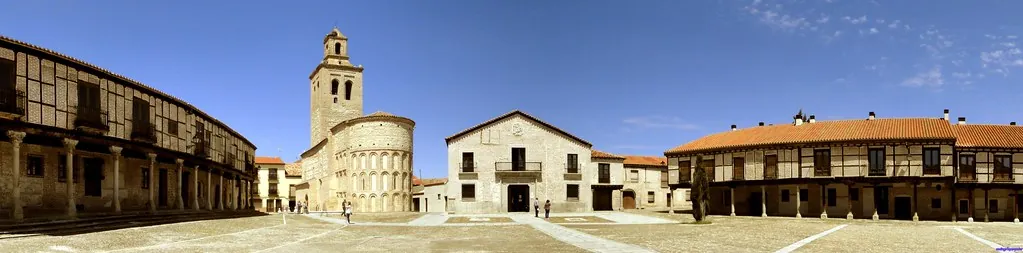
No single monument demands admission, yet the settlement rewards a slow lap. Houses are bonded with a tawny limestone wash that glows honey-coloured at dusk; timber doors, iron-bolted and often centuries old, still seal working storerooms rather than gift shops. The sixteenth-century church of San Pedro keeps its bell tower open: climb on festival days for a 360-degree panorama of grain silos, threshing circles and the occasional ruined dovecote—stone cigars poking from the fields.
Storks nest on every available chimney. Watching them land is a lesson in aviation: wide wings rowing against the thermals, legs dangling like lowered undercarriage, touchdown accompanied by an audible clatter of beaks. They migrate south in late August; the sky feels emptier afterwards.
Eating Like a Harvest Hand
There is no restaurant, only Bar Cervecería La Plaza, open Thursday to Sunday and run by the same family since 1987. Order the menú del día—currently €12—and you receive a bowl of judiones (butter-fat white beans) with chorizo, followed by lechazo, roast milk-fed lamb that shreds at the sight of a fork. Vegetarians get a potato and piquillo pepper stew; vegans should ask in advance or self-cater. House wine comes from neighbouring Peñafiel and tastes better than its plastic carafe suggests.
Fresh produce appears on the picnic table outside the fronton court on Tuesday mornings: lettuces with soil still clinging to the roots, honey sold in re-used gin bottles, eggs priced at two euros a dozen. Bring cash; no one has a card reader and the nearest ATM is in Arévalo.
When to Come, How to Reach
Spring (mid-April to late May) turns the plain emerald and fills the ditches with poppies; early autumn (September) gives you stubble fields the colour of burnt toast and temperatures that drop to jacket-cool after sunset. Both seasons avoid the July furnace and the raw, windy damp of December, when smoke from village chimneys lies in a low haze and the roads can ice over.
Public transport is skeletal. Two daily buses connect Madrid's Estación Sur with Arévalo (1 hr 45 min), from where a local taxi covers the final fifteen minutes for around €18. Hiring a car at Valladolid airport (45 minutes away) is simpler and opens up the whole province; parking in Aldeaseca involves leaving the car where the tarmac ends—traffic wardens have never been seen.
Accommodation is limited to three self-catering casas rurales, two inside the village and one a converted granario 2 km out. Expect stone floors, beams blackened by centuries of grain dust, Wi-Fi that falters when the wind is in the west and nightly rates between €70–90 for two. Book ahead for Easter weekend and the September fiesta; outside those periods you can usually arrange something with 48 hours' notice by telephoning the ayuntamiento.
Fiestas Without the Fuss
The patronal fiesta honouring the Virgen de la Caridad (second weekend in September) involves a Saturday evening procession, brass band included, followed by a community paella cooked over vine prunings in the square. Visitors are welcome to queue with a plate; a donation of €5 is customary. Fireworks are modest—more spark than spectacle—but the evening ends well after 3 a.m., proving that even the most tranquil village can raise its voice when required.
Less advertised is the Verbena de San Juan on 23 June: locals drag garden chairs onto the street, someone uncorks a plastic jug of sangría flecked with peach, and children jump over a brazier for good luck. Tourists are rare; turn up and you will be offered a sausage sandwich before you have time to explain you are British.
The Other Side of the Quiet
Honesty compels a mention of what Aldeaseca cannot give. Nightlife beyond the bar closes at midnight. The only shop sells tinned tuna, tinned tomatoes and tinned beans—fresh milk is classed as a morning luxury that sells out fast. English is patchy: bring Spanish or at least a phrasebook and a smile. Rain turns lanes into gumbo that will coat your trainers; pack walking boots between October and March. And if you crave Alpine views or Moorish palaces, best keep driving—the attraction here is precisely the absence of drama, the sense that after centuries of hard work and hard weather the place has earned its right to do very little.
Come instead to recalibrate your sense of scale: two hours on the edge of this ocean of grain and the mental traffic of modern life starts to settle. When the sun finally drops, the sky performs a slow colour chart—peach, copper, bruised purple—reflected in every window of the village. Then the bell tolls again, the storks clatter home, and the only decision left is whether to have a second glass of wine at La Plaza before tomorrow's wind wakes the fields.