Full Article
about Arévalo
Capital of La Moraña and a Mudejar gem; a historic-artistic ensemble where Isabella the Catholic spent her childhood.
Ocultar artículo Leer artículo completo
The wind hits first. At eight hundred and twenty metres above sea level, it carries the scent of cereal fields across La Moraña and whips through the brick towers that give Arévalo its nickname. From the battlements of the fifteenth-century castle, the view stretches flat and golden to every horizon, broken only by the twin rivers Adaja and Arevalillo that once made this frontier town worth fighting for. It's the kind of vista that makes British visitors realise just how high Spain's central plateau really is—higher than Ben Nevis's base camp, yet barely a ripple on the map.
This is Castile at its most uncompromising. Winters drop to minus twelve, forcing locals to wrap the medieval columns of Plaza de la Villa in foam padding when ice makes the stone arcades lethal. Summers swing the other way, pushing forty degrees and sending residents down to the river paths where poplars offer meagre shade. The altitude means nights stay cool enough to justify the region's hearty food: roast cochinillo that crackles like the best pork belly, and judiones beans stewed with jamón that could fuel a Cambridge crew team through winter training.
The brickwork defines everything. Not the honey-coloured stone of Salamanca an hour away, but proper red clay fired in local kilns since the Moors left. Six churches rise in Mudejar style, their towers patterned like chess boards against the sky. San Martín's bell tower leans slightly after five centuries of wind; Santa María la Mayor keeps its twelfth-century fortress look, as if the congregation expected trouble during Mass. None follow the neat opening hours of English heritage sites—turn up on a Tuesday morning and find the doors locked, come back after the siesta and discover the sacristan has gone to visit his sister in Valladolid. It requires patience, or better still, advance enquiry at the tiny tourist office tucked under the town hall's wooden balcony.
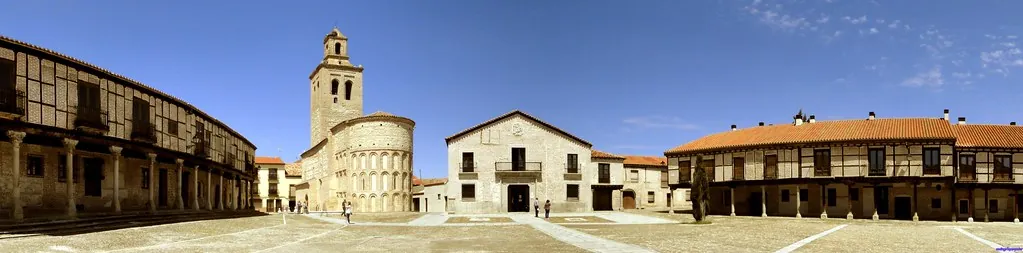
That balcony matters. Plaza de la Villa ranks among Spain's oldest medieval squares, its irregular shape dictated by livestock markets rather than town planners. The arcades mix stone columns with timber beams, some originals still bearing axe marks from when they were hewn in nearby forests. British visitors often pause here, cameras lowered, trying to work out why the place feels familiar yet foreign. The answer lies in scale: smaller than Salamanca's Plaza Mayor, cleaner than most Andalusian squares, and entirely free of souvenir shops selling flamenco dolls. On market Wednesdays, farmers spread beans and saffron across tarpaulins while old men argue about football beneath the porticoes. No one offers overpriced paella to tourists because there aren't any—at least not foreign ones.
The castle keeps different time. Built where rivers meet, its walls once hosted the young Isabella, future queen of a unified Spain. Today it houses the Museo de Cereales, explaining why entire provinces grow wheat visible from space. The exhibition won't blow minds—expect vintage threshing machines and sacks of grain—but it answers the fundamental question of why anyone bothered building a fortress here in the first place. Control the harvest, control the plateau. Opening hours remain stubbornly Spanish: Monday to Friday mornings and evenings, Saturday mornings only. Turn up on Sunday and you'll find locked gates and a guard who shrugs with genuine sympathy.
Between castle and square lies a grid of cobbled lanes where washing hangs from wrought-iron balconies and grandmothers sweep doorways with straw brooms. The town's five thousand souls occupy houses that change little between centuries—whitewashed walls, terracotta roofs, the occasional modern glass balcony that looks frankly embarrassed. At number 14 Calle Real, the bakery makes "patatas de Arévalo", marzipan shaped like potatoes and dusted with cocoa. They travel well, surviving the two-hour drive to Madrid airport intact, though few make it that far.
Getting here requires commitment. The AVE high-speed line thunders past on its way to Galicia but refuses to stop, forcing travellers onto slower regional trains or the A-6 motorway. Public transport from Madrid works only for the determined—the last bus leaves at 17:30, turning missed connections into unplanned overnights. Driving makes more sense, following the A-50 through ochre plains that turn emerald in spring when the wheat germinates. Winter access can prove entertaining: the N-502 occasionally closes when snow drifts across the plateau, though locals regard anything less than thirty centimetres as light dusting.
Staying overnight limits options to essentially three: the Parador occupies a converted sixteenth-century palace opposite the castle, its restaurant serving cochinillo that justifies the €28 price tag for half portions. Two smaller pensions offer rooms above bars where breakfast means coffee and churros consumed alongside truck drivers discussing diesel prices. All require advance booking during Arévalo's brief high seasons—Easter week when processions fill the streets, and August when Spanish families escape coastal humidity for mountain air. Outside these periods, turning up unannounced usually works, though Sunday nights see everything shut tighter than a drum.
The walking helps. A circuit of the town walls takes forty minutes, longer if you stop to read plaques explaining which bits fell down during the War of Spanish Succession. South along the Adaja, a proper footpath leads three kilometres to abandoned watermills where herons fish in pools created by medieval dams. North lies cereal sea—tracks between wheat fields that crunch underfoot in July when the harvest begins. The altitude means you feel every climb: what looks flat from the castle reveals itself as rolling countryside that drops away to river valleys carved over millennia.
Evening brings the real reward. When the day-trippers depart and the wind drops, Arévalo settles into rhythms older than the United Kingdom. Old men play cards under the arcade; women in black coats walk small dogs; teenagers circle the plaza on mopeds that buzz like angry wasps. Order a caña of local Rueda wine—it tastes closer to Sauvignon Blanc than Rioja—and watch the light fade from the brick towers. The temperature drops ten degrees with the sun, reminding you exactly how high you are.
There's no souvenir shop selling fridge magnets. No costumed interpreters staging mock battles. Just a Castilian town that happened to survive the modern age intact, where the baker knows every customer's name and the castle guard locks up at precisely 19:30. It won't change your life, but it might recalibrate your sense of what Spain actually is beyond the costas. Bring cash, patience, and an appetite for pork crackling. Leave the flamenco cliches at home—they never reached this altitude anyway.