Full Article
about Barromán
A town on the Moraña plain, noted for its Mudéjar church and surrounding cereal fields.
Hide article Read full article
A small village on the Castilian plateau
Barromán sits in the centre of La Moraña, about 800 metres above sea level, within the province of Ávila. The landscape here feels wide and level, with only slight undulations breaking the horizon. Agriculture has shaped this territory for centuries, and that long relationship with the land still defines the place today.
Around 170 people live in Barromán. That small population gives a clear sense of its scale and the pace of daily life. This is not a village of grand landmarks or busy streets. Instead, it belongs to a network of rural settlements that grew around farming, where the organisation of space reflects practical needs rather than display.
La Moraña has long been known as a cereal-producing region. Since the Middle Ages, it supplied larger centres such as Arévalo, which acted as a commercial and administrative hub. Barromán formed part of that system, tied to the rhythms of cultivation and exchange that structured the area for generations.
Earth-built houses and a modest parish church
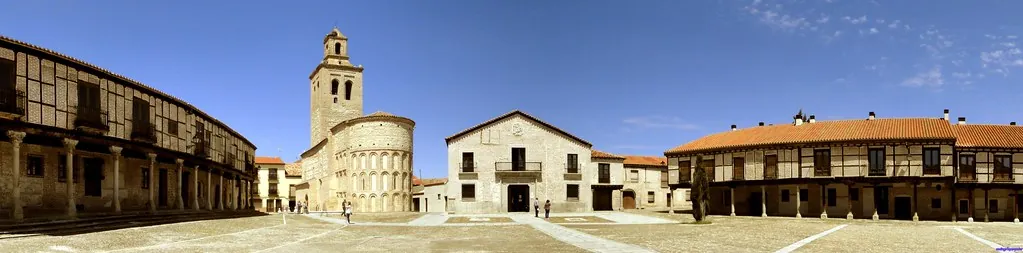
The architecture in Barromán follows the same practical logic as its landscape. Traditional houses made of adobe and tapial still line several streets, sometimes alongside more recent buildings. These techniques use compacted earth reinforced with wood, materials that respond well to the dry climate of the plateau.
Some houses retain wooden galleries on the upper floor. These spaces were used for drying produce or ventilating interiors, and they offer a glimpse into everyday domestic life in earlier periods. The buildings do not aim to impress, but they show how closely construction methods were tied to local conditions.
At the centre of the village stands the parish church. Its origins are usually placed in the 16th century, although later alterations have changed parts of the structure. Like many churches in the area, it has a simple appearance. Inside, there is a modest Baroque-style altarpiece. Its value lies less in visual impact and more in what it reveals about religious art in rural settings.
The wide landscape of La Moraña
The surroundings of Barromán present one of the most characteristic landscapes of northern Spain’s plateau. Large खेती plots stretch outward, with open horizons and very few elements interrupting the view. The scene shifts with the seasons. Spring brings a brief period of green, while summer turns the fields a golden colour as the cereal ripens.
At first glance, the terrain can seem uniform. A slower look reveals subtle changes in light and tone throughout the day. The edges of some fields still preserve old boundaries, where tall grasses grow alongside small trees or traces of former divisions between plots.
Tracks lead out from the village towards neighbouring settlements. Most are dirt paths used by agricultural vehicles. They are generally flat and easy to follow. Walking or cycling along them gives a clearer sense of the scale of La Moraña: long distances, open fields, and villages appearing on the horizon as small clusters of rooftops.
Birds over the cereal fields
The open farmland around Barromán supports a quiet but noticeable range of wildlife. Small birds of prey often circle above the crops, including kestrels. At certain times of year, harriers linked to cereal fields can also be seen.
This is not a place specifically known for birdwatching. Even so, the calm atmosphere and the lack of traffic make it easy to stop and observe. A bit of patience is enough to notice movement in the sky or along the edges of the fields.
Part of a wider network: Barromán and Arévalo
Barromán makes more sense when seen as part of a broader route through La Moraña. A short distance away lies Arévalo, historically the main town of the area. It concentrated commercial and administrative functions, and its influence extended across nearby villages.
Arévalo also preserves several notable examples of Mudéjar architecture in Castile, along with a castle and an urban layout that reflects its importance in the later Middle Ages. Many surrounding villages, including Barromán, depended on this structure at different points in their history.
Understanding that relationship helps place Barromán within a larger context. It was never an isolated settlement, but part of a connected rural system shaped by agriculture and regional exchange.
Traditions that bring people together
Festivities in Barromán usually take place in summer. At that time of year, many people who live elsewhere return to the village. Celebrations focus on the church and on shared gatherings in streets or communal spaces. In a place of this size, these occasions are less about spectacle and more about reunion between families and generations.
Winter brings another reference point with San Antonio Abad. This celebration has traditionally been associated with the protection of domestic animals. In many Castilian villages, it included blessings and bonfires. The exact form of the event can vary from year to year, but its presence connects Barromán to a wider set of rural traditions.
A brief visit with a clear purpose
Barromán can be explored quickly. The urban area is small, and a short walk through its streets is enough to get an overall sense of the place.
The visit becomes more meaningful with the right perspective. This is a village that reflects how agricultural life in La Moraña has been organised over time. Its scale, its earth-built architecture, and the open landscape that surrounds it all contribute to that understanding.
With that context in mind, even a brief stop offers a clear impression of how people have lived here across generations.