Full Article
about Blasconuño de Matacabras
One of the smallest villages; set on the northern plain with an odd name and farmland all around.
Hide article Read full article
The wooden gate on the main street creaks on its hinges, a sound that carries far in the silence of mid-morning. Blasconuño de Matacabras appears as a smudge of ochre and terracotta against the endless cereal fields of La Moraña. Around fourteen people live here, and that number feels exact. The quiet is granular, made of wind over dry grass and the distant call of a bird you can’t quite name.
The name demands an explanation no one can fully give. “Matacabras” hangs in the air, a conversation starter with the ghosts of old shepherds. In places this small, words often outlive their stories.
The architecture of sky and plain
This is flat country. The horizon is a clean, unbroken line where the vast dome of the sky meets the earth. The landscape changes not with hills, but with the hour and the season.
Come April, the fields are a shock of green so vivid it seems to hum under the sun. By late July, that green has baked into a pale, uniform gold, and the air smells of hot earth and cut straw. After the harvest, the land shows its bones—a stubbled expanse of browns and greys. You notice the wind here; it has nothing to stop it, and it pulls fine dust from the tractor tracks into little spirals.
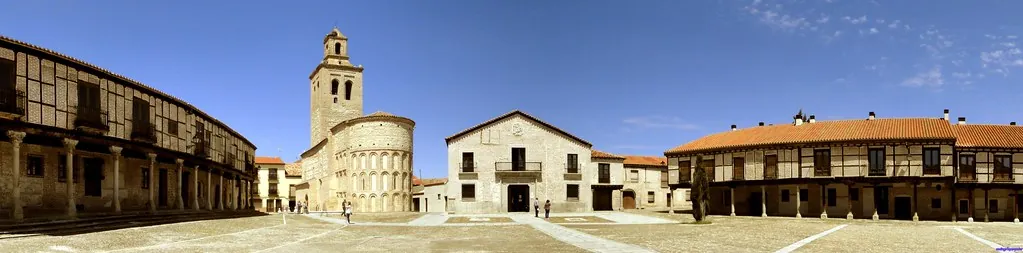
The village itself is a brief arrangement of low houses. You won’t find a shop or a bar. You will find weathered adobe walls, stone lintels, and courtyards behind large wooden doors where chickens scratch the dirt. The church of San Martín Obispo sits at the centre, a 16th-century structure of simple, sober stone. Its espadaña is the only vertical for miles, a useful landmark when navigating the straight roads of the plain.
The only activity: walking out
There are no signposted trails. The logical thing is to pick one of the farm tracks at the edge of the village and follow it into the fields.
These are wide, flat paths of packed earth. You share them with skylarks that burst upward from the barley, and with birds of prey that circle on thermal currents. The walk is easy underfoot but exposed. In summer, from about eleven onwards, the sun is direct and relentless. Carry water and wear a hat. The light is different at day’s end, long shadows stretching from every isolated barn, turning the gold fields a deep, burnished orange.
The rhythm of return
For most of the year, life here is interior, behind those wooden gates. The tone shifts in August. Then, you might hear voices in the street in the early evening, see a door propped open with a stone.
While the patron saint’s day is in November, it’s during the summer months when former residents return to air out their houses. For a few days, the population triples or quadruples. Benches appear in doorways, and conversations pick up where they left off last year, once the worst of the afternoon heat has passed.
A practical note on light and isolation
Blasconuño de Matacabras is about 40 kilometres north of Ávila, reached via a web of straight secondary roads through open fields. You need a car; there is no bus service.
The best time to come is late spring, for that intense green light and bearable temperatures. If you visit in summer, walk early or very late. Winter has its own severe beauty—the plain under a sheet of snow is a monochrome study in emptiness, but the cold wind cuts like a blade.
This village makes no special provision for visitors. It offers what it has always had: immense sky, whispering grain, and a profound stillness that allows you to hear your own footsteps on the gravel path. Sometimes, that is precisely what you need.