Full Article
about Blascosancho
A town in eastern Moraña; it keeps traditional architecture amid crop fields.
Hide article Read full article
A Small Village on the Moraña Plain
Blascosancho is the sort of place that makes you think of a grandparent’s house in the countryside: a handful of streets, near silence for most of the day, and the feeling that daily life still runs much as it did decades ago. There is not a great deal to “see” in the conventional tourist sense. What there is, instead, is the chance to understand how villages in La Moraña really are.
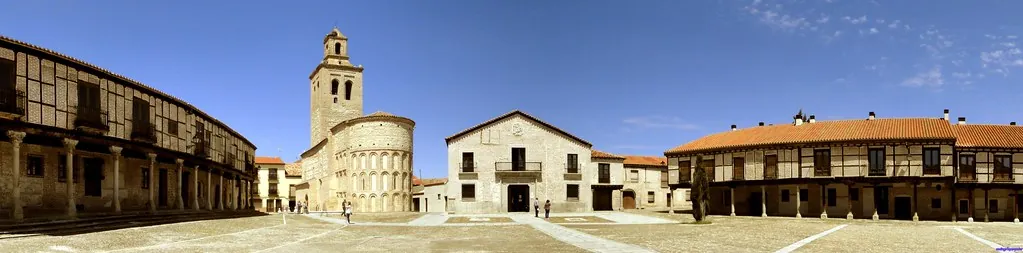
With just over 80 inhabitants, Blascosancho follows the pattern of many settlements on the plains of the province of Ávila. Stone and adobe houses line short streets that almost always lead back to the square or the parish church. Beyond the last row of buildings, cereal fields take over and stretch in every direction.
The village sits at around 900 metres above sea level, in the heart of the comarca of La Moraña. For anyone unfamiliar with this part of Ávila, the first impression tends to be the same: a flat horizon, open fields and a vast sky.
There are no nearby mountains to interrupt the view. At sunset the sky seems to claim half the landscape. It is a simple scene, yet if you stand still for a while it begins to make sense. Here, the landscape works on a broad scale.
The centre of Blascosancho is compact. A small cluster of streets connects the main square with the parish church of San Pedro, which has been the village’s meeting point for centuries. It is a sober church, the kind that does not aim to impress but has endured generation after generation with few changes.
The houses reflect the traditional style of the area: thick walls, a mix of stone and adobe, and gradual alterations made over the years. Some still retain arcades or old iron window grilles, details that reveal themselves when you wander through without rushing.
Life Set by the Fields
In Blascosancho, the calendar is not organised by travel guides. It is set by the cereal crop.
Wheat and other dryland crops dominate the fields around the village. In summer everything turns yellow, an intense shade that can appear almost white under the strong Castilian sun. In autumn the tones become more muted, with freshly worked earth taking centre stage.
Agriculture, along with some livestock farming, has always been the backbone of the village. There is less activity today than there once was, as is the case across much of the comarca, but the countryside still shapes daily life.
Walking along the tracks that lead out of the village, it is normal to come across tractors, trailers or a local resident checking on a plot of land. This is not a staged rural setting. It is simply how things are here.
That connection to the land also explains the steady rhythm of the place. Activity rises and falls with the seasons. Harvest time feels different from the quieter winter months, even if the village itself remains small and understated throughout the year.
Dovecotes and Traces of Rural Economy
In the surrounding area you can still spot several palomares, traditional dovecotes. Many are in a poor state of repair, yet they remain standing as reminders of how rural economies once functioned.
For a long time these structures acted as a modest pantry. Pigeons were used for food, and their droppings were valued as fertiliser. In cereal-growing areas such as this, dovecotes were common.
Elsewhere, dry stone walls mark out plots of land or trace old agricultural paths linking Blascosancho with neighbouring villages. These constructions may seem modest, but they speak of a landscape shaped by work and necessity rather than ornament.
Together, these elements help explain how life was organised in places like La Moraña. The village and its surroundings form a single unit, with buildings, fields and tracks all tied to the same agricultural logic.
Walking the Tracks of La Moraña
For those who enjoy straightforward walks, the paths leading from Blascosancho towards villages such as Peñalba or Villavieja del Cerro offer a clear view of the comarca’s typical landscape.
There are no signposted trails or specially prepared routes. These are long-established agricultural tracks. That is part of their appeal: long straight lines, open fields and a great deal of silence.
The terrain is generally flat, which makes walking uncomplicated. The experience is less about reaching a specific viewpoint and more about absorbing the scale of the plain. With nothing to block the horizon, distances feel both vast and easy to measure.
Anyone carrying binoculars will probably find it easy to spot steppe birds, which are well suited to this kind of open terrain. Stay until sunset and the light across the fields can shift quickly, altering colours and contrasts in a matter of minutes.
The changes are subtle rather than dramatic. A field that seemed pale at midday may turn a deeper gold, then fade towards grey as the sun drops. With so few vertical elements in the landscape, even small variations in light become noticeable.
What to Expect from Blascosancho
Blascosancho is not a destination designed to fill an entire day with activities. It works better as a calm stop for understanding what small villages in this part of Ávila are like.
You can walk around it quickly. One circuit on foot is enough to form a clear picture of the place. The interest lies in the details: old houses, the unhurried pace, the expanse of fields all around.
Anyone arriving in search of major monuments or organised tourist attractions may find it lacking. Blascosancho does not offer that kind of experience. Its appeal is quieter and more understated.
For travellers curious about rural Spain beyond well-known landmarks, it provides context. It shows how settlements in La Moraña have adapted to changing times while still retaining their basic structure and relationship with the land.
Time here seems to move slightly more slowly. That sensation is not created for visitors. It comes from the scale of the village, the open plain and a way of life that still revolves around the fields. Within the map of La Moraña, Blascosancho fits naturally as one more small point on a wide horizon.