Full Article
about Cabezas de Alambre
Brick-built town on the plain; noted for its church and quiet streets.
Hide article Read full article
A Different Pace in La Moraña
Some villages come with a checklist: viewpoint, museum, photo, on to the next stop. Tourism in Cabezas de Alambre works differently. It feels more like pulling into a roadside petrol station and ending up in a half-hour conversation with someone local. Not because there is a long list of sights, but because the place quietly insists that you slow down.
Cabezas de Alambre sits in the middle of La Moraña, just over half an hour from Ávila along roads that cut through cereal fields from one side of the horizon to the other. A little over 150 people live here. The landscape sets the tone: open terrain, wide skies and fields that shift in colour with the seasons. In spring everything turns green. By harvest time the land takes on that deep golden shade so closely associated with Castilla.
The village has the air of somewhere that made peace with time decades ago. There is no tourist noise, no signs competing for attention. The streets are simple, the houses built from stone and adobe, and daily life seems to follow a rhythm that has barely altered in years.
The Church on the Skyline
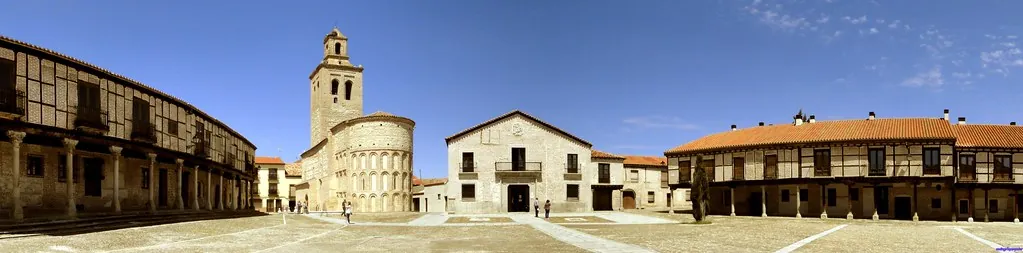
In Cabezas de Alambre there is one clear landmark: the parish church. Its tower is visible from several points before you even enter the village, a familiar sight in this part of the province of Ávila where church towers often define the skyline.
The building combines stone with elements from the Mudéjar tradition, a style that developed in Spain under Christian rule but drew heavily on Islamic artistic and architectural influences. In La Moraña this blend is common. The church here is not monumental, nor does it receive a steady flow of visitors. In fact, it is usually closed unless there is a service. Even so, walking around the exterior gives a good sense of how these temples were constructed in small agricultural communities.
The oldest part of the village clusters around the church. From there, the streets extend outwards in short stretches that can be covered easily on foot.
Short Streets, Solid Walls
Exploring Cabezas de Alambre does not take long. An hour is enough to walk the entire village at an unhurried pace. The interest lies in the details rather than in grand sights.
Many houses still have thick walls, large wooden gates and small windows protected by iron grilles. Some properties have been restored, others show the passing of time without disguise. It is the kind of place where an old cart might be leaning against a wall, or where an inner courtyard can be glimpsed through a half-open door.
Then there is the silence. At times the only sounds are a dog barking, a tractor in the distance or the wind moving through the cereal crops. For visitors used to busier destinations, that quiet can feel striking.
There are no attractions competing for attention, no marked routes demanding to be followed. The experience is simply that of walking, observing and letting the atmosphere settle.
The Landscape That Sets the Rules
Anyone arriving in search of mountains or dense forests will have chosen the wrong destination. La Moraña plays by different rules: broad horizons and flat land that stretches for kilometres.
The surroundings of Cabezas de Alambre are largely farmland, broken here and there by scattered holm oak groves. Agricultural tracks leave the village in several directions. They can be followed on foot or by bicycle without much difficulty. These are straightforward routes, suited to stretching your legs while looking out over open countryside.
The seasons shape the experience. In winter the wind is more noticeable and the cold can bite. In summer the sun bears down strongly and the landscape becomes dry and austere. This is Castilla in its purest form: expansive, exposed and defined by agriculture.
There are no dramatic natural landmarks, yet the sense of space is part of the appeal. The horizon feels distant, the sky broad. It is a setting that invites slow walking and long views rather than busy itineraries.
Village Life and Festivities
Social life in Cabezas de Alambre revolves largely around the traditional calendar. The patron saint festivities are usually held in summer, when those with family ties to the village return, even if they live elsewhere for most of the year.
These celebrations are simple: a procession, music at night and plenty of conversation in the square. They are less an event designed to attract outsiders and more a reunion of neighbours and relatives. For visitors who happen to be in the area at the right time, they offer a glimpse of how closely knit small communities remain.
In winter, rural customs still survive, including family pig slaughters, known in Spain as matanzas. Today these tend to take place in a private setting rather than as public events, but they reflect the agricultural roots that continue to shape life here.
Daily routines are understated. The village is small enough that everyone knows one another, and the pace is dictated by the fields and the seasons rather than by tourism.
How to Fit a Visit into Your Plans
Cabezas de Alambre is not a destination for a full day of activities. It works better as a quiet stop if you are travelling through La Moraña or moving between villages in the area.
Arrive, take a walk, look at the church, follow one of the tracks leading out towards the fields. In doing so, you gain a clearer sense of what small plateau villages in this part of Castilla y León are like.
There is value in that simplicity. Some places do not require a packed programme to justify a visit. A short, slow stroll can be enough to understand how life unfolds there. Cabezas de Alambre is one of those places, defined less by sights than by atmosphere, less by spectacle than by the steady rhythm of a rural community in the heart of La Moraña.