Full Article
about Cabezas del Pozo
Small farming town; keeps the charm of the adobe-and-brick villages of the northern area.
Hide article Read full article
A Turn Off the Road in La Moraña
Some places appear almost by accident. You are driving along a secondary road in the province of Ávila, glance across the fields and spot a bell tower rising above the crops. On impulse, you turn off for a look. That is often how people arrive in Cabezas del Pozo, a village where time seems to move at a different pace.
There is nothing designed to catch your eye. No grand entrance, no sign promising attractions. And that is precisely the point. With around eighty registered residents, Cabezas del Pozo stands in the heart of La Moraña, a comarca in the north of Ávila known for its vast cereal plains. The landscape stretches out in long horizons, especially stark in winter when the wind sweeps across open ground. Every few kilometres, another small settlement appears, like a cluster of stone and tiled roofs set down in the middle of the fields.
This is rural Castile in its simplest form.
A Village That Still Makes Sense
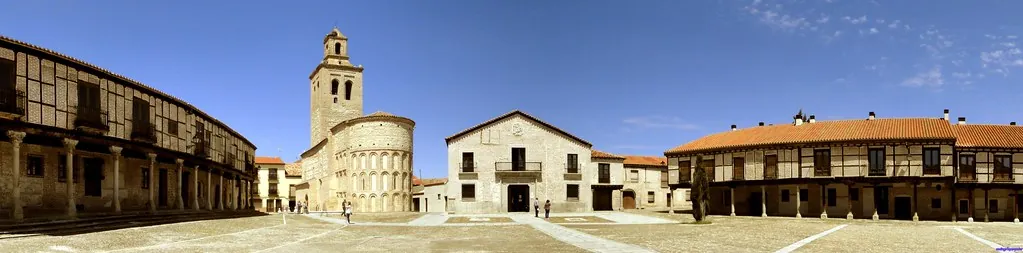
The centre of Cabezas del Pozo is small and easy to walk. A handful of streets, stone houses built from local masonry, some whitewashed walls and large wooden gates that hint at a time when each home had a yard or corral behind it. The architecture does not attempt to impress. It was built to last, and it has.
Wells can still be seen in courtyards and enclosures, a common feature in this part of Ávila and the reason behind the village’s name. Many remain in place even if they are no longer used as they once were. Strolling slowly through the streets, traces of the area’s agricultural past become clear. Old grain stores, simple sheds and small presses that some neighbours still keep speak of a life closely tied to the land.
Nothing here feels curated. It is simply the way the village has evolved over time.
The Church at the Centre
In settlements of this size there is usually one place around which everything revolves. In Cabezas del Pozo, that role belongs to the parish church. Built in stone and without elaborate decoration, it reflects the same restrained character as the rest of the village.
Its interest lies less in artistic detail and more in its function. The church remains a meeting point during festivals and celebrations, a space that still gathers people together. Even when the square is empty, there is a sense that it has witnessed years of shared moments, from religious events to informal conversations after mass.
In villages across Castile, the church often anchors daily life. Here, it continues to do so in a quiet, matter-of-fact way.
Open Tracks and Wide Skies
The real appeal of Cabezas del Pozo begins once you step beyond the built-up area. Several agricultural tracks lead out from the village, linking it with other nearby communities in La Moraña. These are flat paths used by tractors and local residents, suitable for walking or cycling without worrying about steep climbs.
There are no dramatic viewpoints or rugged scenery. What defines this landscape is space. In spring the fields turn a soft green for a brief period before the colour fades. By summer, the land shifts to gold and the sun falls directly across the plains with little to interrupt it.
This is classic Castilian countryside, shaped by cereal farming and long agricultural cycles. The changes between seasons are subtle but noticeable if you spend time looking.
The area is also known for steppe birds. With patience and a pair of binoculars, it is possible to spot species such as the avutarda, known in English as the great bustard, and the sisón, or little bustard, in parts of the comarca. Towards dusk, a harrier may be seen flying low over the crops. There are no signposted wildlife routes, just open land and the possibility of seeing what lives there.
For those who enjoy uncomplicated walks under wide skies, this setting offers exactly that.
Food and Sleep: Come Prepared
It is best to be clear about expectations. Cabezas del Pozo is not a gastronomic destination, nor a place to visit in search of terraces or restaurants. It is a very small village, and services are limited.
Travellers passing through the area typically base themselves in slightly larger towns nearby. Across La Moraña, however, the culinary tradition remains rooted in simple Castilian cooking: pulses, hearty stews, cured meats and spoon dishes that are particularly welcome when the cold wind blows across the plain.
The food reflects the climate and the agricultural setting. It is practical, filling and tied to local produce rather than presentation.
When the Village Fills Again
Like many villages in Castilla, Cabezas del Pozo comes to life during its summer patronal festival. At that time, former residents who now live elsewhere return to spend a few days in the place where they grew up.
The pattern is familiar across the region. For most of the year, the streets are quiet. Then, during the festival, there is music, groups of neighbours talking in circles and children running around the square. The church once again becomes a focal point, and the village briefly regains a busier rhythm.
Afterwards, the celebrations end and daily life returns to its usual calm.
Is It Worth the Detour?
Cabezas del Pozo is not a place to travel to from far away as a stand-alone destination. There is no famous monument, no landmark that appears on postcards. It does not aim to compete with larger historic towns in Ávila province.
Yet if you are exploring La Moraña, or simply driving through this part of Castilla Leon and feel like turning off the road for a while, stopping here makes sense. A short walk through its streets, a glance at the wells and stone houses, and a stroll along one of the agricultural tracks offer a clear impression of how life unfolds in this stretch of the Meseta, Spain’s high central plateau.
Travel is sometimes about ticking off major sights. At other times, it is about pausing for ten minutes, walking without a plan and continuing your journey with a slightly better understanding of the map. Cabezas del Pozo belongs to that second category.