Full Article
about Canales
Tiny Moraña municipality; known for its quiet and modest traditional architecture.
Hide article Read full article
At eight in the morning, before the sun has properly warmed the cereal fields around Canales, the quiet feels heavier than usual. A dog barks somewhere in the distance, and the wind brushes against the grain. Stone and rammed-earth houses, with thick walls and curved roof tiles, still hold on to the night’s shade. In a village of barely forty-something residents, the day begins slowly.
Canales sits in the heart of La Moraña, a rural area in the north of the province of Ávila. It is one of many small settlements scattered across this wide plain, reached by secondary roads that cut through open farmland. The village stands on flat ground at just over 800 metres above sea level. That elevation brings a slight coolness to summer nights, even though daytime heat can be intense in July and August.
Here, La Moraña shows itself plainly. The horizon stretches far, broken only by cereal plots, a few clusters of trees near the houses and a wind that is almost constant. In summer the land turns dry and golden. In spring, if the rains have been kind, the fields shift to a vivid green that lasts only a few weeks.
The Church and the Village Core
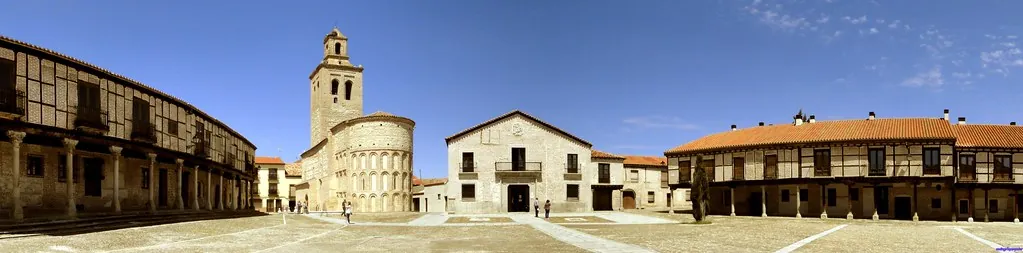
The parish church of San Cristóbal is easy to spot, its bell tower rising above the rooftops. It is not large or particularly ornate, yet it anchors daily life in the village. The stone has a muted tone shaped by time, and the main streets spread out around it.
A slow walk through Canales reveals wide gateways once designed for carts, interior courtyards barely visible from the street, and façades where rammed earth appears beneath layers of more recent limewash. There is no marked route to follow. The village can be crossed in a matter of minutes, though it rewards a slower pace, paying attention to details that reflect a way of life closely tied to agriculture.
The layout feels practical rather than decorative. Everything points back to the land: storage, access, shelter. Even in its stillness, the village carries that connection.
Tracks Through the Fields
Several agricultural tracks lead out from the edges of Canales. They are not signposted walking routes but working paths used by farmers to reach their fields. They are wide, made of compacted earth, and easy to walk as long as the surrounding farmland is respected.
From these tracks, the character of La Moraña becomes clear. The terrain is almost completely flat, allowing views to travel a long way. On clear days, looking south, the distant outline of the Sierra de Ávila appears as a faint blue line, breaking the otherwise horizontal landscape.
These paths also offer a chance to notice birdlife. Large flocks often move across the fields, and birds of prey can be seen gliding once the air begins to warm towards mid-morning. There is little to interrupt their movement, and the openness of the land makes everything more visible.
Walking here is less about reaching a destination and more about observing what is already there: the changing colour of the crops, the steady wind, the scale of the sky.
Nightfall and the Sky Above
As evening turns to night, Canales becomes almost completely dark. Stepping just a short distance away from the last houses is enough for the sky to deepen dramatically. On clear summer nights, far more stars are visible than in urban areas.
There is a distinct stillness at that hour. The sound of insects fills the air, the dry scent of the earth lingers, and the temperature drops quickly once the sun has gone. The absence of artificial light sharpens everything, from the outline of the land to the brightness overhead.
It is a simple experience, yet striking in its clarity. The landscape that feels so open during the day becomes something quieter and more enclosed under the night sky.
When to Go and What to Expect
Spring is often the most comfortable time to explore the surroundings. Temperatures are mild, and if rainfall has been sufficient, the fields turn green for a short but noticeable period. It is a brief window when the plain looks very different from its summer appearance.
Summer brings long days and clear skies. The light is strong and constant, and the heat can be intense at midday, pressing down on the open land. Early morning and late afternoon are more suitable for walking, when the temperature is less severe and the light softens the edges of the fields.
In autumn, the colours shift towards ochre tones, and nights begin to turn cold. Winter can feel harsher. The wind becomes more cutting, and the sense of isolation increases across the plain.
Canales is a very small village with limited services. Bars or shops are not always open, so it is sensible to bring water or something to eat if planning to spend several hours walking in the area. The experience here is not about amenities or attractions in the usual sense, but about the landscape itself and the rhythm of a place where little changes quickly.
In that stillness, shaped by fields, weather and distance, Canales offers a clear view of La Moraña as it is.