Full Article
about Castellanos de Zapardiel
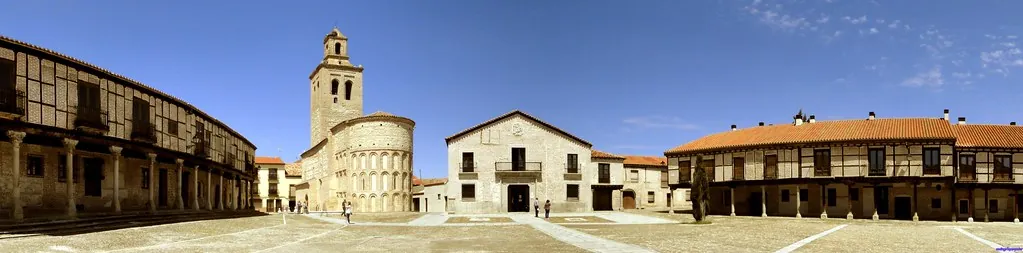
Small town on the banks of the Zapardiel; farmland and traditional plain architecture.
Hide article Read full article
A village that moves to a different rhythm
Some places seem to run like a clock, only much slower. Castellanos de Zapardiel is one of them. On arrival, what stands out is not a grand monument or a busy square, but the quiet of the surrounding countryside and the steady movement of agricultural machinery along the tracks. In this part of La Moraña, in the province of Ávila, daily life has revolved around the land for generations.
The village has just over a hundred residents and lies roughly 180 kilometres from Madrid. That small population already hints at the atmosphere. People know each other, and the pace of life follows the agricultural cycle rather than any external schedule. There are no large museums or attractions designed for visitors. What you find instead is a kind of calm that is increasingly rare if you are used to city life.
San Andrés, the centre of village life
At the heart of Castellanos de Zapardiel stands the parish church of San Andrés. It is not an imposing structure. Rather, it belongs to that group of Castilian churches that have gradually changed over the centuries, adapting to the needs of each period. The building combines masonry walls with sections of rammed earth, and its entrance is notably simple.
Walking around it gives a sense of how the village is organised. The church still acts as a reference point for everyday life. Celebrations take place here, as do gatherings, and when the time comes, the local festivities also revolve around it.
Adobe streets and traces of rural life
The village layout mixes older houses with more recent alterations. Many homes retain adobe walls or whitewashed façades, features that are typical across La Moraña. Attached to some of these houses are old corrales, traditional enclosures once used for animals. Some remain in use, while others have been converted into storage spaces or garages.
A walk through the streets does not take long. Castellanos de Zapardiel is not a large place. What makes it interesting is how clearly everything reflects a life tied to the countryside. There are garages designed for tractors, wide courtyards, and large gates built for daily work rather than appearance. The practical needs of farming have shaped the village more than any aesthetic plan.
La Moraña: wide horizons and changing seasons
The real setting of Castellanos de Zapardiel lies beyond its streets. La Moraña is a region defined by open horizons and extensive cereal fields that shift in appearance throughout the year.
In spring, the landscape turns green almost overnight. By summer, golden tones dominate as wheat and barley ripen under the heat, which arrives early in the day. Autumn brings a more stripped-back scene, with ochre colours and the broad skies typical of Spain’s central plateau.
For those who enjoy walking, the easiest option is to follow one of the agricultural tracks that leave the village. These are dirt paths used by tractors and farm machinery. They are not marked hiking routes, but they offer a straightforward way to explore the surrounding countryside without difficulty.
Steppe birds and the sound of silence
This open terrain is also home to steppe birds, species adapted to wide, treeless landscapes. With some patience and a pair of binoculars, it is possible to spot great bustards moving across the fields, along with harriers and different types of lark.
There are no dedicated observation points or facilities. The usual approach is simple: stop along a track, step out, and scan the horizon.
And then there is the silence. When no tractor is passing, it becomes almost absolute. It is one of the defining features of the area, as much as the fields themselves.
A small village with simple services
In Castellanos de Zapardiel, services match the size of the population. For shopping or a livelier atmosphere, people usually head to nearby towns within the region.
Even so, the village changes noticeably in summer. Many houses reopen, and more people return, often those with family roots in the area. Streets become livelier, especially in the evening. It is common to see neighbours sitting outside their homes, talking at an unhurried pace as the heat of the day fades.
The patron saint festivities are typically held in September. They bring together many of those who maintain ties to the village, even if they now live elsewhere. These are days of processions, music and family gatherings, a pattern shared by many villages in this part of Spain.
Is it worth the detour?
Castellanos de Zapardiel is not a destination for grand sights. It is better understood as a place that helps explain what life is like across the plains of La Moraña.
If you are already travelling through this part of Ávila, it makes sense to stop. Park, take a short walk through the streets, then head out along the cereal tracks for a while. Listen to the quiet of the fields. In places like this, the interest often lies precisely there.