Full Article
about Cisla
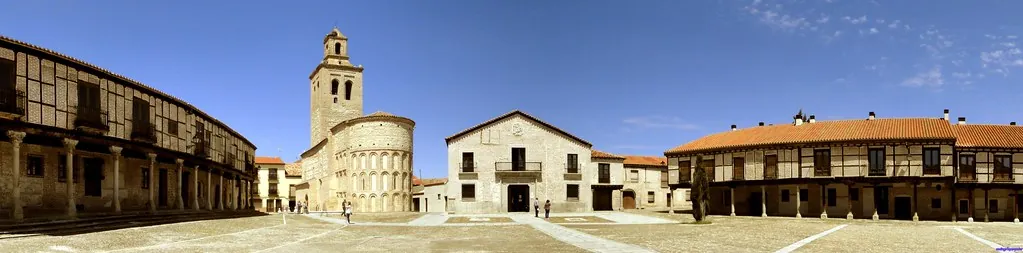
A town on the plain with a notable Mudejar church; quiet, agricultural setting.
Hide article Read full article
A village that reveals itself quickly
Some places take time to figure out. Cisla is not one of them. You arrive, take a short walk around the few streets, and you have a clear sense of what it is. Tourism here works in that same straightforward way. With just over a hundred residents in the Moraña region of Ávila province, this is not a village arranged to impress visitors. It is an agricultural settlement at around 850 metres above sea level, where daily life still revolves around the land.
First impressions tend to be consistent: adobe and brick, quiet streets, and a noticeable absence of noise. Not the curated kind of silence often described in travel guides, but something more matter-of-fact. There is little traffic, and no urgency to fill the space with activity. It feels like a very direct expression of Castile, if that can be said.
The surrounding landscape follows the familiar pattern of La Moraña. Broad, open cereal fields stretch out across mostly flat terrain, shifting colour with the seasons. Spring brings greens, summer turns everything into a strong yellow that can feel almost blinding in full sun, and autumn softens the tones again. For those who enjoy walking without a fixed plan, the tracks between fields have their own appeal.
Looking closely at Cisla
The most recognisable building is the parish church of San Juan Bautista. It matches what you find in many small villages in the province: restrained, with little ornamentation, and closely tied to the rhythm of local life. Outside of religious services it is usually closed, which is typical in places of this size.
Beyond that, the interest lies in the details scattered across the village. Some houses still have old adobe or brick walls, with small windows designed to keep out the winter cold. Others have been updated, yet retain the traditional rural layout, often organised around an interior courtyard.
Here and there, older agricultural structures appear. There are corrales, once used for keeping animals, and occasional underground cellars. They are not marked or presented as attractions, but they give a sense of how domestic life used to be organised when farming and livestock shaped nearly everything.
Walking out into La Moraña
Cisla works well as a starting point for exploring the surrounding countryside on foot. There are no official routes or interpretive signs. The paths are working tracks, used by people who tend the fields.
The advantage is the terrain itself. It is mostly flat, so walking is easy and does not require much planning. It is common to come across tractors or locals checking their land, so it is best to step aside when needed and avoid entering planted areas.
With a pair of binoculars, it is possible to spot birds of prey circling above the fields. The environment is shaped by cereal farming, so expectations should be modest, but towards the end of the day species such as kites and kestrels often appear, taking advantage of rising air currents.
Nearby places and wider context
A visit to Cisla is often combined with stops in other nearby villages. La Moraña is known for its churches in the Romanesque-Mudéjar style, a blend of medieval architectural traditions that can be found across the region. Small towns in the area also preserve discreet traces of medieval layouts and structures.
The city of Ávila is within reasonable driving distance, making it a natural addition to a day out. After time spent walking through fields and quiet streets, heading there offers a contrast with more monumental architecture and a larger urban setting.
Eating and planning your stop
Cisla does not have tourist infrastructure in the usual sense. It is not a place for moving between bars or restaurants over the course of a day. Planning ahead makes things simpler.
Many visitors bring something to eat or arrange to stop in a nearby town with more services. Across the area, local cooking is shaped by ingredients such as legumes, hearty stews, and meat from cattle or lamb raised in the province. These dishes are a consistent presence in the wider regional cuisine.
Summer and the village at its liveliest
Like many small villages, Cisla changes rhythm in summer. August in particular brings back residents who live elsewhere for most of the year, and the population briefly expands.
The patron saint festivities dedicated to San Juan Bautista are the focal point. They usually include processions, traditional music, and long family gatherings that fill the streets and the main square. These celebrations are not designed as a visitor attraction. They are, above all, a yearly reunion for the people connected to the village.
If a visit coincides with these days, the best approach is simply to observe respectfully and follow the atmosphere as it unfolds. In a place this small, the celebrations remain rooted in community rather than tourism.
Cisla does not try to stand out. It is an agricultural village in La Moraña where the landscape sets the pace, and where understanding comes from spending time walking the paths that lead out from the centre. For many, that is enough.