Full Article
about Collado de Contreras
A Moraña village with an interesting church amid cereal plains.
Hide article Read full article
By late afternoon, when the sun begins to dip over La Moraña, the air carries a dry scent of stubble and warm earth. Cereal fields stretch in every direction and the wind moves across them without obstruction, bending the heads of grain with a steady murmur. In this wide, open landscape sits Collado de Contreras, a small village in the province of Ávila where daily life still follows the agricultural calendar and the routines of its 147 residents.
There are no dramatic shifts of scenery here. The defining features are the flat plain, cold winters, long summers and a way of life that continues to revolve around the land.
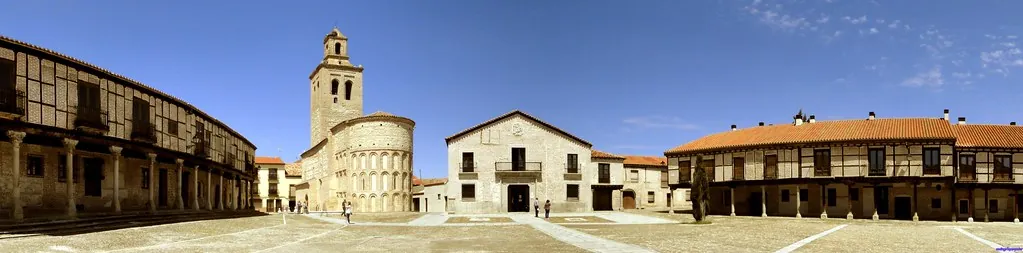
The square and adobe houses
The village is organised around a simple central square where the parish church stands. Earthy tones dominate at first glance: adobe walls, stone plinths and wooden gates that have been replaced or repaired over time. Many houses show gradual alterations carried out in different periods, with materials that reflect changing needs and possibilities. The result is not architectural uniformity but a practical logic shaped by farming life. Interior courtyards, animal pens and thick walls protect against the winter cold.
Early mornings are quiet. The soundscape rarely goes beyond a car starting up or the metallic slam of a door on an agricultural shed. Collado de Contreras rises early, in step with fieldwork rather than office hours.
The scale of the village means that everything lies within a short walk. From the square, it takes only minutes to reach the edges of the settlement and the tracks that lead out into open country.
Open fields and distant horizons
The surroundings of Collado de Contreras reflect the typical landscape of La Moraña. Large plots of farmland spread out in straight lines, crossed by long dirt tracks and framed by a horizon that always seems slightly out of reach.
Each season alters the palette. Spring turns the fields green, with small patches of wildflowers appearing among the crops. Summer brings the yellow of ripened grain and the sharp smell of freshly cut straw. After the harvest, the land lies flat and exposed, and the wind sweeps across it with even greater force.
There are no marked viewpoints. Any of the slight rises around the village offer views that extend for kilometres across the plain. On clear days, the bluish outline of the Sierra de Ávila often appears to the south, faint but distinct against the sky.
This is not a landscape of forests or dramatic rock formations. Its character lies in space and light. The sense of scale becomes clearer the longer you look: fields merging into one another, tracks running straight ahead, the sky occupying as much presence as the ground below.
Along the agricultural tracks
Several dirt tracks lead out from Collado de Contreras towards other villages in the comarca, or local district, of La Moraña. These routes serve tractors and farm machinery first and foremost, yet they can also be walked or cycled if you are prepared to share the way with working vehicles.
Silence defines much of the experience. Birds provide the main interruption. The cereal plains of the Meseta still support species typical of this habitat: crested larks on the ground, harriers gliding low in search of prey and, with some luck, great bustards moving slowly between the crops.
Shade is scarce across these open fields. The summer sun bears down hard in this part of the province, so the central hours of the day are best avoided in the hottest months. Conditions shift quickly once the sun drops, when the wind regains its edge and the temperature falls.
The appeal of these walks lies in their simplicity. Straight tracks, wide views and the constant presence of sky define the route more than any specific landmark.
Food rooted in the Meseta
Cooking in this area of Ávila remains closely tied to local produce and long-established habits. Pulses play a central role in everyday meals, forming the base of hearty dishes prepared slowly rather than hurriedly. Lamb features regularly, reflecting the livestock traditions of the region. Traditional potato recipes are also common across the province.
In many households, bread is still baked in the traditional way. The winter calendar often includes the matanzas familiares, the family pig slaughters that have long formed part of rural life. These practices connect food directly to the agricultural cycle and the seasons.
Meals tend to reflect the climate and the demands of fieldwork. Substantial stews suit the cold winters, while the rhythm of preparation follows the pace of village life rather than strict timetables.
Festivities and the return of former residents
As in many small villages, the year changes pace when the summer patron saint festivities arrive. During these days, people who now live elsewhere return to Collado de Contreras. The population swells beyond its usual figure, and the streets take on a livelier atmosphere. Music fills the evenings, neighbours gather for long conversations outdoors and processions follow routes that form part of local tradition.
Winter presents a different picture. January often brings celebrations linked to San Antón, a saint associated with animals and rural life. Bonfires and neighbourhood gatherings take place if the weather allows, offering moments of shared warmth during the coldest period of the year.
Outside these occasions, daily life is calm. The contrast between the busy summer festivities and the quiet winter months highlights how strongly the village rhythm depends on both the seasons and the agricultural calendar.
Getting there and moving around
Collado de Contreras lies around 45 kilometres from the city of Ávila. Access is via regional roads that pass through other villages of La Moraña, with long stretches running between open fields.
There is no tourist infrastructure and no large designated parking areas. Visitors usually leave their car on a wide street near the square and continue on foot. The village is small, and within a few minutes you reach the tracks that lead out into the surrounding farmland.
Anyone planning a visit should come with a clear idea of what Collado de Contreras offers. This is an agricultural village on the plains of Ávila. Its interest does not centre on specific monuments but on the open landscape, the quiet and the unhurried way the day unfolds. Here, hours seem to be measured more by light and wind than by the clock.