Full Article
about Constanzana
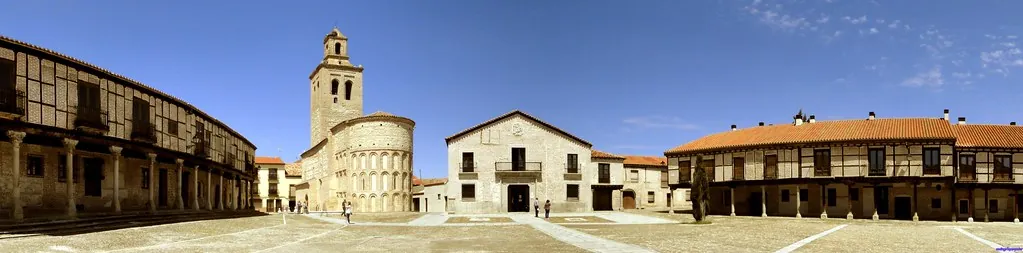
Municipality that includes the hamlet of Jaraices; noted for its brick architecture and open fields.
Hide article Read full article
A village shaped by distance
Constanzana sits in the middle of La Moraña, a broad agricultural plain in the north of the province of Ávila. Villages here are spaced far apart, and that sense of distance defines the place as much as anything else. The land sets the rhythm: open fields, barely any rises, and a network of tracks that for centuries carried grain between small settlements and larger market towns. Today, just over a hundred people live here, which gives a clear idea of its scale.
Nearby Arévalo helps place Constanzana in context. In the Middle Ages and into the early modern period, Arévalo acted as the commercial and administrative centre for the area. Smaller villages like Constanzana were tied to that system, part of a cereal-based economy that shaped both the landscape and the way buildings were constructed.
The cereal plains of La Moraña
The municipality is almost entirely given over to cultivation. Wheat and barley dominate most of the land. In spring, the colours shift quickly across the fields, while in summer everything turns dry and golden.
This regular, almost uninterrupted landscape is not accidental. La Moraña was one of Castile’s major cereal-producing regions. Clay soils and the absence of slopes encouraged a stable agricultural model, with large plots and straight paths that can still be traced across the terrain.
Wildlife adapted to these open spaces also appears here. The plains are home to steppe birds, and with some patience, especially early in the day, it is sometimes possible to spot great bustards or little bustards moving quietly among the crops.
San Pedro: a modest landmark
At the centre of Constanzana stands the parish church, dedicated to San Pedro Apóstol. The building combines rubble masonry with sections of brick and stone, a common approach in this part of Castilla.
Its current structure reflects several phases of construction. Inside, there are older elements, likely dating back to the 16th century, although the church has been altered over time. The main altar features a simple Baroque altarpiece, closer in spirit to local craftsmanship than to the large urban workshops found in bigger cities.
The church also acts as a point of reference for the village itself. From its surroundings, the scale of Constanzana becomes clear: short streets, small blocks, and houses that rarely rise beyond two storeys. Everything feels measured against the needs of a small rural community.
Adobe houses and underground cellars
Many of the traditional homes in Constanzana are built from adobe, a material widely used across La Moraña. These walls often rest on a stone base, designed to protect them from damp. Wooden doors and interior courtyards reflect a way of life closely tied to daily agricultural work.
Beneath some houses, or on the edges of the village, there are cellars dug into the ground. Not all are still in use, but they point to an older custom: producing and storing wine for family consumption. These underground spaces take advantage of the earth’s steady temperature, offering natural conditions for preservation.
Together, these elements form a built landscape that is practical rather than decorative, shaped by climate, materials and long-standing habits.
Paths across open ground
The surroundings invite walking without much effort. There are no significant slopes, and agricultural tracks lead out of the village in several directions. They cross open fields where the horizon remains uninterrupted, giving a strong sense of space.
From Constanzana, it is also easy to reach Arévalo, known for its Mudéjar architecture and a castle that is well recognised in the area. Other nearby villages preserve churches and traditional buildings that help explain how this territory was organised over centuries.
Getting to Constanzana
Constanzana lies around 50 kilometres from the city of Ávila. Access is usually via local roads that run through farmland with little interruption.
Public transport in this area is limited and varies depending on the time of year, so travelling by car is the usual option. Once there, the village can be explored on foot in a short time. What matters most is not distance but attention, taking the time to observe how life has adapted to the wide, steady plains of La Moraña.