Full Article
about Donjimeno
Small Moraña town with farming roots and a striking parish church.
Hide article Read full article
A village shaped by the wind
By mid-afternoon, when the wind moves freely across the fields of La Moraña, Donjimeno falls quiet. There is little to interrupt it. A door might creak and close somewhere, or the wings of storks beat against the air above the church roof. With just 69 residents, the scale of the place sets the rhythm of everything that happens here.
Donjimeno sits squarely on the Moraña plain, a wide agricultural area in the province of Ávila. The village appears suddenly among cereal fields, without a grand entrance or designated viewpoints. A calm road leads in, and within a few metres the car is already inside the village. There is no transition between countryside and settlement. One simply becomes the other.
Walls of earth and tile
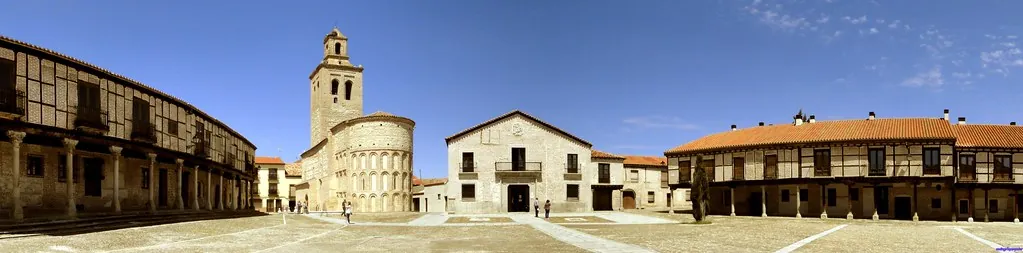
The houses combine stone, brick and tapial, a traditional building method using compacted earth. Many still have heavy wooden gates, darkened by years of sun and weather. Roofs are topped with old clay tiles, laid in uneven lines that give each building a slightly irregular outline. Some façades show signs of recent repairs, while others keep fine cracks that speak of many winters of frost.
The streets do not follow a strict pattern. They narrow, bend, then open out again into small spaces where a bench or an old watering trough might appear. The ground changes from one stretch to another, with patches of asphalt, concrete or compacted earth.
Almost every rooftop supports a stork’s nest. In spring, their presence is unmistakable. The sound of their beaks clattering carries across several streets at once, echoing lightly through the village.
The church at the edge
At one end of the village stands the church of the Asunción. It is a restrained stone building, with a square tower rising above the surrounding houses. At certain times of day, the bell rings out briefly, its sound fading quickly into the open fields beyond.
The interior is not always accessible. When it is open, it reveals simple altarpieces and walls marked by time. There is nothing ornate or imposing, but the space feels closely tied to the daily life of the village. It reflects continuity rather than display.
The changing face of La Moraña
A short walk is enough to leave the village behind and step into open farmland. Fields of cereal stretch in every direction. In spring, the green is intense, and the wind creates visible waves across the crops. By summer, everything turns gold, and the air lifts fine dust from the paths.
The plain may seem unchanging at first glance, yet it shifts with the seasons. Winter leaves the land bare, with the sky taking up most of the view. In autumn, colours become more muted, and occasional holm oaks appear along the horizon, breaking the flat line.
Birdlife is part of this landscape. Storks are the most visible, thanks to their nests within the village, but others are present too. Harriers can be seen flying low over the fields, and partridges are often heard among the stubble.
Paths linking nearby villages
Several agricultural tracks lead out from Donjimeno towards neighbouring villages such as Las Casas and Villafrechós. These routes are flat and straightforward, with no technical difficulty. Walking here means crossing open farmland, with long horizons and very few vertical landmarks to guide the way.
In summer, the central hours of the day are best avoided. Shade is scarce, and the sun falls directly across the land for long stretches without interruption.
Before setting out
Donjimeno remains quiet even at weekends. There are no services aimed at visitors within the village itself, so it is common to travel to nearby places for food or basic supplies.
The most suitable times for a walk are early morning or late afternoon. At those hours, the lower light brings out the textures of adobe walls, old doors and stone surfaces. In the stillness, the character of the village becomes clearer.