Full Article
about Donvidas
Tiny municipality in the north of the province; quiet Castilian plain landscape
Hide article Read full article
A Village You Could Easily Miss
Some places seem designed to be driven past. You’re on a secondary road, glance sideways and spot a handful of houses, a church tower and open fields stretching to the horizon. Donvidas, in the heart of the comarca of La Moraña, has something of that feel. With barely thirty residents, it could easily be mistaken for one of the many tiny settlements scattered across the north of the province of Ávila.
If nobody pointed it out, you might never register its name. Yet if you stop the car and walk for a while, the place begins to make more sense. Donvidas is not about sights in the conventional sense. It offers something quieter: a glimpse of how life unfolds in villages that rarely appear on tourist maps.
The Road Across La Moraña
Long before you see Donvidas itself, you understand its setting. La Moraña is an agricultural plain in the purest sense. Cereal fields, straight tracks and vast horizons define the landscape. Driving here can feel almost hypnotic. There are no dramatic mountain backdrops or sweeping bends in the road. Just cultivated land and, every so often, a cluster of trees marking a stream or a boundary between plots.
The village appears without ceremony. A small cluster of houses, short streets, and the sound of wind when no car is passing through. Step out of the vehicle and the first thing that strikes is the silence. It is not staged or curated silence, but the ordinary quiet of a place where little traffic passes and daily life moves at a slower pace.
Donvidas sits squarely within this wide, open geography. The land shapes everything, from the layout of the settlement to the materials used in its buildings. Nothing here feels imposed on the terrain. Instead, it seems to have grown from it.
Santa María Magdalena: The Village Landmark
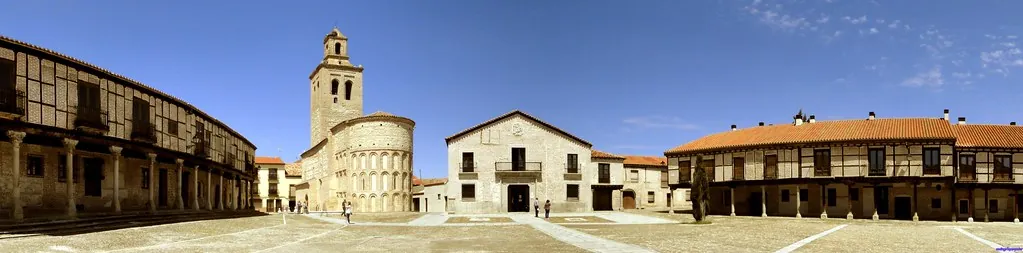
The most noticeable building in Donvidas is the parish church, dedicated to Santa María Magdalena. It is not monumental and does not attempt to be. Its proportions are simple, and it has the solid, practical look common to many churches on the Castilian plateau.
Like in many villages of this size, the church is sometimes closed. That is fairly typical in places with so few inhabitants. Even so, it is worth walking over to the square and circling the building. From the outside alone, it is clear how central it has been to village life over the centuries.
The church anchors the settlement visually and socially. In a community this small, such a building is more than architecture. It defines the space around it, giving shape to the square and offering a point of reference from almost any angle. There are no grand façades or elaborate decorations described here, just a sturdy presence that reflects the character of the place itself.
A Short Walk Through Donvidas
Donvidas can be covered in very little time. In twenty minutes, perhaps less, you will have walked along almost all of its streets.
The houses combine stone, adobe and traditional curved roof tiles known in Spain as teja árabe. Some are carefully maintained, their façades neat and solid. Others show the gentle wear of time. Wooden doors and large gateways open onto inner courtyards or former animal pens. In a few cases, old tools or carts are still visible, quiet reminders that agriculture here was not scenery but daily work.
There are no shops to browse and little visible activity. In villages this small, services are usually found in nearby towns. Donvidas operates on a different rhythm. The absence of commercial movement is part of its identity. What you encounter instead are empty streets, the occasional detail on a doorway, and the sense that the built environment remains closely tied to the surrounding fields.
Walking here is less about ticking off sights and more about noticing textures. The roughness of adobe walls, the muted colours of tiles, the way one house leans slightly towards the next. Everything feels compact and contained, shaped by generations who lived from the land around them.
Fields and Sky: The Landscape Beyond the Houses
If Donvidas is defined by anything, it is what lies just beyond its last house. Within a few steps of leaving the built-up area, you are among cultivated plots and agricultural tracks.
The terrain is flat, which makes walking or cycling straightforward. The paths are wide and generally clear, although they are not marked as official routes. Many visitors simply follow the farm tracks between fields for a while before turning back. There is no prescribed circuit, only the open plain and the choice of direction.
The changing seasons alter the atmosphere dramatically. In spring, the fields turn green. By summer, the dominant tone is the golden colour of ripened cereal. These shifts are simple yet striking, because there are few other elements competing for attention.
At sunset, something curious happens. The sky appears larger than expected. With no mountains or tall buildings to interrupt it, the light lingers above the plain. The horizon remains unobstructed, and the evening glow seems to hover for longer than in more enclosed landscapes. It is an effect created purely by openness.
This expanse gives context to the village. Donvidas is not an isolated dot but part of a broad agricultural system that has shaped La Moraña for generations. The fields are not a backdrop; they are the reason the settlement exists at all.
What to Expect From a Stop in Donvidas
It helps to arrive with the right expectations. Donvidas is not a destination for major monuments or a packed cultural calendar. It works better as a brief pause, a way to understand the character of many villages across La Moraña.
The stop does not require much time. A short walk, a look at the church of Santa María Magdalena, a wander along the streets and perhaps a stroll out towards the fields. That is enough to grasp its scale and atmosphere.
The experience is closer to stretching your legs during a long drive than to planning a full day’s sightseeing, except here it is your gaze that stretches. You look at the houses, glance towards the crops, take in the silence and then continue on your way.
There is no need to linger for hours. And precisely because the visit is so simple, it can stay in the memory. For a short while, everything moves more slowly than almost anywhere else. In that pause, Donvidas reveals its quiet logic: a village shaped by land, routine and a horizon that never seems to end.