Full Article
about El Parral
Small transitional municipality; noted for its quiet and holm-oak setting.
Hide article Read full article
The smell of cold soil and dry grain hangs in the air before the sun has properly cleared the horizon. A shutter lifts slowly on its hinge. In a village of sixty-four, in the heart of La Moraña, the day begins under an enormous, empty sky.
Here, the landscape sets the tone. A long, open plain where cereal fields shift in colour with the seasons. In spring they turn a soft, supple green. By summer they become brittle and gold, and the air carries the scent of warm straw. Winter brings mud, frost, and a white light that seems to hover just above the flat land.
Walking the Agricultural Tracks
Getting out into it is straightforward. Unmarked agricultural tracks leave directly from the edge of the village, cutting across plots in straight lines for kilometres. Any of them will do for a walk or a short bike ride. In summer, avoid the middle of the day; shade is scarce and the sun falls hard on the plain. The only sounds are often the wind and the distant hum of a tractor.
The Church and the Rhythm of the Square
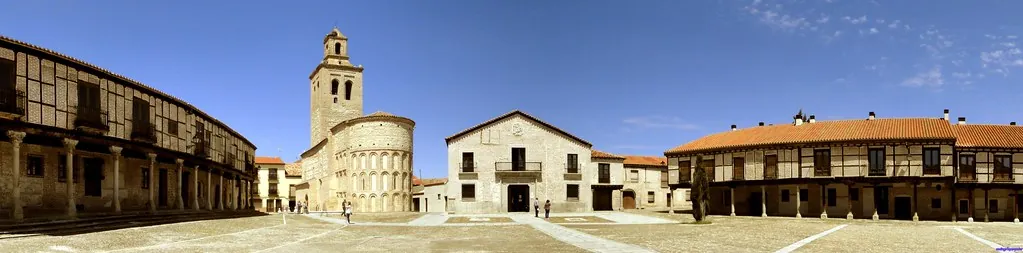
The iglesia de San Pedro stands beside the square, built in pale stone with a sober presence. It has probably been standing for several centuries. Its exterior doesn’t draw much attention, but when the heavy door is open, a darker wooden interior comes into view, soft light filtering through small, high windows.
On Sundays when there is Mass, people linger afterwards in the square. Conversation turns to the year ahead: whether there has been enough rain, if the cereal is holding up. In villages of this size, such moments still form the fabric of daily life. There is no sense of rush. Time follows the rhythm of the fields.
Textures on a Quiet Street
A walk through the streets reveals low houses with thick walls of adobe and brick, designed to withstand the winter cold. Many still have large wooden gates that require a firm push of the shoulder to open.
Look closely and you’ll see small details: iron window grilles slightly bent by time, darkened wooden lintels, balconies with room for little more than a single geranium pot. Not everything has been restored. Layers of repairs and patches remain visible in the walls, marking the passing years without disguise. The scale of the place means a stroll doesn’t take long, but it encourages a slower pace—attention shifts to the grit in the adobe, the way afternoon light falls on brick.
Where the Fields Begin
Step beyond the last house and the fields begin almost immediately. Tractors and grain silos set the rhythm. When the wind blows from the south, the smell of ripe cereal drifts right into the streets.
Walk slowly along any track and watch the sky. It’s not unusual to spot kestrels hovering or a small eagle gliding over the plots. Flocks of steppe birds appear, particularly in spring and autumn. There are no hides or visitor facilities here; observation depends on patience, binoculars, and silence.
The sense of space is constant. The plain stretches outward with few visual barriers. In every direction there is sky, fields, and the occasional lonely farm building.
The Quality of Light
The last hour of afternoon is when everything turns gold. The sun sinks low over the plain and picks out the textures of adobe walls, the deep furrows in turned earth, wooden fences twisted by time.
In winter, when the air is clear, frozen puddles reflect the sky with a metallic sharpness. After dark, if clouds stay away, the firmament fills with stars in a clarity that city dwellers forget exists. The darkness here is real and complete. If you come with a camera, bring a tripod. Once the light fades, it goes quickly.
A Practical Note on Visits
El Parral is very small. Don’t expect to find a bar or restaurant open regularly; bringing some food is often simplest, or planning to drive to larger towns like Arévalo for a meal.
A walk through the village itself doesn’t require much time. The surrounding landscape, however, encourages a longer stay for those who enjoy quiet tracks or simply sitting to watch the light move. Facilities are limited—that simplicity is part of it. Visits are uncomplicated: a wander through the streets, a walk out towards the fields, a pause in the square.
The Sound of San Pedro
The village fills with sound at the end of June for its fiesta de San Pedro. Residents who live elsewhere return; tables appear outdoors in the square and long conversations unfold late into the evening.
Houses that stay closed for much of the year open their doors. For a weekend, El Parral feels larger than it is. Familiar faces return, and quiet routines give way to shared meals and gatherings in open air. It’s a brief contrast to the usual calm—a reminder of how many people this place holds in memory.
El Parral sits in the middle of La Moraña plain and lives to the rhythm of its fields. Anyone arriving in search of monuments will leave quickly. Those willing to walk its straight tracks, listen to wind moving through barley or wheat, and watch evening settle over that flat horizon may find reason to stay until dark falls completely